


I looked like I had it all together. Clean house. High-pressure job. Jokes at parties. Always on time. Always in control.
But at night—when no one was watching—I unraveled. Not dramatically. Quietly. The kind of unraveling that’s easy to hide under spreadsheets, small talk, and “just one more glass.”
I used to think asking for help would ruin the image I’d built. The truth? It saved me.
I Was the Person Everyone Counted On
You know the type—first one to show up, last one to complain, always offering to help with someone else’s crisis. I was the person who picked up the pieces, who made sure the group text stayed on track, who smiled at the front desk after another ten-hour day.
And all that control became its own kind of prison.
I didn’t drink in the mornings. I didn’t miss work. I didn’t cause drama. But I needed something to take the edge off the pressure, and alcohol was always there. Quiet. Socially acceptable. Easy to explain away.
I never blacked out. I never got caught. I just slowly stopped feeling.
It Wasn’t “Bad Enough” to Count as a Problem—Right?
I didn’t fit the image I had in my head of someone who needed treatment. No one was begging me to stop. I wasn’t spending rent money at the liquor store. I still made dinner. I still hit deadlines.
But I also cried in the bathroom stall at work. I also forgot entire conversations with people I loved. I also kept a separate bottle in the laundry room and made sure the recycling bin never looked suspicious.
High-functioning doesn’t mean okay. It just means you’re falling apart in ways that don’t get noticed.
And that might be the most dangerous part.
The Quiet Breaking Point
There wasn’t a big scene. Just a normal weekday. A normal morning. I put on makeup, made coffee, got dressed for work. And then I sat in the driver’s seat of my car and couldn’t start the engine.
My chest felt tight. My hands were shaking. My brain kept saying, Just go. You’re fine. But I couldn’t move. I just kept thinking: I don’t want to do this anymore.
Not in a suicidal way. Just… I didn’t want to keep pretending.
So I opened my phone and searched: “Help for people who can’t fall apart in public.”
It led me to the Intensive Outpatient Program at Greater Boston Behavioral Health.
What IOP Looked Like For Me
I didn’t want to go away for 30 days. I couldn’t disappear from my job or make up a reason to leave town. I needed something that fit into my life without requiring me to blow it all up.
That’s exactly what IOP offered.
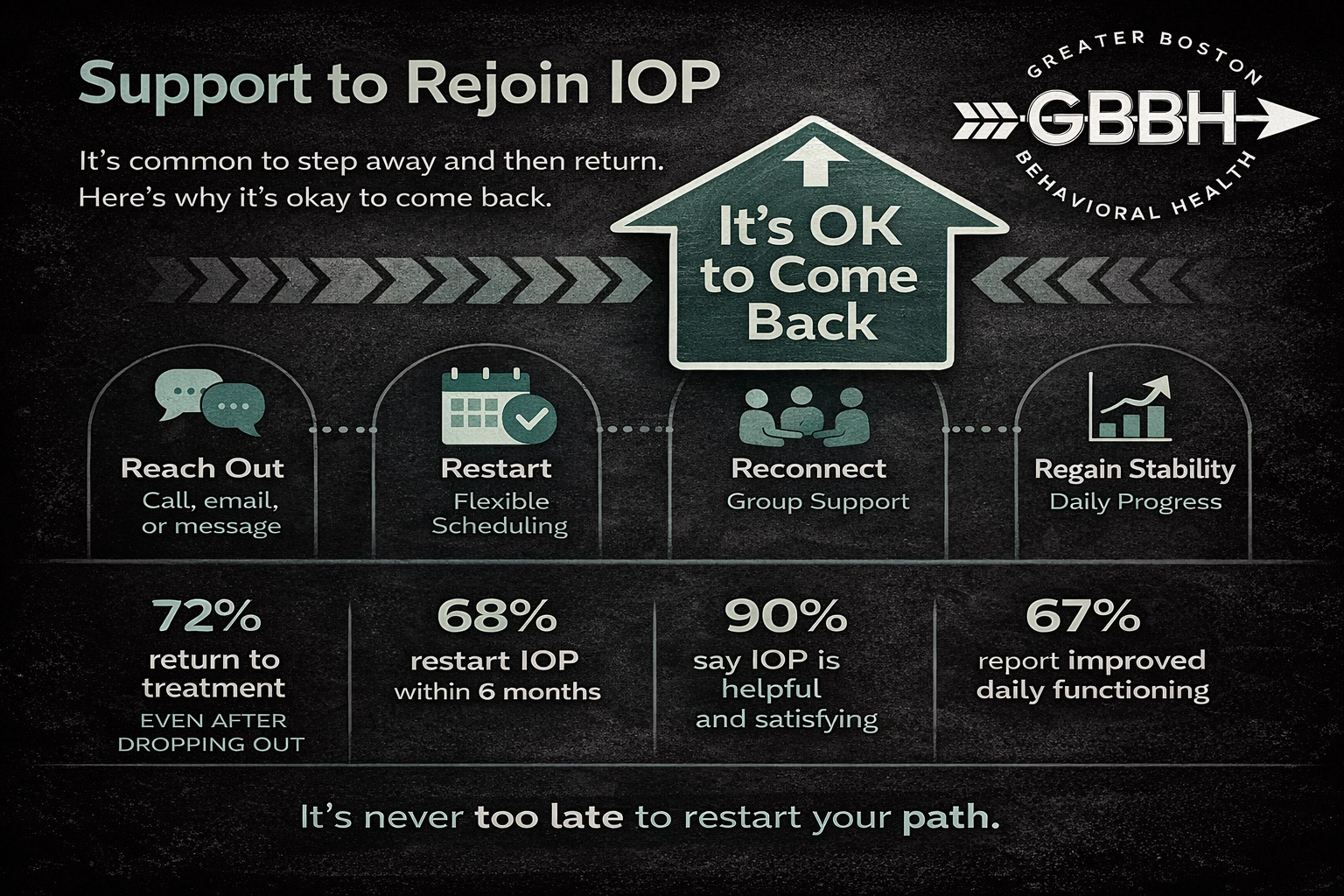
Three days a week. A few hours each session. Evening options that worked with my schedule. Group therapy that didn’t feel like performance. A place where I could tell the truth and not be punished for it.
It wasn’t a magic fix. But it was the first place I felt safe enough to stop performing. And that safety changed everything.
The Group Didn’t Judge Me—They Got Me
I thought I’d be the only “professional” in the room. I thought people would roll their eyes at me or think I was too put-together to be there.
Instead, I met teachers. Engineers. Stay-at-home parents. Nurses. IT professionals. People who had also mastered the art of seeming fine while crumbling on the inside.
And for the first time, I felt less alone.
One woman said something in group I’ll never forget: “I don’t want to drink anymore. But I also don’t know who I am without needing to.”
That hit so hard I couldn’t even speak. Just nodded, and cried quietly into a tissue someone passed me without making it weird.
IOP Didn’t Break My Image. It Helped Me Rebuild My Identity.
I used to believe I had to earn rest. That I had to deserve help by reaching some dramatic low point. But IOP taught me something I never learned growing up: you can ask for support before everything collapses.
Through therapy and group, I started to build a life that didn’t depend on performance. I learned to set boundaries without apologizing. I learned that I could say “I’m not okay” without it being a crisis. And I started to feel emotions I’d numbed for years—grief, joy, frustration, relief.
For once, I wasn’t carrying everyone else. And I wasn’t hiding from myself.
That’s not weakness. That’s healing.
High-Functioning People Need Help Too
If you’re reading this and wondering if you’re “bad enough” to need support, let me tell you what someone once told me: The question isn’t how bad it is. The question is—do you want more than just getting by?
You don’t have to hit bottom. You don’t have to explain it perfectly. You just have to want something better than the secret ache you carry around every day.
Whether it’s anxiety, burnout, substance use, or just that feeling of emotional flatness that won’t go away—IOP might be the space where you can finally exhale.
Greater Boston Support—Closer Than You Think
If you’re local to Boston or nearby areas, you don’t have to search far. Whether you’re downtown or looking for an Intensive Outpatient Program in Newton, MA, there’s support that respects your time, your life, and your image—without compromising your healing.
You Don’t Have to Fall Apart to Deserve a Fresh Start
You can keep juggling. Or you can put something down.
You can keep saying, “I’m fine.” Or you can whisper, “I’m not okay”—and see who answers.
For me, the answer was an Intensive Outpatient Program. For you, maybe it’s just reading this and realizing… you’re not alone.
Call (888) 450-3097 to learn more about our Intensive Outpatient Program services in Boston, Massachusetts.
Frequently Asked Questions
What is an Intensive Outpatient Program (IOP)?
An IOP is a structured mental health treatment program that allows you to receive therapy and support several times a week—without needing to stay overnight. It’s ideal for people who need more than weekly therapy but still want to live at home and continue working or caring for family.
Is IOP only for people with addiction?
Not at all. While many people enter IOP for substance use concerns, it also supports individuals dealing with depression, anxiety, burnout, trauma, and other mental health challenges. IOP helps people who are struggling but still functioning—especially those who don’t want to wait for things to fall apart.
Will I have to explain everything about my life?
Only what you’re comfortable sharing. No one will pressure you to talk before you’re ready. Most programs begin with a personal intake session and ease you into group work as you feel safe.
Can I keep working while in IOP?
Yes. Many IOPs—including the one at Greater Boston Behavioral Health—offer morning, afternoon, and evening sessions to fit work and family schedules. You won’t need to quit your job or take extended time off.
What if I’m not sure I’m “sick enough” for this?
If you’re asking that question, you probably already know you need support. IOP isn’t just for crises—it’s for people who want to stop surviving and start healing.
