


They look like they’ve got it all together.
They’re the ones leading the meeting, picking up the kids, staying late at work, sending birthday cards, and still finding time to support everyone else in their life.
From the outside, high-achieving adults seem unshakable. But behind the confidence, the calendar, and the constant motion, there’s often something else: chronic overwhelm.
At Greater Boston Behavioral Health, we’ve seen it firsthand. People come to us not because their lives have fallen apart, but because they’re exhausted from holding everything together. They don’t look like the stereotype. They look like you.
And that’s why an Intensive Outpatient Program (IOP) can be the exact support they need—before the burnout, before the breakdown, before the spiral.
Success and Struggle Can Coexist
One of the most misunderstood things in mental health is that achievement doesn’t cancel out pain.
It’s entirely possible to:
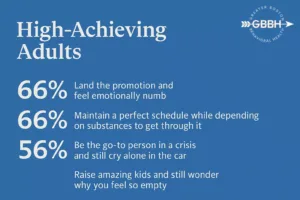
- Land the promotion and feel emotionally numb
- Be the go-to person in a crisis and still cry alone in the car
- Raise amazing kids and still wonder why you feel so empty
- Maintain a perfect schedule while depending on substances to get through it
If any of this sounds familiar, you’re not failing. You’re simply over-extended—and under-supported.
High-Functioning Doesn’t Mean Thriving
People often ask, “How could I be struggling? I’m still getting things done.”
But functionality is not the same as emotional health.
In our IOP groups, it’s common to hear clients say:
- “Everyone thinks I’m fine.”
- “I can’t stop moving because then I’d fall apart.”
- “My anxiety is the only thing keeping me on track.”
- “No one knows how much I drink at night to turn it all off.”
You don’t need to fall apart publicly to deserve support. You just need to acknowledge that something’s off—and that you’re tired of pretending otherwise.
Why IOP Works for High-Achievers
Our Intensive Outpatient Program is built for people who have big responsibilities and limited bandwidth—but also have the self-awareness to know they can’t keep doing things the same way.
Here’s how IOP helps high-functioning adults:
- It offers structure without disruption.
You don’t need to quit your job or uproot your life. With both daytime and evening programs, IOP works around your schedule. - It gives space to drop the mask.
In IOP, you’re not expected to perform. You’re allowed to be messy, uncertain, raw—whatever you actually are. - It’s deeper than weekly therapy.
Three to five sessions per week give you momentum. The consistency matters. It helps build real change—not just insight. - It treats the root, not just the symptoms.
Whether you’re battling anxiety, burnout, alcohol misuse, or past trauma, our IOP helps untangle the emotional and behavioral cycles that keep you stuck.
If you’re looking for an Intensive Outpatient Program in Newton, MA or nearby, we serve high-achievers throughout the Boston area, including Dedham and Needham.
What to Expect in Our Intensive Outpatient Program
Our IOP is a non-residential, evidence-based program designed to give you a higher level of support while still living your life.
You’ll receive:
- Individual therapy tailored to your personal goals and challenges
- Group sessions that offer real connection—not forced sharing
- Psychoeducation to help you understand the “why” behind your patterns
- Coping skills for stress, substance use, anxiety, and relationship strain
- Optional psychiatric consultation and medication management
And perhaps most importantly, you’ll be surrounded by people who are also high-functioning, smart, and deeply human—people who are ready to stop pretending and start healing.
When Your Strength Becomes a Survival Strategy
There’s a moment that happens in IOP where clients realize: the very traits that made them successful—control, perfectionism, emotional detachment—are the same traits that are now hurting them.
They were once strategies. Now, they’re symptoms.
That’s the thing about high-functioning adults: we get really good at adapting to stress. Until the adaptation becomes unsustainable.
You don’t have to give up your ambition, your goals, or your identity. But you may need to soften the armor. To learn other ways of coping. To stop confusing numbness with peace.
That’s what IOP creates space for.
You Don’t Need a Breakdown to Start Healing
Some people worry they’re “not bad enough” for treatment.
But here’s the truth: IOP isn’t just for crisis. It’s for people on the edge of burnout. It’s for people who feel like they’ve lost connection with themselves. It’s for people who don’t want to wait for everything to crash.
Whether you’re in Boston or looking for an Intensive Outpatient Program in Dedham, MA, you can start before it all breaks down.
Starting IOP isn’t a sign that you’re weak—it’s proof that you’re self-aware enough to take care of yourself now.
What Our Clients Say After IOP
We’ve supported high-achieving professionals, parents, creatives, caretakers, and students. And when they finish IOP, we often hear things like:
- “I didn’t know how much I needed this until I gave myself permission to try.”
- “This was the first time I felt seen without having to explain myself.”
- “I thought I had to earn rest. Now I know I deserve support.”
The mask gets heavy. You don’t have to keep wearing it.
FAQs: Intensive Outpatient Program for High-Achievers
Do I need a diagnosis to qualify for IOP?
Not necessarily. We’ll help you assess whether IOP is the right fit based on your current challenges and goals—not just a label.
Will I have to take time off work?
Not if you don’t want to. Many of our clients maintain work or caregiving responsibilities while attending IOP. We offer flexible schedules to accommodate your reality.
Is IOP only for addiction?
No. Our IOP supports individuals navigating anxiety, depression, trauma, burnout, and more—whether or not substance use is involved.
What if I don’t feel “sick enough”?
That feeling is incredibly common among high-functioning adults. But the truth is, emotional suffering isn’t measured by severity—it’s measured by impact. If your mental health is affecting your quality of life, that’s reason enough.
What happens after IOP?
You won’t be left alone. We’ll help you step down into regular outpatient therapy, support groups, or continued care that feels sustainable.
You’ve Done Everything Alone. Now You Don’t Have To.
If you’re tired of holding it all together on the outside while falling apart inside, this is your invitation to try something different.
Call (888) 450-3097 or visit Greater Boston Behavioral Health’s Intensive Outpatient Program to learn more about our IOP services in Boston, Massachusetts.
You’ve carried so much. Let us carry some of it with you.
