


There’s a kind of exhaustion that sleep doesn’t fix. The kind that comes from always waiting for the next call, the next shift, the next sign something’s wrong again.
If that’s where you are, you’re not alone. And you’re not failing.
Some parents find relief through structured daytime care that helps rebuild stability without turning life completely upside down.
The Weight of Always Being “On”
You start to live in reaction mode.
Phone always nearby. Mind always scanning. Conversations always half-finished because part of you is somewhere else—wondering, worrying, bracing.
It’s not just stress. It’s grief mixed with hope, on repeat.
And over time, it wears you down in ways you don’t always have words for.
It’s Not That You Haven’t Tried
You’ve had the talks.
You’ve set boundaries.
You’ve shown up, over and over again.
And still, things feel fragile.
That doesn’t mean nothing is working. It means the situation is bigger than what one person—especially a parent—can hold alone.
There’s a difference between loving someone and being their entire support system. No one can sustain that forever.
Stability Doesn’t Have to Mean Disappearing From Life
A lot of parents hesitate at the idea of more intensive help because it sounds extreme.
Like everything has to stop. Like life gets put on hold.
But there are options that don’t require that kind of full disruption.
Structured, multi-day support during the day can create consistency—without removing your child completely from their world.
It’s not about punishment or escalation.
It’s about creating a rhythm that isn’t driven by crisis.
What Changes When There’s Structure
Something shifts when the day has a plan.
Not rigid control. Not pressure. Just… predictability.
Support shows up at the same time each day.
Expectations are clear.
There’s space to actually work through what’s going on—not just react to it.
And for you?
You get moments to breathe again.
Not because you’ve stopped caring—but because you’re no longer carrying it alone.
You’re Allowed to Want Relief Too
This part matters more than most parents admit.
You’re allowed to want things to feel calmer.
You’re allowed to be tired.
You’re allowed to need support—not just for your child, but for yourself.
That doesn’t make you selfish.
It makes you human.
“I didn’t realize how much I was holding until I didn’t have to hold it all anymore.”
– Parent of a young adult in treatment
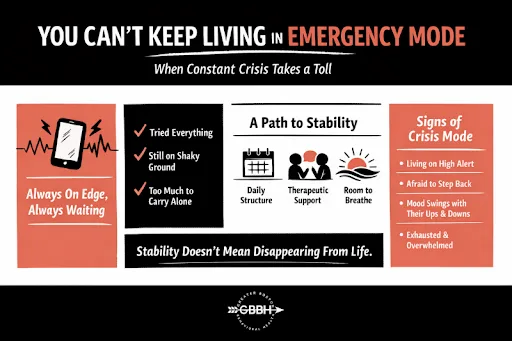
Signs You Might Be Stuck in Crisis Mode
You might recognize this more than you expected:
- Every day feels unpredictable, even when nothing major happens
- You’re constantly waiting for something to go wrong
- Your mood depends on how your child is doing that day
- You feel guilty even thinking about stepping back
- You’re exhausted—but can’t relax
If that’s your reality, it’s not sustainable. And it’s not something you’re meant to solve alone.
There Is a Way Out of Constant Emergency
This doesn’t fix everything overnight.
But it changes the pace. The pressure. The feeling that you’re always one step behind the next problem.
Programs like a Partial Hospitalization Program can offer that middle ground—real support, real structure, without removing your child completely from daily life.
And sometimes, that’s exactly where stability starts.
You’ve been holding a lot for a long time. It’s okay to look for something that helps hold it with you.
Call (888) 450-3097 or explore your options for treatment in Boston to learn more about our Partial Hospitalization Program services in Boston.
