


It’s more common than you think—stepping away, missing a few days, then a few more. If you’ve been avoiding coming back, you’re not alone. And you’re not disqualified.
If you’ve been thinking about returning to support, you can start by revisiting what care can look like now—not what it looked like before. You can explore your options for multi-day weekly treatment at your own pace.
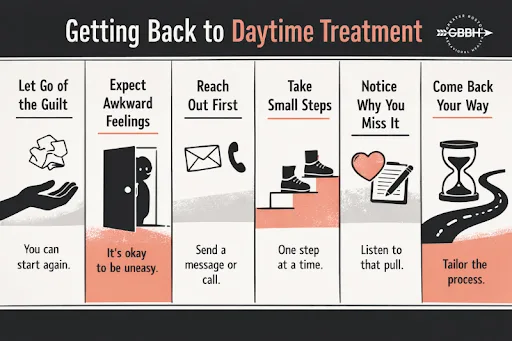
Start by Dropping the Story That You “Messed It Up”
Most people don’t come back because of logistics. They stay away because of the story in their head.
“I disappeared.”
“They probably wrote me off.”
“I should’ve handled this better.”
From a clinical perspective, pauses happen. Avoidance happens. Life gets loud, or heavy, or confusing. None of that cancels your place here.
You’re not starting over—you’re resuming.
Expect Awkwardness—and Let It Be There
Coming back might feel like walking into a room where you think everyone noticed your absence.
Here’s the truth: the discomfort usually peaks before you walk in, not after.
You don’t need a perfect explanation. A simple, honest sentence is enough:
- “I’ve been having a hard time getting back.”
- “I wasn’t ready before, but I think I am now.”
That’s more than enough to begin again.
Reach Out Before You Show Up
If walking through the door feels like too much, start smaller.
Send a message. Make a call. Ask a simple question:
- “Can I come back?”
- “What would rejoining look like?”
You don’t need to have everything figured out. You just need a point of contact.
Most programs—including any ethical intensive outpatient program—are built to welcome people back, not shut them out.
Focus on the Next Step, Not the Full Return
Thinking about “going back fully” can feel overwhelming. So don’t.
Shrink the goal.
- One call
- One conversation
- One day back
Momentum builds quietly. You don’t need motivation to start—you need a small, doable step.
Notice What’s Pulling You Back (Even If It’s Subtle)
People rarely consider returning because everything is fine.
There’s usually something underneath:
- Things feel harder to manage alone
- Old patterns are creeping back
- You miss structure more than you expected
That pull matters. It’s not weakness—it’s awareness.
Let the Door Be Open—Even If You’re Not Fully Ready
You don’t have to feel 100% ready to return. In fact, most people aren’t.
Readiness often shows up after you take the first step, not before.
Think of it like this:
You don’t need to be certain. You just need to be willing to try again.
You’re Allowed to Come Back Differently This Time
Whatever made it hard before—timing, fear, resistance, life circumstances—that can be part of the conversation now.
This isn’t about repeating the same experience. It’s about adjusting it so it fits you better.
Different pace. Different expectations. Same support.
Coming back after time away can feel heavier than starting the first time. But it’s also where some of the most honest, meaningful progress begins.
If you’ve been avoiding it, that doesn’t mean you’ve failed. It might just mean you’re closer than you think.
Call (888) 450-3097 or visit our treatment options to learn more about our intensive outpatient program services.
