


You started an Intensive Outpatient Program (IOP) for a reason.
Maybe it was anxiety that finally started disrupting your work. Maybe depression made it too hard to keep pretending everything was okay. Maybe you were dealing with substance use and knew you didn’t want to wait for rock bottom.
Whatever brought you to the door, you walked through it. And that matters.
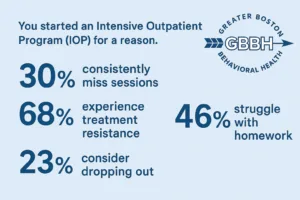
But now, something’s shifted. You’re finding it hard to keep showing up. Group sessions feel draining. Homework feels impossible. You’re canceling appointments or skipping them altogether. You might even be thinking about dropping out—or already have.
If this is where you are, take a breath. You’re not failing. You’re not broken. And you’re not the only one who’s felt this way.
At Greater Boston Behavioral Health, we work with clients across Boston, Newton, and beyond who hit this same wall during treatment. We want you to know: it’s okay to struggle inside a program that’s designed to help. That doesn’t mean it’s the wrong program. It just means you need a different way forward—one that feels lighter, more human, and built for where you actually are.
Here’s how to make your IOP feel more doable—without giving up on yourself.
1. Let Go of the Idea That You’re “Messing This Up”
If you’ve ghosted a few sessions, fallen behind on assignments, or stopped engaging in group—you might be carrying around a quiet sense of shame. The voice that says, “I’m wasting everyone’s time.” Or “If I can’t even stick with this, I must really be broken.”
Pause that thought. Here’s the truth: dropping off in treatment isn’t unusual. It’s common. Emotional work is hard. Showing up consistently is hard. Life gets messy. Resistance is human.
You didn’t break anything by stepping away—or by wanting to. You’re still allowed to come back. You’re still worth helping. You don’t need a reason more valid than “I want to try again.”
2. Reach Out to Just One Person on Your Care Team
Re-engaging doesn’t have to mean jumping back in with both feet. Sometimes, it just starts with sending one message.
If you’re feeling unsure, try saying something like:
“I’m feeling disconnected from the program and not sure how to get back into it. Can we talk?”
That’s it. That one step opens the door.
At Greater Boston Behavioral Health, we get these messages all the time—and we respond with compassion, not pressure. Whether you’re in Boston or looking for an Intensive Outpatient Program in Newton, MA, we’ll meet you gently, wherever you are.
3. Ask Yourself: What Exactly Feels Too Hard Right Now?
It’s easy to feel overwhelmed by the idea of IOP—but the overwhelm often comes from something specific inside it.
Ask yourself:
- Is the schedule too hard to manage with work or caregiving?
- Does the group format feel intimidating?
- Do you feel emotionally flooded from digging too deep, too fast?
- Is it hard to stay focused or remember what was said?
- Do you feel disconnected from your therapist or peers?
Identifying the pain point gives your team something to work with. Most programs, including ours, are flexible. We want to adjust things that aren’t working. You don’t have to force yourself through something that feels impossible.
4. Shrink the Goal—You Don’t Have to Be “All In” Right Away
When you’re already overwhelmed, “complete the program” might feel like a mountain.
Try a smaller step.
- “Let me attend just two sessions this week.”
- “Let me listen quietly, even if I don’t speak.”
- “Let me text my therapist instead of calling.”
- “Let me show up, even if I’m late or not ready.”
Healing isn’t a performance. There are no gold stars. The bravest thing you can do is try again in a way that actually feels doable today—not in some idealized version of yourself.
5. Name What You Need—Even If You’re Not Sure It’s “Allowed”
A lot of clients hesitate to ask for changes. They think they have to stick with the original plan or else they’ll “ruin” the process.
But good IOPs are built to flex. That includes:
- Adjusting how many sessions you attend
- Switching you to a different group that feels safer or more relatable
- Changing your therapist if the fit isn’t right
- Offering short-term breaks if your life circumstances shift
You can even step down to a lower level of care—like weekly outpatient—if IOP isn’t what you need right now.
If you’re in Boston or seeking IOP care in Dorchester, MA, we’ll walk through your options without pressure. You don’t have to explain everything perfectly. Just show up and be honest about what hurts.
6. Don’t Wait Until You’re “Ready”—Start From Where You Are
Sometimes, people wait for motivation to return before reaching out. They wait to feel “ready” or “strong” again. But the truth is, you may never feel fully ready. You might just feel tired of being stuck.
You can return while still feeling unsure. You can speak up while still feeling ashamed. You can restart even if part of you wants to quit again tomorrow.
Progress often starts not with clarity—but with the courage to show up uncertain.
What Real Clients Say About Returning After Struggling
“I ghosted for three weeks. I thought I blew it. But when I came back, nobody scolded me. They were just glad I came back.”
— IOP Client, 2023
“I didn’t finish the first time. But I came back three months later, and this time, I was ready. It mattered.”
— Former IOP Client, 2022
“There were weeks I hated every session. I still kept going. And now I’m glad I did.”
— Current IOP Participant
FAQs: Intensive Outpatient Program When You’re Struggling to Stay Engaged
What if I’ve already missed too many sessions?
You haven’t. We welcome you back, whether it’s been a few days or a few months. We’ll meet you where you are and help you figure out the next step—no lectures, no guilt.
Can I reduce how often I attend?
Yes. Depending on your situation, we can adjust your schedule or explore a step-down plan. Flexibility is part of good care.
What if I don’t want to rejoin the same group?
That’s valid. We can look at other group options or discuss alternative formats that feel safer or more manageable.
Is it okay to ask for a different therapist?
Absolutely. Finding the right fit is key. If something isn’t working, you’re allowed to speak up—and we’ll support that decision.
Will I have to explain why I left?
Only if you want to. Your story is yours. A simple “I needed some time away” is more than enough. You won’t be judged for being human.
You’re Allowed to Come Back—Quietly, Messily, On Your Own Timeline
There’s no perfect way to do this. No right pace. No set script. If you’re still hurting—but something inside you wants to try again—that’s all the permission you need.
Whether you return today or next month, the door is still open.
You’re not a dropout. You’re not a lost cause. You’re a human being doing your best to heal in a world that makes that incredibly hard.
And that’s more than enough.
Ready to Try Again—In a Way That Works for You?
Call (888) 450-3097 or visit our Intensive Outpatient Program page to learn more about IOP services in Boston, Massachusetts. We’re here—whether it’s your first time reaching out or your fifth.
