


You’re not the only one who left treatment early. You’re not the only one who disappeared after a few sessions, or even after a few months of showing up consistently. And here’s the truth: walking away doesn’t disqualify you. Not from healing. Not from support. And definitely not from coming back.
Maybe things got too hard. Maybe life got busy. Maybe part of you didn’t feel ready, or felt like you didn’t belong. Whatever the reason, it’s okay. If you’re reading this, it means some part of you is wondering if the door is still open. And it is.
At Greater Boston Behavioral Health, we welcome you exactly as you are—even if you’ve stepped away before.
You Don’t Need to Justify Why You Left
One of the most common fears people have after leaving an Intensive Outpatient Program (IOP) is that they’ll be expected to explain themselves. To give the perfect reason. To prove they had a valid excuse.
But let’s be honest—healing isn’t linear. And most people step away from care at some point. It might be due to work stress, depression, shame, transportation issues, a tough group conversation, or simply emotional exhaustion. All of these are valid. And none of them require an apology.
You don’t have to rehearse a speech. You don’t have to tell your whole story. It’s enough to say: “I think I’m ready to come back.”
That’s all we need.
Treatment Isn’t a One-Way Road—It Has Exits and On-Ramps
Mental health recovery rarely moves in a straight line. It loops. It stalls. It circles back.
An IOP is designed to support you through life’s ups and downs—not demand perfection. Whether you’ve missed a few days or a few months, returning doesn’t mean you start over from scratch. You’re not being sent to the back of the line. You’re getting back on the road.
And that road includes rest stops. Detours. Sometimes even full pauses.
Coming back just means reengaging with your care. We’ll help you reconnect in a way that feels safe, appropriate, and respectful of where you are now.
You Can Come Back Even If You’re Struggling Again
Let’s name something out loud: sometimes, leaving IOP is followed by a rough patch. Symptoms might flare. Old habits return. That doesn’t mean you failed. It just means you’re still human—and possibly even more ready for support.
Whether you’ve been isolating again, dealing with anxiety spikes, or feeling overwhelmed by depression, you don’t have to hide it to be welcomed back. We expect imperfection. We understand regression. And we still want to help.
Coming back after a struggle isn’t a setback. It’s a courageous move toward stability.
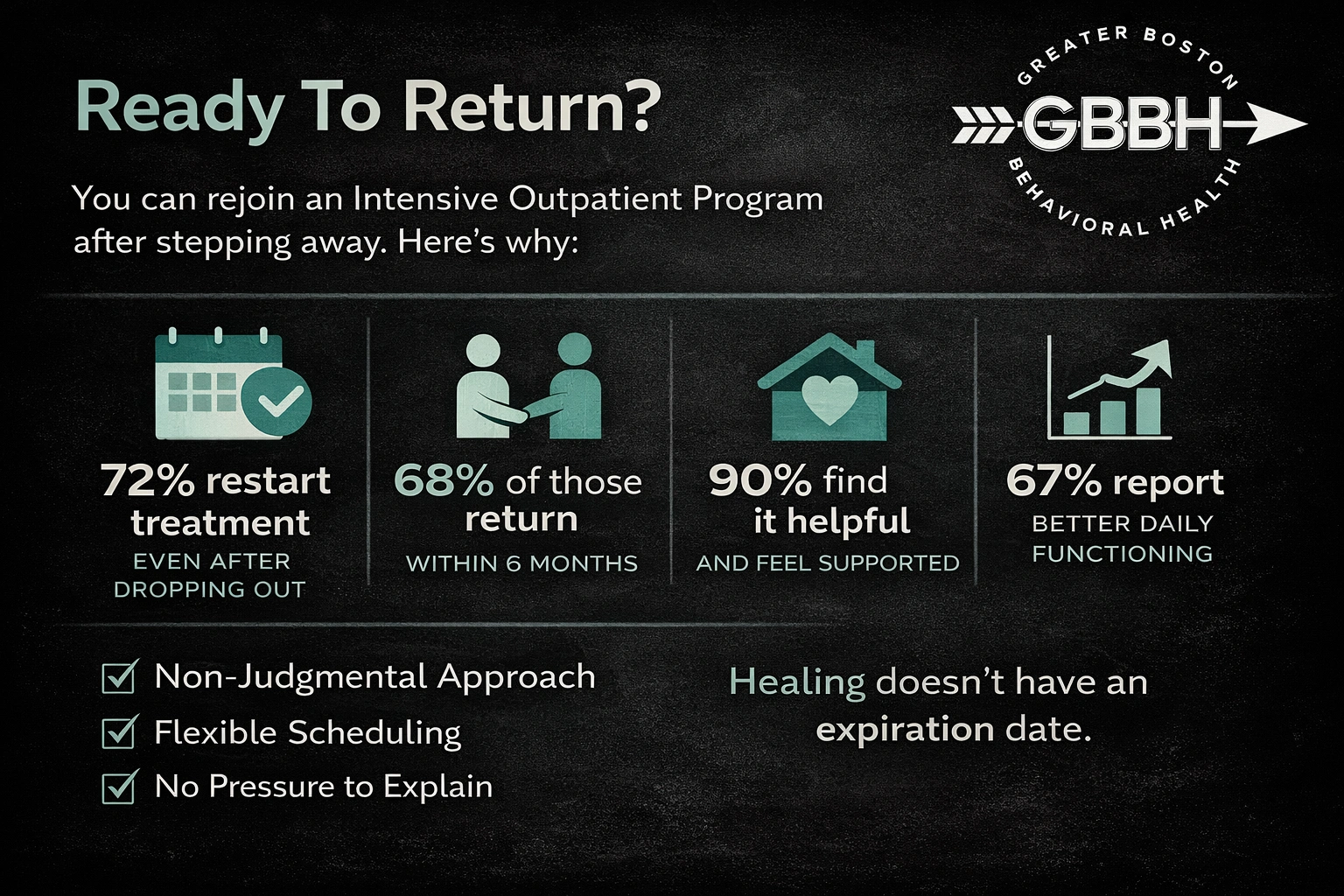
You Won’t Be Judged, Quizzed, or Punished
It’s natural to worry about how staff or peers might react when you return. Will someone ask why you left? Will you feel embarrassed walking into group again?
Here’s what to expect at Greater Boston Behavioral Health:
- A welcoming tone from our front desk and clinical team
- No public callouts or pressure to disclose anything you’re not ready to share
- A conversation (in private) about how to best re-engage
- Respect for your privacy, your pace, and your needs
You deserve care without conditions. Reentry is a process we’ll navigate together—with kindness, not judgment.
Rejoining Is Often Simpler Than You Think
You don’t need to complete a big intake process again. You don’t have to prove anything. Often, returning clients can be folded back into their previous group or supported in transitioning to a new one that better fits their schedule or emotional needs.
Here’s what the process usually involves:
- Reach out: Call or email us and say, “I was in the IOP before. Can I talk to someone about coming back?”
- Quick conversation: One of our team members will connect with you to understand your current needs and make a plan.
- Return plan: We’ll discuss your group availability, individual therapy needs, and whether any updates to your treatment plan are needed.
- Start again: Once you’re comfortable, you can rejoin sessions.
No drama. No delay. Just a clear path forward.
You Might Feel Awkward—And That’s Okay
Coming back to a program you stepped away from can feel vulnerable. You might wonder what others will think. You might even feel like you “don’t belong” anymore.
Here’s the truth: discomfort doesn’t mean you’re not welcome. It means you’re doing something brave. And bravery almost always feels awkward at first.
You don’t have to explain yourself to your group. You can participate at your pace. Some people return and speak openly about why they left; others prefer to stay quiet and ease back in. Both are okay.
And if returning to your original group doesn’t feel right, we can work with you to try a new schedule or setting.
Your Progress Still Counts
One common myth is that stepping away from IOP erases all your progress. It doesn’t.
Even if you were gone for a while—even if things got worse after you left—your prior growth still matters. You may be surprised by how much of it is still inside you. Coping tools you thought you forgot. Insight that returns. Strength you didn’t realize was still there.
Your progress paused. It didn’t vanish.
Rejoining Your IOP Can Help Stabilize More Than Just Symptoms
Getting back into care doesn’t only help with clinical symptoms—it can also bring back:
- A sense of routine
- Supportive accountability
- Peer connection
- Space to process recent events
- Reminders that you’re not alone
These stabilizing factors often lay the groundwork for long-term wellness. You don’t have to rebuild everything overnight. Just stepping into the room again is a powerful start.
A Reminder for Those Who Live Nearby
If you’re in Greater Boston or surrounding areas, know that we also serve nearby communities. If it’s been hard to return due to distance or changing circumstances, ask us about our availability near you. We offer support for those looking for an Intensive Outpatient Program in Dedham, MA and Needham, MA, and can help you find the right location fit.
Frequently Asked Questions (FAQs)
What if I left IOP on bad terms—can I still return?
Most likely, yes. Unless there were significant clinical or safety-related concerns, we believe in second chances and clean slates. Let us know your concerns, and we’ll talk about the best path forward.
Will I have to redo the whole program?
Not usually. We’ll revisit your treatment goals and schedule, but you won’t have to start from zero. We aim to build on what you’ve already done.
What if I’m not sure I’m ready?
That’s okay. Many people feel uncertain before returning. Starting with a conversation doesn’t lock you into anything. You can explore the option without pressure.
What if I’ve been using again?
We understand that symptoms—including substance use or self-harming behavior—can return. We’ll work with you to assess your current needs and recommend the best level of care.
Can I come back discreetly?
Yes. We can help you rejoin in a way that feels comfortable—whether that means adjusting your schedule, switching groups, or keeping participation low-key at first.
Still Thinking About It? You’re Already Closer Than You Think.
Returning to treatment doesn’t require a dramatic gesture. You don’t need to be perfect, or certain, or fully “ready.” You just need to be willing to take the next small step.
You’re not the only one who left. You’re not the only one wondering if you can come back.
You can.
Call (888) 450-3097 to learn more about our Intensive Outpatient Program services in Boston, Massachusetts.
