


You didn’t plan to leave. You meant to go back. Maybe tomorrow, maybe next week. But then time passed, and life picked up speed, and now it’s been a while—and reaching out again feels harder than starting the first time.
If this sounds familiar, you’re not alone. At Greater Boston Behavioral Health, we hear from people every week who left their Intensive Outpatient Program (IOP) and aren’t sure if—or how—they’re “allowed” to return.
Here’s the truth: you are. The door never closed. And you don’t need to start from scratch.
This blog is for anyone who ghosted a program mid-way, drifted out slowly, or left abruptly. It’s not too late. Here’s how to stop the cycle of dropout—and begin again with support that meets you exactly where you are.
1. Understand That Dropout Isn’t a Dealbreaker
Leaving treatment isn’t failure. It’s human.
Maybe your schedule exploded. Maybe you hit an emotional wall. Maybe something someone said in group made you shut down. Or maybe you just weren’t ready.
Whatever your reason was, it’s valid—and it’s not a reason to disqualify yourself from help.
In fact, stepping away often gives you more insight into what you actually need from a program the second time around. And knowing what didn’t work? That’s information we can use to make this time better.
2. Spot the Pattern, Not Just the Exit
For many people, dropout isn’t a one-time event—it’s a loop.
It can sound like this:
- “I’ll miss just one session.”
- “I’ll reschedule next week.”
- “It’s too awkward to go back now.”
- “I blew it. I can’t face them.”
And then months go by.
That shame cycle keeps people stuck—not just in their symptoms, but in the belief that change isn’t possible. Spotting that pattern is the first way to break it.
At Greater Boston Behavioral Health, we see this all the time. The good news? There’s no expiration date on coming back.
3. Reach Out Without Rehearsing
You don’t need to prepare a speech. You don’t need to explain why you left. You don’t need the right words. You just need to contact us.
When someone calls or messages us after stepping away from IOP, our response is simple:
“Welcome back. What’s going on for you now?”
That’s it.
Whether you’re in Boston or surrounding towns like Dedham or Newton, there’s no lecture waiting for you—only the support you asked for before, still available now.
4. Expect Flexibility, Not Judgment
You might be worried you’ll be dropped into the same group or same curriculum you weren’t ready for. Don’t be.
When you come back to our Intensive Outpatient Program, we’ll reassess your needs. We won’t just pick up where we left off—we’ll meet you where you are now.
That could mean:
- A different track or therapy focus
- Starting with one-on-one support before returning to group
- Adjusting your schedule for work, school, or caregiving needs
- Exploring additional supports like case management or family counseling
We don’t treat your return as a do-over. We treat it as a continuation—with compassion.
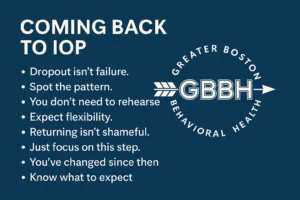
5. Normalize the Re-Entry
Here’s what most returning clients say:
“I thought you’d be mad.”
“I thought I blew my chance.”
“I thought I’d have to explain everything.”
Here’s what we say:
“You’re here. That’s enough.”
In recovery work, returning is part of the process. Many of our strongest clients are the ones who’ve left and come back—because they know firsthand what’s at stake, and what’s possible.
6. Focus on This Step—Not the Whole Ladder
It’s easy to feel overwhelmed thinking about “completing the program” or “doing it right this time.” But all you need to do today is reconnect.
Recovery isn’t about flawless consistency. It’s about resilience—and that starts with the next step.
That next step might be:
- Making a call
- Sending an email
- Booking a re-assessment
- Talking to someone about your fears
The ladder will still be there tomorrow. Just take the first rung today.
7. Let Yourself Be New—Even If You’ve Been Here Before
You are not the same person you were when you started treatment. You’re also not the same person who left.
You’ve learned something. You’ve lived through something. And that counts.
You’re not repeating a cycle—you’re returning to yourself.
Our job is to support that return, whether it’s your first attempt or your fifth. We don’t measure your worth in attendance. We measure it in your willingness to keep trying.
8. Know What You’re Coming Back To
If it’s been a while, you might be wondering what’s changed.
Our Intensive Outpatient Program still offers:
- Morning and evening sessions to fit your life
- Trauma-informed therapy and skills-based groups
- Individual support alongside peer connection
- Local access for clients in Boston, West Roxbury, and beyond
But what’s new is that you’re not starting from scratch. You’re stepping back into care with insight, courage, and a story that’s still being written.
Frequently Asked Questions: Returning to IOP
Can I rejoin an IOP even if it’s been months since I left?
Yes. We welcome returning clients no matter how long it’s been. We’ll reassess your needs and build a plan that makes sense for where you are now.
Will I have to explain why I left?
Only if you want to. Some clients share what got in the way, and others just say, “I’m ready now.” Both are okay.
Will I be placed in the same group as before?
Not necessarily. We consider clinical fit, your comfort, and what’s changed since you last participated. You won’t be forced back into anything that didn’t work the first time.
Is IOP flexible if I have a job or family obligations?
Yes. That’s one of the core benefits of IOP. We offer morning and evening scheduling options to support real life.
What if I feel ashamed to come back?
Shame is normal—but we don’t operate from it. We meet all returning clients with warmth, respect, and belief in their capacity to keep going.
Can I re-start IOP even if I’m not sure I’ll stay again?
Yes. We don’t require guarantees. We’re here for as long as you’re ready to engage—no pressure, no contracts, no guilt.
Will my insurance still cover it?
Many insurance plans will still cover IOP services if you return. Our team can walk you through coverage options and check your benefits.
You’re Still Welcome—Whenever You’re Ready
You didn’t ruin anything. You didn’t miss your shot. You just took a break—and now, you’re ready to return.
Call (888) 450-3097 or visit Greater Boston Behavioral Health’s Intensive Outpatient Program in Boston, Massachusetts to learn more.
