


I didn’t relapse.
I didn’t lose my job.
I didn’t blow up a relationship.
From the outside, I looked solid.
But inside? Sobriety had started to feel flat. Predictable. Mechanical. And I didn’t want to admit that out loud.
If you’ve been sober a year or more and something feels slightly disconnected — like you’re doing everything right but not really feeling it — I know that space. It’s uncomfortable because nothing is technically wrong.
That’s exactly why I almost ignored it.
Instead, I went back to structured therapy. Not because I was in crisis — but because I felt stuck. I revisited the approach outlined in this cognitive behavioral therapy program quietly, without announcing it to the world.
Here’s why.
The Plateau No One Talks About
Early sobriety is loud.
You’re counting days. Tracking progress. Everything feels fragile but meaningful. People cheer you on. You feel change happening.
Then time passes.
You’re stable. Reliable. Functional.
And somewhere in that stability, you hit a plateau.
Not depressed.
Not craving.
Just… flat.
Routine replaces urgency. Meetings become predictable. You start going through the motions.
Sobriety stops feeling like a breakthrough and starts feeling like maintenance.
Maintenance isn’t bad. But if you never build beyond it, it can feel empty.
I Was Sober — But My Thinking Was Still Old
This was the uncomfortable realization.
Even though I wasn’t using, I was still thinking in the same distorted ways:
- Catastrophizing minor issues.
- Assuming rejection before it happened.
- Taking small criticism as confirmation I wasn’t enough.
- Treating discomfort like danger.
I wasn’t numbing those thoughts anymore.
But I was still living inside them.
And white-knuckling your thoughts is exhausting — even if you’re sober.
Going back to structured therapy wasn’t about protecting my sobriety.
It was about upgrading my mental framework.
That’s where CBT came back in.
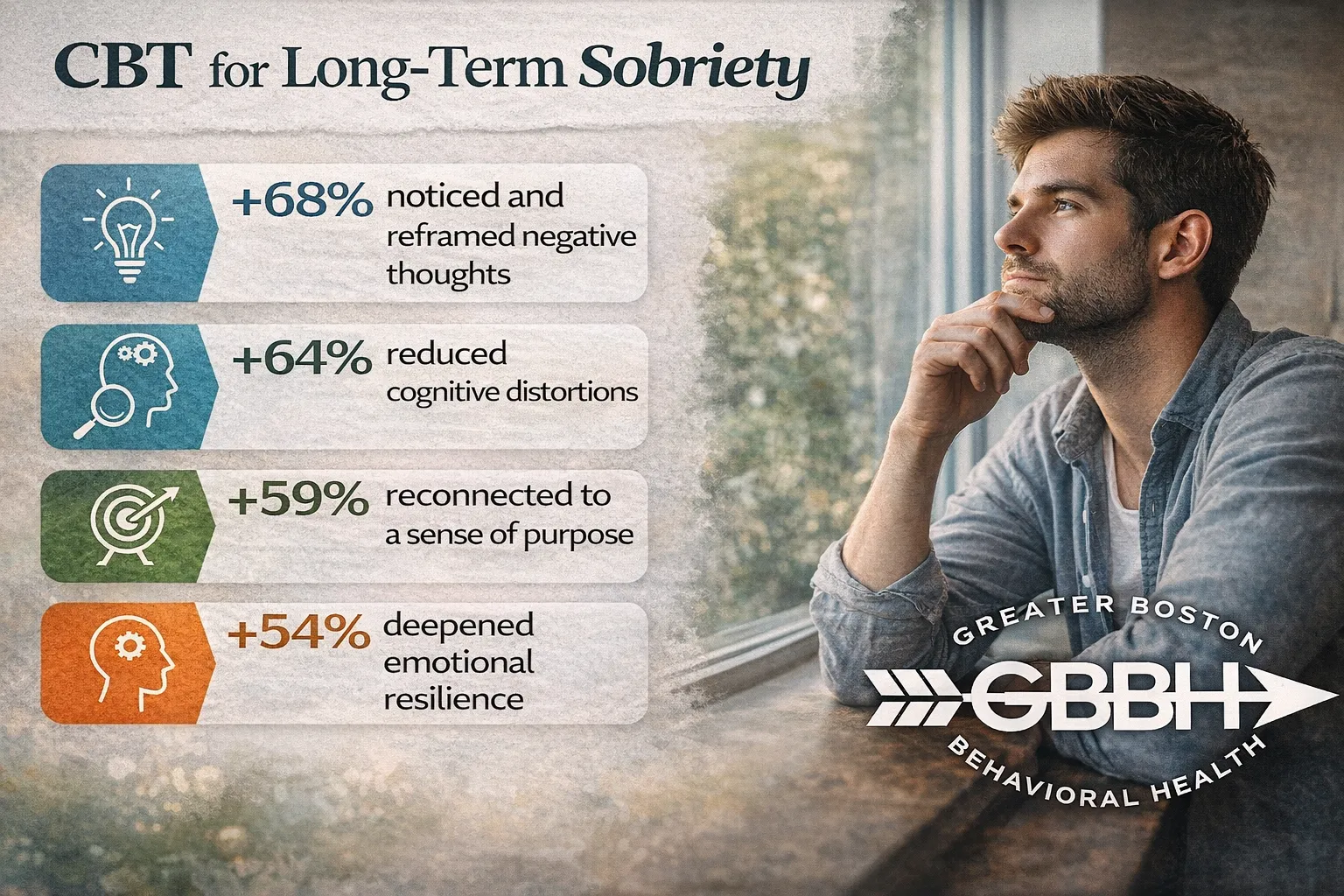
Sobriety Doesn’t Automatically Rewire Your Brain
I used to believe time sober would fix everything.
It fixes a lot. It clears the fog. It stabilizes chaos.
But it doesn’t automatically rewrite thinking patterns that formed over decades.
CBT gave me something I hadn’t fully leaned into before:
- Identify the automatic thought.
- Evaluate the evidence.
- Challenge the distortion.
- Replace it with something balanced.
- Practice that new thought in real life.
Simple. Structured. Not glamorous.
But structure gave me traction again.
I Didn’t Want To Be The Alum Who “Needed More Help”
Let’s be honest about pride.
I didn’t want to look like I hadn’t “figured it out.” Long-term alumni are supposed to be the stable ones. The examples. The proof that recovery works.
Admitting I felt stale felt almost ungrateful.
But growth doesn’t expire.
If you’re in or around Newton, Massachusetts, and you’ve been quietly wondering if it’s okay to want more depth in your recovery, the answer is yes.
You don’t outgrow support. You outgrow certain versions of it.
And sometimes that means revisiting something with new maturity.
Stale Doesn’t Mean You’re About To Relapse
This is important.
Feeling disconnected doesn’t automatically mean you’re in danger.
But ignoring it can create slow resentment.
Resentment builds quietly. It sounds like:
“Is this all there is?”
“Did I give up too much?”
“Why doesn’t this feel meaningful anymore?”
Those thoughts don’t cause relapse overnight. They erode motivation over time.
Going back to CBT interrupted that erosion.
It forced me to look at the mental habits feeding the flatness.
What Actually Shifted When I Went Back
I didn’t have a cinematic breakthrough.
I had clarity.
CBT helped me notice:
- I was filtering out positive feedback automatically.
- I dismissed accomplishments as luck.
- I predicted worst-case scenarios constantly.
- I interpreted neutral situations as threats.
Once those patterns were visible, they lost authority.
Instead of believing every thought, I started questioning them.
Sobriety stopped feeling like something I was maintaining.
It started feeling like something I was strengthening.
Sobriety Is The Foundation — Not The Finish Line
This is the metaphor that helped me.
Sobriety is the foundation of a house.
It keeps everything upright. Stable. Secure.
But if you never build walls, design rooms, add windows — you’re just standing on a slab of concrete.
Going back to CBT felt like adding rooms.
More emotional range. More self-trust. More flexibility in my thinking.
Recovery became expansive again.
Long-Term Recovery Requires New Challenges
Early sobriety challenges are obvious:
- Don’t use.
- Avoid triggers.
- Build structure.
- Stay accountable.
Long-term sobriety challenges are subtler:
- Avoid stagnation.
- Address lingering cognitive distortions.
- Reconnect to purpose.
- Deepen emotional resilience.
If you’ve been sober for years and you’re near Needham, Massachusetts, and something feels slightly hollow, that doesn’t mean you’re ungrateful.
It might mean you’re ready for a deeper layer.
CBT gave me that layer.
I Stopped Treating My Thoughts As Facts
The biggest gift CBT gave me this time around?
Separation.
Instead of:
“I’m failing.”
It became:
“I’m having the thought that I’m failing.”
That distance matters.
It creates choice.
Once I stopped fusing with every negative interpretation, I felt lighter. Not euphoric — but steadier.
And steady is powerful.
Recovery Felt Alive Again
Before going back, sobriety felt like maintenance mode.
After revisiting structured cognitive work, it felt intentional again.
I wasn’t just avoiding relapse.
I was actively reshaping my internal dialogue.
The spark didn’t return as fireworks.
It returned as clarity.
And clarity lasts longer than excitement.
Frequently Asked Questions About Going Back To Therapy In Long-Term Sobriety
Does going back to therapy mean my recovery is weak?
No. It often means your awareness has grown. Recognizing stagnation is a sign of insight, not failure.
Isn’t long-term sobriety supposed to feel stable?
Stable, yes. Static, no. Growth is ongoing. If things feel flat, it may signal readiness for deeper work.
How is this different from early recovery therapy?
In early recovery, therapy often focuses on crisis management and stabilization. In long-term recovery, it can focus on refining thinking patterns, identity, and purpose.
What if I’m not struggling — just bored?
Boredom can mask deeper dissatisfaction. Structured cognitive work can uncover subtle distortions that keep life feeling small.
Can I revisit CBT even if I’ve done it before?
Absolutely. The same tools hit differently at different life stages. Experience changes how you apply them.
How do I know if I need more than meetings?
If you’re sober but still:
- Mentally stuck in negative loops,
- Feeling disconnected from purpose,
- Quietly resentful,
- Or emotionally flat,
It might be time to expand your support.
You’re Allowed To Want Depth
You can be grateful for sobriety and still want more.
You can be stable and still feel disconnected.
You can be years in and still evolve.
Going back to CBT wasn’t about fixing something broken.
It was about refusing to settle for stale.
If sobriety feels like a routine instead of a growth path, that’s not a threat.
It’s an invitation.
Call (888) 450-3097 or explore our cognitive behavioral therapy in Boston, Massachusetts to learn more.
You didn’t come this far to plateau.
You came this far to keep becoming.
