


I wasn’t spiraling out of control.
I was just tired of waking up and thinking, Why did I do that again?
If you’re sober curious, you might not be in crisis. You might be functioning. Working. Showing up. But something feels repetitive. Predictable. A little too automatic.
That’s where I was when I first learned about dbt.
I didn’t need a dramatic intervention. I needed a pause long enough to see my patterns clearly.
And that’s what DBT gave me.
Before I ever committed, I read through the structure of the Dialectical Behavior Therapy program. Seeing that it was skill-based and practical made it feel less intimidating and more doable.
Here’s how it actually helped me.
Step 1: Stop Debating Labels And Start Tracking Patterns
When you’re sober curious, it’s easy to get stuck in identity questions.
“Do I have a problem?”
“Am I overreacting?”
“Is this bad enough to justify help?”
Those questions kept me frozen for months.
DBT shifted the focus. Instead of asking whether I was “bad,” I started asking:
- What situations trigger me?
- What emotion hits first?
- What thought follows?
- What behavior usually comes next?
No drama. No judgment.
Just observation.
Once I mapped it out, my patterns were embarrassingly clear. Stress at work → tension at home → glass of wine to “take the edge off” → two glasses → regret → promise to reset Monday.
Patterns lose power when you see them clearly.
Step 2: Learn That There Is A Space Between Feeling And Reacting
Before DBT, emotions felt urgent.
Anxiety meant I needed relief immediately.
Frustration meant I needed to vent or withdraw.
Loneliness meant I needed distraction.
Through mindfulness skills in dbt, I learned something simple but life-changing:
There is a space between the trigger and the response.
At first, that space was half a second.
I’d notice:
My chest is tight.
My thoughts are racing.
I’m about to pour a drink.
That tiny awareness felt almost useless.
But over time, that half-second turned into a breath. Then two breaths. Then a choice.
You can’t change what you don’t notice. DBT helped me notice.
Step 3: Build Distress Tolerance Instead Of Escaping Discomfort
This was huge for me.
I didn’t drink because life was unbearable. I drank because discomfort felt intolerable.
Boredom. Awkwardness. Rejection. Stress. Even excitement.
DBT taught me distress tolerance skills — practical ways to ride emotional waves without making things worse.
Not glamorous tools. Grounded ones:
- Splashing cold water to reset my nervous system.
- Stepping outside for a brisk five-minute walk.
- Using paced breathing to lower intensity.
- Distracting myself intentionally for a short window.
The goal wasn’t to eliminate the feeling. It was to survive it.
When you realize you can survive discomfort without numbing it, something shifts internally. You stop seeing urges as commands.
They become sensations. Temporary. Manageable.
Step 4: Understand Emotions Instead Of Fighting Them
Before DBT, I had two modes: suppress or explode.
In dbt, I learned to ask:
- What emotion am I feeling?
- Does it fit the facts?
- What action would be effective here?
For example, I realized that what I called “stress” was often shame. And what I called “anger” was often hurt.
When you mislabel emotions, you mis-handle them.
When I started accurately identifying them, my reactions softened.
Instead of drinking to escape shame, I could address the actual issue. Instead of numbing loneliness, I could reach out to someone safe.
Emotions stopped feeling like enemies. They became information.
And information is workable.
Step 5: Practice Opposite Action When The Pattern Is Predictable
One of the most practical tools I learned was opposite action.
If my pattern was:
Feel socially awkward → Drink to loosen up
Opposite action became:
Feel socially awkward → Stay present → Leave early if needed, sober
If my pattern was:
Feel overwhelmed → Cancel plans and isolate
Opposite action became:
Feel overwhelmed → Keep one small commitment
It wasn’t about forcing myself to be happy. It was about interrupting predictable cycles.
Patterns thrive on repetition.
DBT gave me interruption points.
And interruption creates new outcomes.
Step 6: Strengthen Relationships So Urges Decrease Naturally
A lot of my drinking wasn’t about the drink.
It was about relationships.
Conflict would spike my anxiety. Miscommunication would leave me spiraling. I’d feel misunderstood and shut down.
Interpersonal effectiveness skills in DBT helped me:
- Ask for what I need clearly.
- Say no without overexplaining.
- Validate someone else without abandoning myself.
- Stay steady during disagreement.
When my relationships stabilized, my urge to escape them decreased.
It turns out, when your life feels less chaotic, you don’t crave relief as urgently.
If you’re in the Boston area — whether you’re closer to West Roxbury, Massachusetts or another surrounding neighborhood — having access to structured, skill-based therapy can make these changes feel supported instead of overwhelming.
You don’t have to figure it out alone.
Step 7: Hold Two Truths At Once — Acceptance And Change
The “dialectical” in Dialectical Behavior Therapy means holding two truths at the same time.
I can accept myself as I am.
And I can work to change harmful patterns.
For someone sober curious, that balance matters.
You don’t have to label yourself an addict to want healthier coping skills. You don’t have to hit a dramatic low point to justify support.
You can simply say:
“This pattern isn’t working for me anymore.”
That’s enough.
Acceptance without change leads to stagnation.
Change without acceptance leads to shame.
DBT holds both.
Step 8: Practice Skills When You’re Calm — Not Just In Crisis
One mistake I made early on was only using skills when I was already overwhelmed.
DBT works best when practiced consistently.
I started:
- Doing short daily mindfulness check-ins.
- Noticing emotional shifts throughout the day.
- Rehearsing how I’d handle predictable triggers.
It felt mechanical at first.
But repetition builds muscle memory.
When a high-stress moment hit, I didn’t have to invent a response. I had one ready.
That preparation made sobriety — or even mindful moderation — feel less fragile.
Step 9: Redefine What “Bottom” Means For You
I used to think therapy was for people who had lost everything.
But what if bottom isn’t losing your job or relationship?
What if bottom is realizing you don’t like who you are becoming?
DBT met me before catastrophe.
It met me in the subtle dissatisfaction. The repeated promises. The quiet awareness that something needed adjusting.
If you’re in or around Dorchester, Massachusetts, and you’re noticing early warning signs in your patterns, that awareness is a strength — not an overreaction.
Early intervention is wisdom.
What Actually Changed Over Time
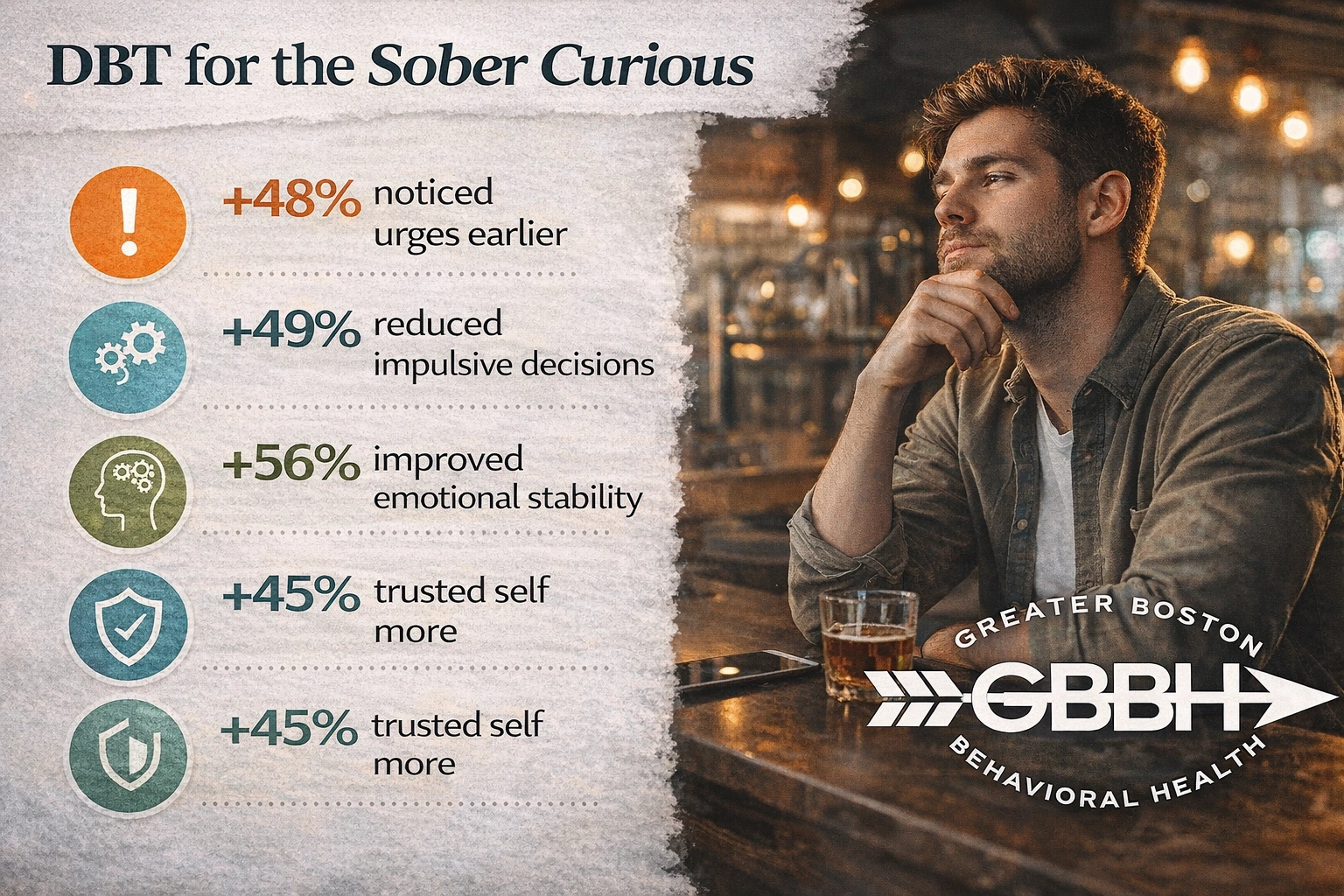
After several months of practicing DBT skills consistently, here’s what shifted:
- I noticed urges earlier.
- My reactions felt less automatic.
- I felt more emotionally steady.
- I reduced impulsive decisions.
- I trusted myself more.
It wasn’t dramatic. No lightning bolt moment.
It was gradual.
Like turning down background noise until you can finally hear your own thoughts clearly.
And once I could hear myself clearly, my choices aligned better with who I actually wanted to be.
Frequently Asked Questions About DBT For The Sober Curious
Is DBT only for people with severe mental health diagnoses?
No. While DBT is often associated with intense emotional dysregulation, the skills are broadly applicable. Many people use DBT to improve stress management, impulse control, and communication.
Do I have to commit to total sobriety to start DBT?
Not necessarily. DBT focuses on building awareness and coping skills. Some people pursue full sobriety. Others start by examining patterns and making intentional adjustments.
Is DBT mostly group-based?
Many programs combine individual therapy with skills-based group sessions. The group component allows you to practice real-life skills in a structured environment, while individual therapy personalizes the work.
How long does DBT take?
It varies. Some structured DBT programs run several months. Many people begin noticing changes in awareness and emotional regulation within weeks when practicing consistently.
What if I’ve tried therapy before and it didn’t stick?
DBT is highly structured and skill-focused. If open-ended talk therapy felt vague or unproductive for you, DBT’s concrete tools may feel more practical and actionable.
Can DBT help even if I’m not sure I have a substance problem?
Yes. DBT addresses emotional regulation and behavioral patterns. Even if your relationship with substances is still exploratory, these skills can improve overall stability and clarity.
If You’re Quietly Paying Attention To Yourself
Being sober curious doesn’t mean you’re broken.
It means you’re aware.
That awareness is worth listening to.
You don’t have to wait for a crisis to justify support. You don’t have to hit a dramatic low point to deserve tools.
Learning DBT didn’t force me into an identity. It gave me options.
It helped me slow down long enough to see my patterns clearly — and choose differently.
If you’re ready to explore whether DBT could help you build steadier coping skills and a more intentional relationship with alcohol or other habits, support is available.
Call (888) 450-3097 to learn more about our Dialectical Behavior Therapy in Boston, Massachusetts.
