


You didn’t mean to stop showing up.
Maybe it started with one missed session—then a few. Maybe you ghosted your intensive outpatient program completely. The messages went unread. You stopped replying. Your clinician checked in, but you just… couldn’t.
Now the idea of returning feels weirdly harder than starting in the first place.
But if you’re reading this? You haven’t given up.
And that matters.
At Greater Boston Behavioral Health, we meet people every week who disappeared from treatment and quietly found the courage to return. We never judge. We just pick up where you left off—because that’s what healing looks like sometimes.
First, Take a Breath. You’re Not Broken.
Avoidance isn’t a personality flaw. It’s a nervous system strategy.
You ghosted because showing up started to feel like too much. Too vulnerable. Too exhausting. Too close to something raw you weren’t ready to touch yet.
So your brain did what it does best: it protected you.
That protection may have looked like disengaging, numbing out, diving into work, or isolating.
It doesn’t mean you failed. It means your body and mind were doing their best.
Now they’re giving you a new signal—maybe one that sounds like:
- I kinda miss the space I had in group.
- I want to feel like I’m trying again.
- I just don’t want to feel stuck anymore.
That’s your readiness returning—not all at once, but enough to start walking back in.
Why You Left Matters Less Than Why You Want to Come Back
People often torture themselves over the why of leaving.
- “Was I too weak?”
- “Did I waste everyone’s time?”
- “Will they be mad at me?”
Here’s the truth: You’re not the first, and you won’t be the last.
Clients from West Roxbury, Massachusetts to Cambridge have taken time off from IOP—sometimes days, sometimes months. What matters isn’t the gap. What matters is that they return.
So the question now is simple: Why are you thinking about coming back?
Not the polished version. The honest one.
- You’re tired of spiraling.
- You miss being around people who get it.
- You realized your coping isn’t working anymore.
- You want to try—without having to pretend you never left.
That’s enough.
Start Small — One Honest Step at a Time
You don’t need a grand re-entry.
Start with a message. A call. A form. You don’t even have to say much. You can literally write:
“Hey, I dropped out of IOP a while ago. I’d like to talk about coming back, but I’m nervous.”
That’s it.
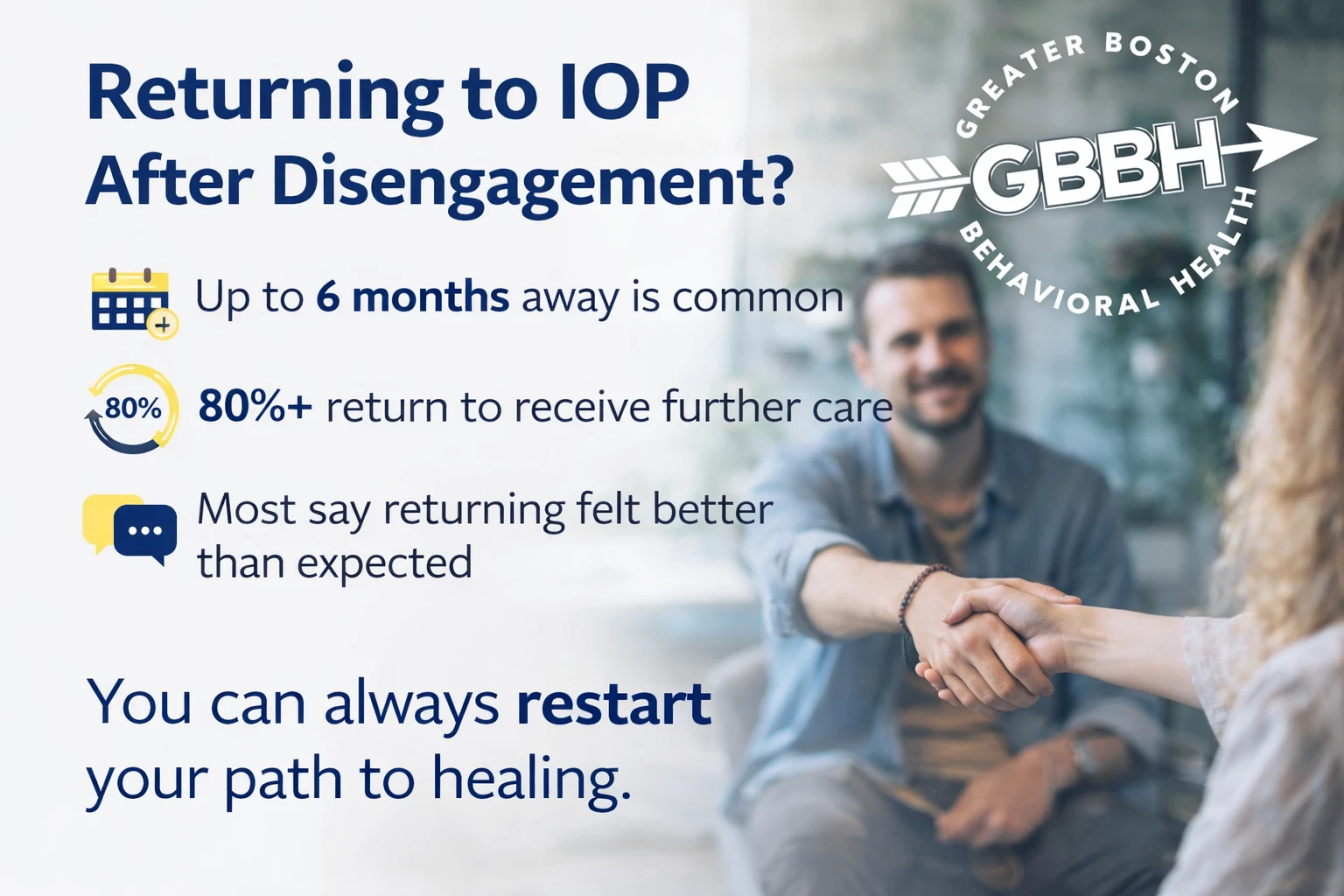
We’ve heard versions of that from students, professionals, parents, and folks who ghosted for six months and still found their way back.
When you reach out, we’ll help you figure out next steps—without pressure. Without shame.
You’re not being graded. You’re being met where you are.
You Don’t Have to Explain Everything to Re-Engage
A common fear is this:
“I’ll have to walk in and explain why I bailed.”
Nope.
In most cases, re-engagement starts with a simple check-in. Not a full account of your time away.
You can share:
- What got hard
- What you want to do differently
- What pace feels safe now
But you don’t owe us a confession.
You owe yourself permission to begin again.
The Skills You Built Before Are Still With You
Think you forgot everything? You didn’t.
What you learned before—whether it was grounding, DBT distress tolerance, or setting boundaries—still lives in your body.
It might be dusty. But it’s not gone.
Clients are often surprised by how quickly old tools come back online once they re-enter group space.
And when you return, the experience often feels different. Because you are different. Not broken. Not behind. Just walking in with a new layer of self-awareness.
Group Will Welcome You Back—Even If You’re Nervous
Rejoining group therapy after time away is intimidating.
But here’s what most returning clients say:
“People were kind. No one asked for a backstory. We just picked up.”
Because everyone in group has had a “drop the ball” moment. That’s what makes the space real.
Recovery isn’t a straight line.
It’s loops. Detours. Rest stops.
The group doesn’t expect perfection. It expects honesty.
The Support You Need This Time Might Look Different
Let’s be real—something wasn’t working before.
So what if we restructured things?
- Maybe fewer sessions a week at first
- A different group composition
- More 1:1 check-ins
- Targeted support for trauma or relapse
- A pacing plan you actually feel good about
You don’t have to return to what didn’t work. You get to co-create what does.
We’ve helped clients from Dorchester, Massachusetts re-engage in flexible ways that fit their schedule, energy level, and emotional bandwidth.
Healing isn’t about discipline. It’s about alignment.
FAQs for Re-Entering IOP After Disengagement
How do I tell the team I want to return?
Start with an email, call, or contact form. Keep it simple: “I was in IOP before and want to explore coming back.” That’s enough.
Will I have to restart from scratch?
No. We build on what you already know. We also adjust your plan based on what worked and didn’t work last time.
Do I have to explain why I left?
Only if you want to. Some clients share; others don’t. You’ll never be pressured to justify your journey.
What if I ghost again?
That fear is common. We’ll help you build a safety plan that includes early support, check-ins, and strategies for re-engagement if you feel yourself slipping.
Will group members judge me for dropping out?
Nope. Many have done the same. Group welcomes honesty, not perfection.
You Can Reconnect Without Pretending Nothing Happened
This isn’t about pretending the dropout didn’t happen.
It’s about letting it be part of your story without letting it be the end.
You’re allowed to change your mind.
You’re allowed to try again.
You’re allowed to need time—and still come back strong.
The door never closed.
You just had to find your way back to it.
Call (888) 450-3097 to learn more about our Intensive Outpatient Program (IOP) in Boston, Massachusetts.
We’ll walk with you—no matter where you left off.
