


You swore you’d never go through this again.
The phone call that doesn’t come. The texts that don’t make sense. The gut feeling that won’t leave. The look in their eyes when they say they’re “fine”—but you know, deep down, they’re not.
Your child relapsed. Again.
Maybe it was just a weekend. Maybe it was “just weed.” Maybe it was one pill, one drink, one moment they promised would never happen again.
And now you’re staring down the same path you thought you’d already walked.
You’re not being dramatic. You’re not overreacting. You’re being a parent who knows what’s at stake.
Because one weekend relapse, if ignored, can turn into a month lost. Then a year. And then it’s not just about the relapse—it’s about trying to get your kid back at all.
That’s where a Partial Hospitalization Program (PHP) comes in.
At Greater Boston Behavioral Health, our Partial Hospitalization Program in Boston is designed to catch relapses before they spiral. It’s built for families like yours—who are tired, afraid, and still holding onto hope.
The Moment to Intervene Is Sooner Than You Think
Here’s what we see far too often: a relapse gets brushed aside.
The logic sounds like this:
- They’re young. They’ll bounce back.
- It was just a slip. Everyone makes mistakes.
- They seemed so good for so long—maybe it’s not a big deal.
But you know how quickly “just a weekend” becomes something darker. Missed classes. Forgotten appointments. Lying. Withdrawal. The subtle but unmistakable signs of spiraling.
You don’t need to wait for a rock-bottom moment to act. You don’t need to wait for the job loss, the failed semester, the overdose scare.
You can intervene now—with support that meets them where they are.
What Is a Partial Hospitalization Program—and Why It Works
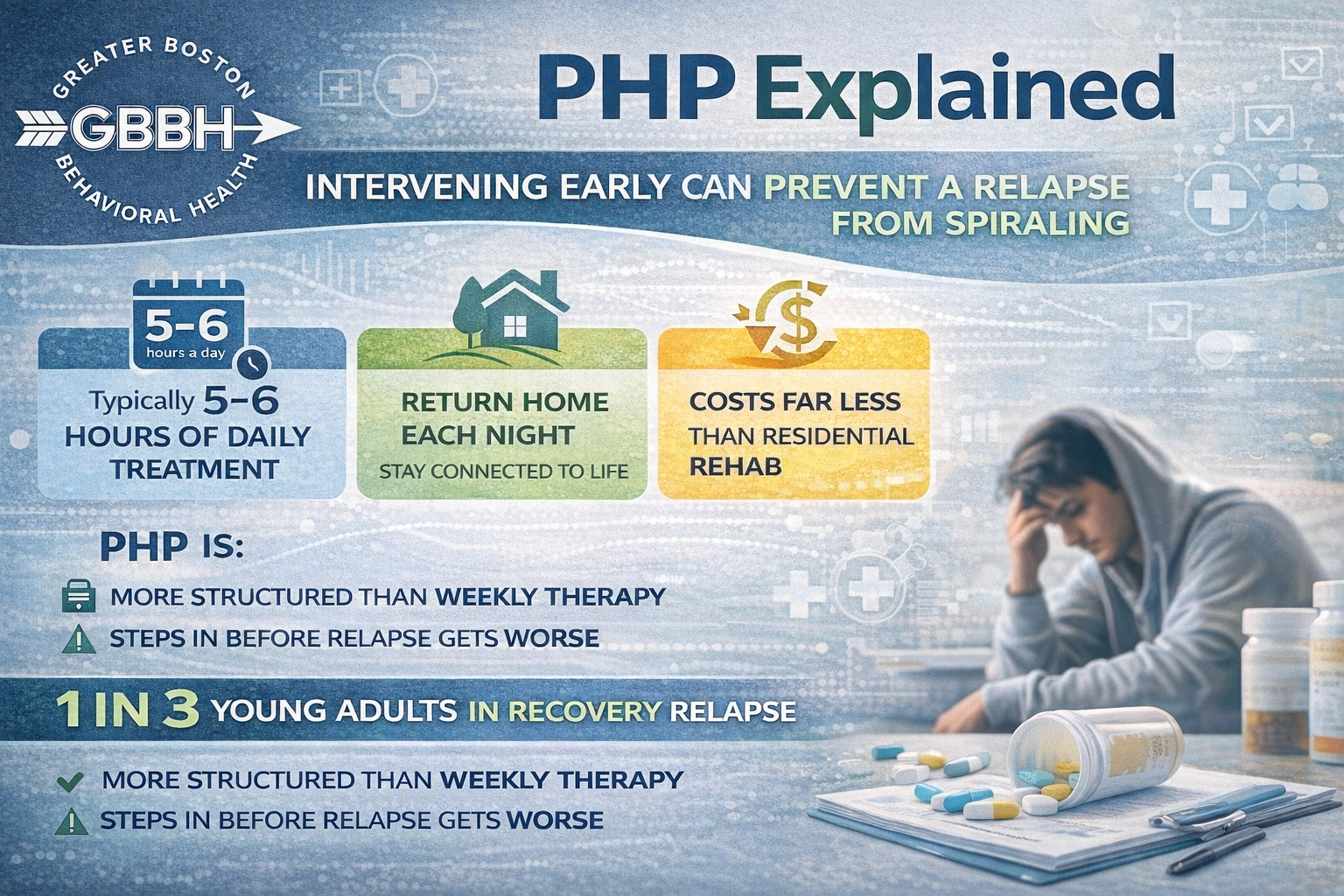
A Partial Hospitalization Program (PHP) is a highly structured form of outpatient treatment. It’s more intensive than traditional therapy, but it doesn’t require overnight stays.
At Greater Boston Behavioral Health, PHP includes:
- 5–6 hours of treatment per day (typically Monday through Friday)
- Individual therapy with licensed clinicians
- Group therapy focused on emotional regulation, relapse prevention, and accountability
- Psychiatric support, including medication management if needed
- Family involvement, when appropriate and welcomed
Your young adult still sleeps at home. They can stay connected to their life—but they’re no longer left to “figure it out” alone.
They have a team. A schedule. And a reason to show up for themselves again.
When Rehab Feels Like Too Much—and Doing Nothing Feels Too Risky
A lot of parents hesitate to suggest residential rehab after a relapse. And for good reason:
- It’s expensive.
- It’s disruptive.
- It can feel like sending your child away.
- It can create fear and shame in young adults who feel “not sick enough” for that level of care.
But doing nothing? That’s not an option either.
PHP is the middle ground. It provides clinical-level care without pulling them out of their life entirely. It’s structured enough to create real change, but flexible enough to feel manageable.
It can be especially effective for young adults who:
- Are still living at home or nearby
- Have relapsed after previous treatment
- Are in school, working part-time, or in transition
- Are showing early signs of substance misuse or mental health deterioration
If your child is near Dedham or Needham, our Partial Hospitalization Program can provide this support close to home.
Why It’s Harder the Second Time—And Why That’s Okay
One of the hardest things about relapse—for both parents and young adults—is the shame.
“I already went through treatment. Why am I back here?”
“My parents will think I didn’t care.”
“I don’t want to start over again.”
These thoughts are common. And they’re dangerous.
Relapse isn’t proof that treatment failed. It’s proof that something is still unmet. That something deeper is still unaddressed. And that the journey isn’t over yet—but that doesn’t mean it can’t be salvaged.
In our PHP, we help clients:
- Understand the emotional triggers that led to the relapse
- Rebuild the tools they lost touch with
- Strengthen coping strategies without shame
- Set realistic, compassionate goals for recovery
This isn’t about punishment. It’s about reconnection—with themselves, their values, their future.
Parents Aren’t the Enemy—But You Need Support, Too
If you’re reading this, you’re probably trying to hold everything together: your worry, your boundaries, your home, your sanity.
But this isn’t just their recovery. It’s your life, too. Your sleepless nights. Your cautious hope. Your heartbreak.
That’s why at Greater Boston Behavioral Health, we include family as part of the treatment plan whenever possible.
- You’ll be kept in the loop—not left in the dark.
- You’ll be offered support—not blamed.
- You’ll have a say—but not all the responsibility.
Because we know how hard it is to walk the line between support and enabling. And we’re here to help you find your footing again, too.
Real Stories, Real Change
One client—a 20-year-old college sophomore—came to us after a “weekend” relapse that had stretched into two months of missed classes and unexplained absences.
Her parents were at a loss. She didn’t want to go back to residential treatment, and outpatient therapy wasn’t enough.
In PHP, she rediscovered her voice. She faced the shame. She learned to stay when things got hard—rather than run. She returned to campus with a plan, a support system, and a new level of self-awareness.
Stories like this happen because families act early.
FAQs: What Parents Ask About PHP
Will this ruin my child’s future?
No. PHP isn’t a disciplinary action—it’s treatment. It’s private, confidential, and designed to help them stabilize and succeed.
Will my child be forced to go?
Not typically. Most young adults are more open to PHP than inpatient rehab once they understand they can still go home at night. We can help you have this conversation in a supportive way.
What if I’m not sure they’ve relapsed?
You don’t need proof to take action. If your instincts say something’s wrong, reach out. We can help assess whether PHP is appropriate.
Can they work or go to school while in PHP?
Some can, depending on their schedule and stress levels. Others take time off during PHP and return afterward. We’ll help you and your child find the right balance.
How long does PHP last?
Most clients participate for 2–4 weeks, with options to step down into less intensive treatment as they stabilize.
One Weekend Can Be a Turning Point—In Either Direction
Relapse doesn’t have to be the beginning of another spiral.
It can be the moment things actually start to shift.
With the right intervention, your child doesn’t have to lose another semester, another job, another year. They can stop the slide before it becomes a fall.
You don’t have to wait. You don’t have to beg. You don’t have to handle this alone.
Don’t let one weekend cost your child another year.
Call (888) 450-3097 to learn more about our Partial Hospitalization Program services in Boston, Massachusetts. We’re ready when you are—because the moment to intervene is now.
