


Even in long-term recovery, it’s possible to feel emotionally stuck. You’re not in crisis. You’re not going backward. But something feels… off. Maybe you’re showing up to work, keeping your commitments, doing all the “right” things—yet life feels muted. The color is gone. The energy is flat.
If that sounds familiar, you’re not alone—and you’re not broken. Many people who’ve done deep personal work in recovery eventually hit this quiet, confusing space. It’s not relapse, and it’s not failure. It’s something more subtle: a spiritual or emotional disconnection that depression can quietly intensify over time.
For long-term alumni—especially those with over a year of sobriety—this can be disorienting. You did everything you were supposed to. Why does it still feel like something’s missing?
This is where a structured depression treatment program can make a meaningful difference. Not because you’re back at square one—but because you’re ready for deeper healing.
The Truth About Depression in Long-Term Recovery
Depression doesn’t always announce itself with tears or hopelessness. For many, it shows up as numbness. Disconnection. A sense of going through the motions.
Especially for people in long-term recovery, that kind of emotional flatness can feel shameful. You’ve worked hard to get where you are. You might think: “I should feel grateful.” Or “Other people have it worse.”
But depression doesn’t care how long you’ve been sober or how many milestones you’ve hit. It can sneak in through the quiet—especially when life stabilizes and the adrenaline of early recovery fades.
This is not failure. This is your mind and body telling you it’s time for something more.
Why Emotional Numbness Deserves Attention
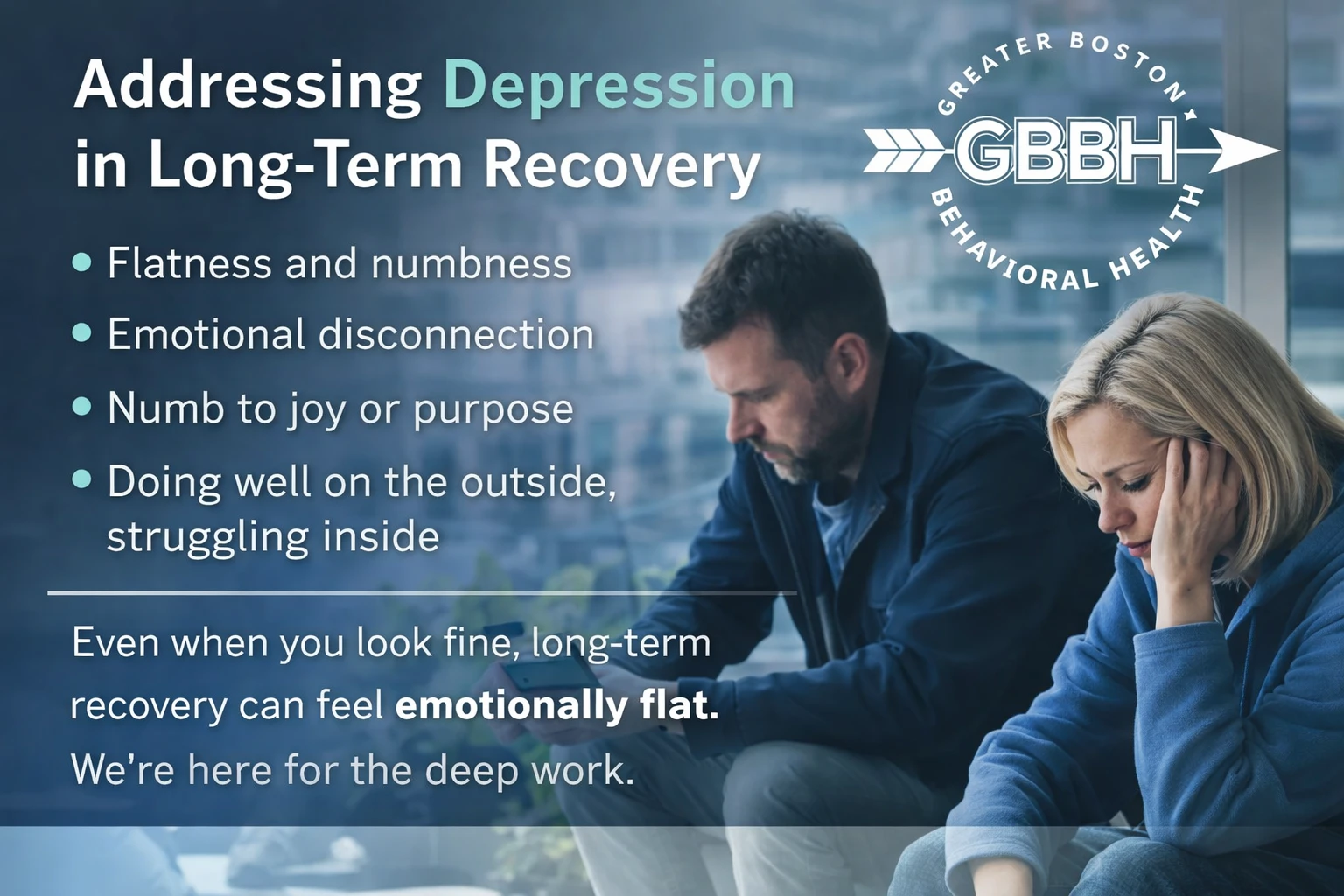
One of the hardest parts of this phase is that everything looks fine. From the outside, you’re functioning. You’re dependable. You’re doing well.
But inside? You may feel:
- Disconnected from people you care about
- Emotionally unavailable, even when you try
- Unmotivated in ways you can’t explain
- Like joy and purpose feel out of reach
These aren’t just passing feelings. Over time, unaddressed emotional numbness can evolve into clinical depression. And if you’ve already battled intense mental health challenges in the past, you know how easy it is to dismiss subtle warning signs until things become harder to manage.
The good news? You don’t have to wait for a breakdown to ask for support.
What Depression Treatment Offers Alumni
Depression treatment isn’t just for people in acute crisis. At Greater Boston Behavioral Health, we work with long-term alumni who are looking for clarity, purpose, and reconnection. You’re not starting over—you’re building on the foundation you’ve already created.
Our depression treatment program is designed to help alumni:
- Explore emotional blocks without judgment
- Address lingering depressive symptoms with clinical support
- Reconnect with themselves and others in a deeper way
- Identify meaning and direction beyond early recovery milestones
Whether you’ve been sober for 18 months or 8 years, you deserve support that reflects the complexity of where you are now—not where you started.
Therapy That Respects the Work You’ve Already Done
We don’t treat you like a beginner. Our clinicians know that you’ve likely done group work, individual therapy, and possibly multiple rounds of treatment before.
That’s why our depression treatment for alumni is:
- Collaborative: We don’t prescribe—we partner.
- Adult-centered: We trust your insight and agency.
- Flexible: Services fit around your life, not the other way around.
- Integrated: We consider the whole picture—not just your symptoms.
This kind of support isn’t about “fixing” you. It’s about helping you find your next layer of growth and presence. That might mean reconnecting with emotions you’ve numbed out. Or rediscovering what joy actually feels like, now that you’re not surviving anymore.
Real Reconnection Doesn’t Always Look Big
Sometimes, people assume that healing from depression means big revelations or dramatic change. But in practice, reconnection often starts with the small stuff:
- Feeling a genuine smile sneak up on you
- Actually hearing the lyrics to a song you’ve played a hundred times
- Noticing you want to show up to something—not just out of obligation
A good depression treatment program helps you notice and build on these moments. You start to reclaim the parts of yourself that felt out of reach.
“I didn’t realize how flat I’d gotten. I wasn’t spiraling—I just wasn’t feeling anything. Getting back into therapy helped me feel human again.”
– Alumni, 2023
Why Now Might Be the Right Time
You don’t need to be in danger to deserve support. And you don’t need to wait for things to fall apart before you reach out.
If anything about this blog resonates with you, consider this your quiet green light. The part of you that’s still paying attention—that’s still you. And that part deserves care.
Especially if you’re in or near Boston, MA or Needham, MA, we invite you to explore what reconnection could look like with us. We’ve built our programs to support every stage of the mental health journey—not just the beginning.
Depression Treatment Program FAQs
What Makes This Different From My Previous Therapy?
Many alumni have already done individual therapy or group work. What makes our program different is the combination of structure, specialization, and community. We focus specifically on depression in the context of long-term recovery, offering support that aligns with your current emotional reality—not just general coping skills.
How Do I Know if What I’m Feeling Is Depression?
Depression can look different in long-term recovery. You might not feel “sad” in the traditional sense. Instead, you might feel:
- Unmotivated or uninterested in things that once mattered
- Disconnected from people or activities
- Like you’re faking your emotions to get through the day
If any of that feels familiar, it’s worth exploring in a professional setting.
I’m Functioning Fine. Isn’t This Just Life?
High-functioning depression is real. Many people continue working, parenting, or leading while quietly struggling. Just because you’re getting things done doesn’t mean you’re okay. And you don’t have to “prove” your suffering to deserve help.
Will This Feel Like I’m Starting Over?
Not at all. We don’t reset your progress—we build on it. You’ve already done deep work. This next phase is about refinement, growth, and healing at a deeper level.
How Do I Get Started?
You can start by calling us directly or filling out our contact form. Our team will walk you through what treatment could look like and help determine the best next steps based on your needs and schedule.
Your Story Isn’t Over—It’s Evolving
You’ve made it through the hardest parts. Now it’s about moving from surviving to actually living. And if something still feels off, that doesn’t mean you’re ungrateful or broken—it just means you’re ready for more.
Greater Boston Behavioral Health offers depression treatment that respects your journey and supports your next step. Whether you’re navigating numbness, low mood, or quiet burnout, we’re here to help you reconnect—with others, with yourself, and with what makes life feel meaningful again.
Call (888) 450-3097 to learn more about our depression treatment program services in Boston, MA and Dedham, MA.
