


“I already tried. Why would this be any different?”
That’s the sentence we hear most often from people who walk into a depression treatment program after a disappointing first (or second, or fifth) try. If that’s where you are right now, this isn’t a pep talk. It’s a look at what it’s actually like to show up skeptical—and still give it one more shot.
At Greater Boston Behavioral Health, we work with a lot of people who didn’t walk in with hope. They walked in with a deadline. A friend’s ultimatum. A “might as well.” If that’s you? You’re not broken. You’re just not convinced yet. And that’s allowed.
Not Everyone Walks In Ready to Get Better
We hear this more than people realize:
“I’m not even sure I want to feel better. I just want to stop feeling like this.”
That’s a big difference—and a valid one.
Some people show up hoping. Others show up daring the program to fail them again. When you’ve tried therapy and it felt useless, or when antidepressants dulled everything but the pain, it’s hard to imagine anything helping at all.
Skepticism isn’t a flaw. It’s a survival skill you built after disappointment. You were let down, and your brain filed that under “evidence.” That makes sense. Our job isn’t to argue with your history. It’s to create a different experience now—one that doesn’t ignore your doubts, but respects them.
The First Few Sessions Might Feel Flat—Or Frustrating
People expect therapy to feel either dramatic or relieving. But honestly? The first few sessions of a depression treatment program often feel…dull. Repetitive. Like circling the same drain you’ve circled before.
That doesn’t mean it’s not working.
In fact, for people with chronic depression, numbness and repetition are part of the landscape—and working with that, not against it, is what a good clinician knows how to do.
You may not feel much at first. You might even leave your first few appointments thinking, “That was a waste of time.” But sometimes, those flat sessions are laying the groundwork for the shift your brain doesn’t believe in yet.
Being Around Other Skeptics Helps More Than You Think
Group therapy isn’t required in every format, but when it’s available, it often becomes the unexpected lifeline for people who feel emotionally checked out. Why? Because sitting in a room with others who get it—who’ve been burned by bad therapy, who’ve spent years hiding how empty they feel—takes away the quiet shame.
One client said:
“Hearing someone else say, ‘I don’t think I’m capable of feeling joy,’ made me feel less broken. Like I wasn’t the only one in the world who felt like a ghost.”
You don’t have to be social. You don’t have to share your whole story. Sometimes just being in a space where people talk openly about things you’ve only said in your head… changes something.
Progress in Depression Treatment Looks Different
Here’s a truth you rarely hear:
You might not feel “better” right away. But you might feel less alone. And that’s the beginning.
In our depression treatment program, progress doesn’t always look like smiles or motivation or peace. Sometimes it looks like:
- Going to the grocery store without crying in the car first
- Answering a text from a friend you’ve been avoiding
- Admitting, out loud, that you don’t feel anything—and being met with calm, not panic
We don’t rush clients to get better. We walk with them through the days when everything feels muted and slow and exhausting. And we celebrate that progress, too.
You’re Allowed to Question the Process Without Being Labeled “Difficult”
You’re not too much. You’re not resistant. You’re asking valid questions that deserve honest answers.
A good depression treatment program should be able to tolerate your doubt.
If something isn’t working—if a therapist’s style doesn’t match yours, or a group doesn’t feel safe, or a technique feels pointless—you can say that. Out loud. Without being dismissed.
The goal isn’t blind faith. The goal is to co-create something that works with your mind, your history, your real-life circumstances.
You Don’t Have to Be Hopeful to Start
A lot of people wait until they “feel ready.” But when you’re dealing with depression, ready doesn’t usually come. It’s not a switch that flips.
You don’t have to feel brave or clear or optimistic.
You just have to be willing to show up once.
That one appointment might not fix anything. But it might be the first time someone takes your exhaustion seriously. It might be the first time no one tries to cheer you up. And sometimes, that’s where the slow climb out actually begins.
Why This Time Might Be Different
We’re not promising a miracle. We won’t give you a sales pitch. What we can say is this:
At Greater Boston Behavioral Health, we don’t treat depression like it’s a puzzle to solve. We treat it like a lived reality to meet with care, patience, and real tools.
We work with people who’ve been through multiple programs. People who were misdiagnosed. People who thought they were “too flat” or “too complex” or “too tired to try again.”
You’re not too anything. You’re human. And we’re ready when you are.
FAQ: Depression Treatment for Skeptical Patients
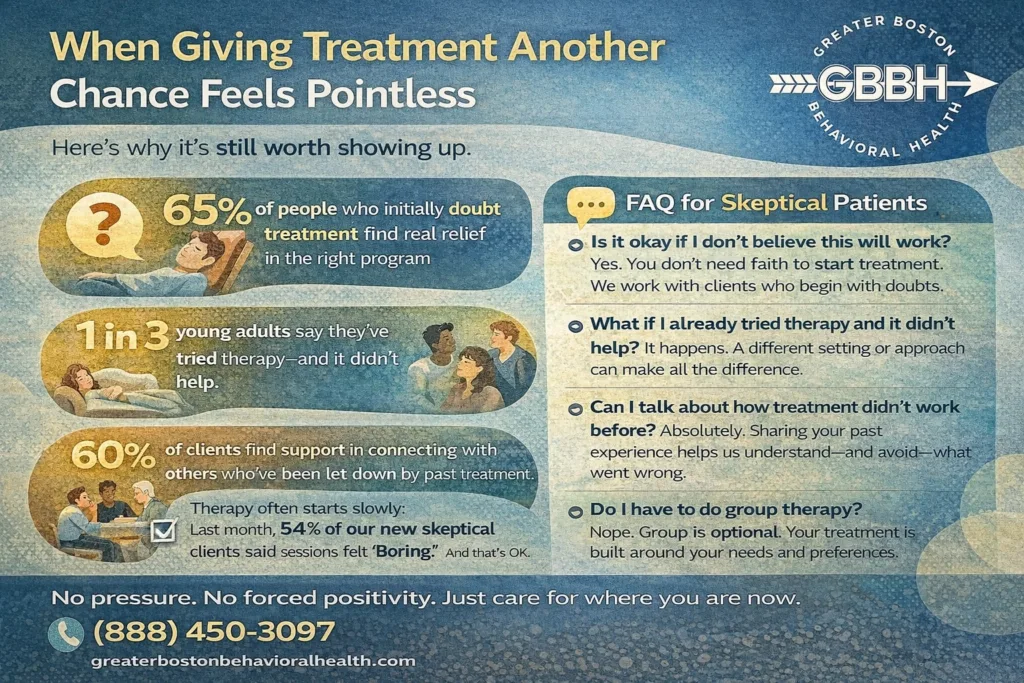
Is it okay if I don’t believe this will work?
Yes. You don’t have to be hopeful to begin treatment. Many clients start from a place of doubt. What matters is showing up and giving the process a chance to meet you where you are.
What if I already tried therapy and it didn’t help?
That doesn’t mean therapy can’t help—it might mean the fit was wrong. Not every therapist, method, or program is right for every person. Our program focuses on tailoring care to what actually helps you—not what “should” help.
Can I talk about how treatment didn’t work before?
Absolutely. In fact, we welcome it. Talking openly about your past experiences helps us understand what you’ve been through—and what not to repeat.
Do I have to do group therapy?
Not unless you want to. Some formats include group sessions as an option, but your individual treatment plan will depend on your comfort level, goals, and needs.
Still Unsure? That’s Okay.
We understand what it’s like to feel like you’ve already tried everything—and to be afraid that nothing can help. But if you’re even a little bit curious about trying again, we’re here to talk. No pressure. No promises we can’t keep.
Call (888) 450-3097 or visit our depression treatment program page to learn more about our services in Boston.
