


When emotions feel overwhelming and unpredictable, it can sometimes feel like there’s no clear path forward. You may be asking yourself, “How do I cope with this intensity without losing myself?” Dialectical Behavior Therapy (dbt) offers something solid: real‑life skills grounded in compassion, logic, and practical steps that help you handle emotional stress in the moment. If you’ve been searching for something that actually supports you where you are right now—without judgment or minimization—this guide is for you.
Early in your journey, you might wonder what dbt really looks and feels like. You’ll find that it’s less about digging into the past and more about building tools for today. At Greater Boston Behavioral Health’s DBT program, many people begin to feel relief not because their feelings disappeared, but because they finally learned how to work with them. One of our community members from Dedham, Massachusetts, found that DBT gave structure to emotions she once thought were chaotic and uncontrollable.
Understanding the Heart of DBT
Dialectical Behavior Therapy, or dbt, was developed in the late 1980s to help people experiencing intense emotions and self‑destructive behaviors. But over time, clinicians found its skills work beautifully for anyone who struggles with emotional regulation, relationship challenges, or stress that feels “too big.” What makes DBT unique isn’t just the name—it’s the way it combines acceptance and change. You’re not told to just calm down or feel differently. Instead, you’re taught how to notice what’s happening inside you, respond with intention, and choose actions that support your life goals. The balance of acceptance and actionable change is what makes DBT genuinely practical.
Imagine learning how to navigate emotional storms with tools that feel anchored in everyday life—tools that really work.
DBT’s Core Skill Sets: Tools You Can Use Today
DBT is organized into four core skill areas. Each set is designed to meet you where you are and help you take steps that are concrete, learnable, and repeatable.
Mindfulness: Being Present Without Judgment
Mindfulness in DBT isn’t about spiritual retreats or hours of meditation (unless that’s what you choose). It’s about noticing:
- What you are feeling in your body
- What thoughts are moving through your mind
- What is happening around you
Without judgment. This skill helps you break the cycle of reacting on autopilot. Instead of emotions taking over, you learn how to observe them—and choose your next step with intention.
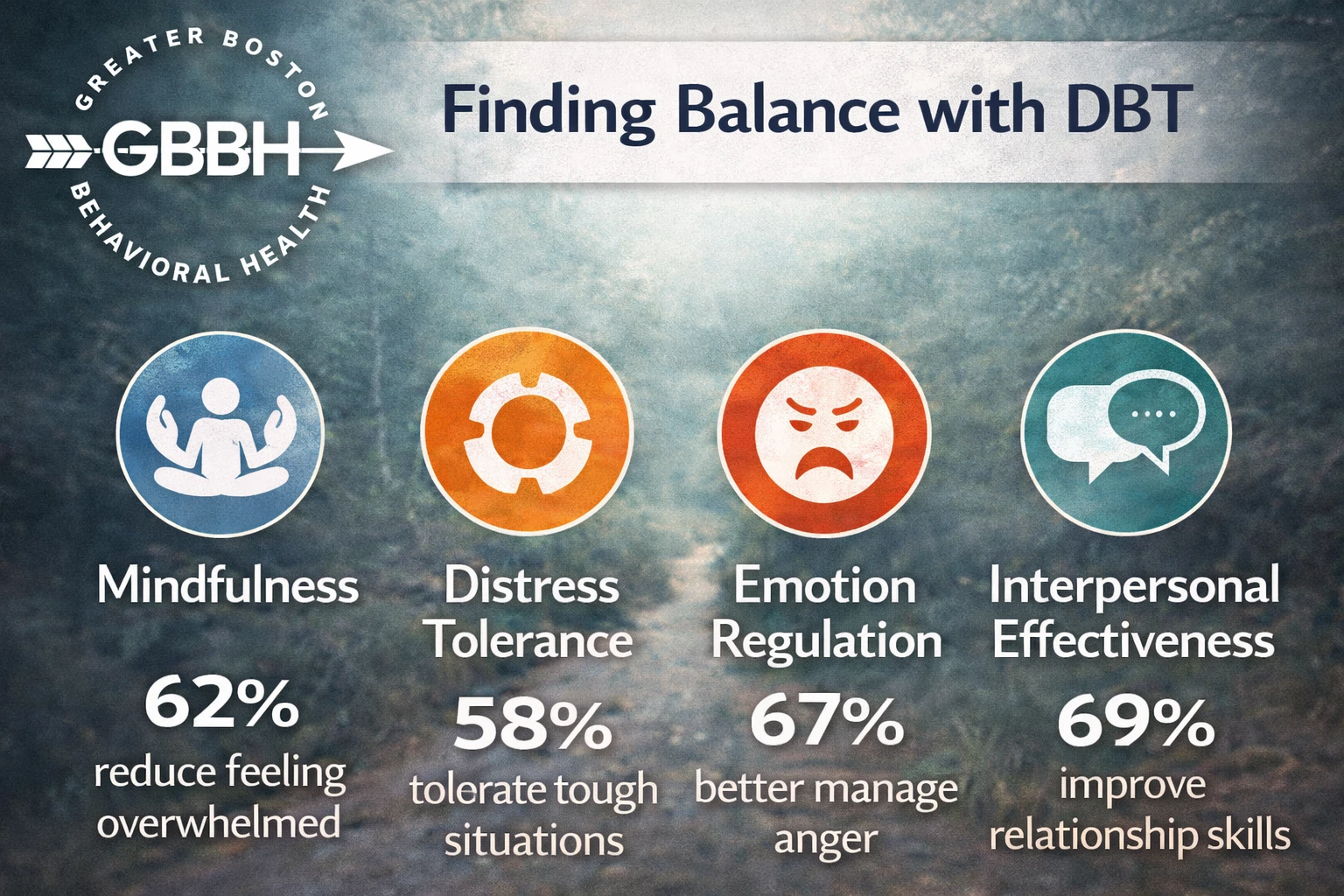
Distress Tolerance: Surviving Hard Moments Without Harm
Life brings moments that hurt. DBT doesn’t pretend difficult emotions won’t occur. Instead, it teaches you how to stay present through them without turning to coping mechanisms that make life harder (like isolation, substance use, or self‑criticism). You’ll learn:
- How to soothe your nervous system
- How to tolerate pain without adding to it
- How to accept reality without giving up
These skills act like emotional first aid—there when you need them.
Emotion Regulation: Understanding and Managing Feelings
Emotions can feel unpredictable, intense, or overwhelming. DBT helps you:
- Identify what you’re actually feeling
- Understand why those feelings show up
- Learn how to respond in ways that are helpful instead of harmful
This isn’t about making emotions disappear. It’s about giving you control over how you act in response to them.
Interpersonal Effectiveness: Connecting Without Conflict
Relationships matter, but they can also be one of the most stressful parts of life. DBT teaches communication skills that help you:
- Set healthy boundaries
- Ask for what you need
- Say “no” without guilt
- Affirm your worth while respecting others
These skills help you maintain connections without getting lost in emotional reactions.
Why DBT’s Structure Works When Other Approaches Don’t
You might have tried therapy before and felt like something was missing. Perhaps you talked for weeks without feeling much change. Or maybe you wanted tools that you could practice between sessions. DBT is different in a few key ways:
- Skills‑Focused: You learn specific tools you can use today—not concepts you’ll “understand someday.”
- Evidence‑Based: DBT has been studied extensively and shown to help with emotional dysregulation, self‑harm behaviors, anxiety, and more.
- Action‑Oriented: You don’t just talk about change. You practice it, track it, and refine it with support.
- Supportive Structure: There are individual sessions and skills groups—so you learn, practice, and integrate skills over time.
This combination helps many people feel stronger, more capable, and better equipped for life’s ups and downs.
What a Typical DBT Week Looks Like
When you start DBT, you’ll usually engage in two core components:
Individual Therapy
This is a one‑on‑one session with a clinician trained in DBT. You focus on:
- What’s most stressful right now
- How your current patterns are functioning
- What skills to apply in real time
- Progress toward personal goals
Your therapist becomes a partner in real, day‑to‑day emotional work—not a judge of how you should feel.
Skills Group Training
In a group setting, you learn DBT skills alongside others. This isn’t therapy in the traditional sense, but a learning environment where you practice:
- Mindfulness
- Distress tolerance
- Emotion regulation
- Interpersonal effectiveness
Group work normalizes your experience. You realize others wrestle with the very things you’ve been carrying alone—and that you’re not “too sensitive” or “overreactive” for wanting help.
How DBT Changes How You React to Stress
One of the quiet miracles of DBT isn’t that it eliminates stress. It’s that it changes your relationship to stress.
Instead of thinking:
“I need to get rid of this feeling before I can function,”
you learn:
“I can feel this and still do what I want with my life.”
That’s huge.
You don’t have to wait until you’re calm to take care of yourself. You learn how to take care of yourself while you’re in the fire.
Common Misconceptions About DBT
Even though DBT has been around for decades, myths still circulate. Let’s clear up a few:
Myth: DBT is only for people with severe mental health diagnoses.
Truth: While DBT was first developed for borderline personality disorder, it helps anyone struggling with emotional intensity, stressful reactions, or challenging relationships.
Myth: DBT is rigid and clinical.
Truth: DBT is highly structured, but it’s also flexible and compassionate. Skills are practical and adaptable to your unique life.
Myth: You have to be “broken” for DBT to help.
Truth: Many people come to DBT seeking growth—not crisis. It’s a tool for resilience, not just survival.
Real People, Real Change
When someone begins DBT, the shift isn’t always dramatic overnight—it’s cumulative. Small wins stack up:
- You handle a conflict without spiraling
- You notice your feelings before they push you under
- You tolerate discomfort and come out the other side
- You speak your truth without panic
These are big steps, and DBT gives you a way to practice them with intention.
FAQs About Dialectical Behavior Therapy
Is DBT only for adults?
No. DBT has been adapted for adolescents, adults, and older adults. Whatever your age, the skills can be tailored to your life stage.
How long does DBT take?
DBT programs often run for several months, with structured skills training and individual therapy. The exact length depends on your needs and progress.
Will I have homework?
Yes—DBT includes practice between sessions. This isn’t busywork; it’s how skills become second nature.
What if I don’t see progress right away?
Change takes time. DBT helps you notice small shifts—like handling a stressful moment better than before—that add up to real transformation.
Can I do DBT virtually?
Many programs offer in‑person and virtual options. What matters most is that you feel supported and connected to your clinician and group.
Starting DBT can feel like stepping into the unknown. But so many people find that after the first few weeks, that unknown becomes a place of trust, confidence, and real emotional skill. You don’t have to navigate overwhelming emotions on your own. There are tools that work. There are people who understand. And there is hope.
Call (888) 450‑3097 to learn more about our Dialectical Behavior Therapy in Boston, Massachusetts.
