


When you’re in love with someone who’s actively using, your mind becomes a battlefield.
You second-guess your instincts. You reread old messages. You panic when they don’t answer and panic more when they do. You rehearse ultimatums in your head, then walk them back. You tell yourself you’re overreacting—and then something happens that proves you’re not.
Being in this kind of relationship isn’t just painful—it’s disorienting. And sometimes the hardest part isn’t deciding what to do. It’s knowing what you actually think, feel, or believe anymore.
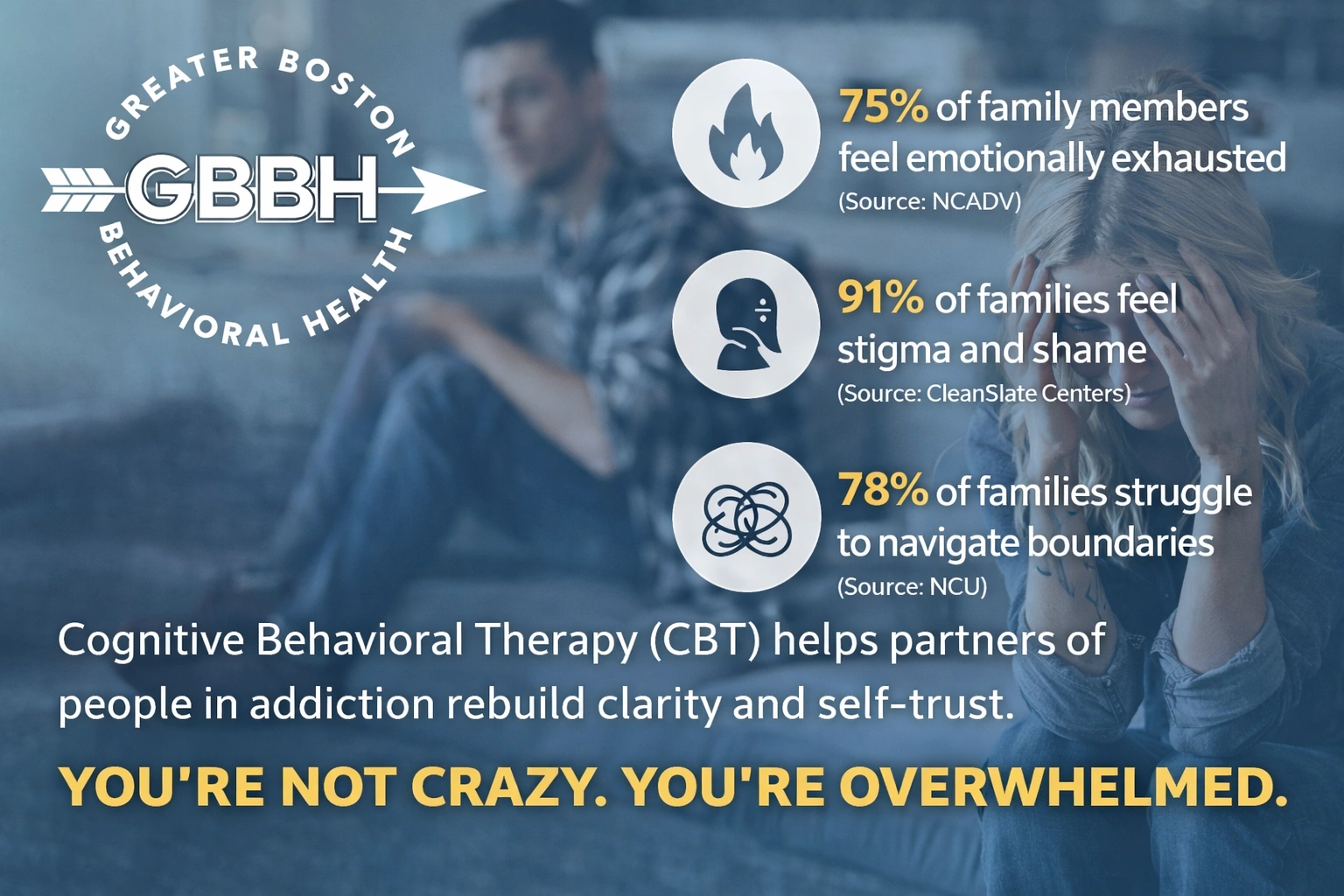
At Greater Boston Behavioral Health, we use CBT (Cognitive Behavioral Therapy) to help partners of people in addiction reconnect with their own clarity. CBT doesn’t force you to make quick decisions or pass judgment. It helps you clear the emotional fog—so you can hear your own voice again.
You’re Not Crazy. You’re Overwhelmed.
Let’s start here: it’s not all in your head.
If your partner lies, disappears, gaslights, or cycles between remorse and rage, it makes sense that your own thoughts feel like quicksand. Your brain has been running emergency protocols for months—or years.
CBT creates structure. It helps you pause and ask:
- What exactly am I thinking right now?
- Is this thought helpful, or just habitual?
- Is it based on fear—or reality?
From there, we start rewiring—not by pretending everything’s fine, but by grounding your thoughts in something more stable than emotional exhaustion.
CBT Teaches You to Separate Urgency From Truth
One of the most disorienting things about loving someone who’s using is how often everything feels urgent. Every call, every crisis, every change in tone.
You start living in reaction mode. Always a little braced. Always scanning.
CBT helps you challenge urgency. It gives you tools to assess:
- What’s real?
- What’s yours?
- What can wait?
When you can slow down your reactions, you’re more likely to make decisions that align with your values—not just your fear. And that’s how you start building a life that feels like yours again.
You Can Set Boundaries Without Losing Yourself
It sounds simple. But when you’re in love with someone in active addiction, setting a boundary can feel like abandonment—or even betrayal.
CBT helps you reframe that.
Instead of “If I say no, they’ll spiral,” you learn to think: “I can be supportive without being consumed.”
We work with clients from all walks of life—including partners in Dedham, Massachusetts—to identify boundary-setting scripts that are clear, compassionate, and sustainable. You’ll learn the difference between punishment and protection. Between distance and disconnection.
Because boundaries aren’t about pushing people away. They’re about staying close to yourself.
Guilt Isn’t a Guide—And CBT Helps You See That
The guilt hits hard:
- I should’ve known they were using again
- I promised to stay no matter what
- I can’t leave them like this
CBT helps you notice when your thinking is dominated by guilt instead of grounded in truth. We’ll help you reframe thoughts like:
“If I set a boundary, I’m selfish”
→ becomes → “If I don’t set a boundary, I’m abandoning myself.”
You don’t need to stop loving them. But you do need permission to stop disappearing inside their pain. CBT gives you that permission—and helps you keep it when things get messy.
Your Healing Doesn’t Have to Wait for Their Recovery
This might be the most important thing you read today:
You don’t have to wait for them to change in order to feel better.
You can begin healing even if they’re still using. Even if they’re in denial. Even if they say you’re the problem.
CBT is about your brain, your heart, your patterns—not theirs.
In sessions, we’ll help you rebuild mental clarity, emotional regulation, and self-trust. That might mean grieving. That might mean shifting roles in the relationship. That might mean discovering that you’re not as stuck as you thought.
You are allowed to get better—even if they don’t.
CBT Can Work Even When You’re Not Ready to Leave
Here’s what we don’t do: pressure you to leave your partner.
You might not be ready. You might still love them deeply. You might be holding out hope—and that’s okay.
CBT doesn’t demand decisions. It builds clarity so that if and when you do make a decision, it’s yours. Thought through. Emotionally grounded. And not made in the middle of a panic spiral at 2 a.m.
We’re here to help you stay steady. Whether you stay, leave, or live in the in-between.
CBT Doesn’t Just Untangle Your Thoughts—It Rebuilds Your Voice
When someone you love is struggling with addiction, your own voice often gets quieter.
You stop asking for things. You make yourself smaller. You become a crisis manager instead of a partner. You say, “I’m fine” when you’re not, because the chaos never seems to stop long enough for you to matter.
CBT helps you get your voice back.
You learn how to notice what you actually feel. How to speak with self-respect instead of fear. How to ask for what you need—not as a demand, but as a truth.
Clients from Needham, Massachusetts often share that CBT helped them remember who they were before they became a caretaker. Before their life revolved around checking their partner’s behavior for signs of danger.
And from there, they begin again.
FAQs: CBT for Partners of People in Active Addiction
Q: What is CBT, exactly?
A: CBT (Cognitive Behavioral Therapy) is a structured, evidence-based approach that helps people change unhelpful thought and behavior patterns. It’s especially helpful for people caught in chronic stress, fear, or relationship confusion.
Q: Will CBT tell me to leave my partner?
A: No. CBT doesn’t force any decisions. It helps you gain clarity so you can choose what’s right for you—without guilt, fear, or confusion making the choice for you.
Q: Can I do CBT even if my partner isn’t in treatment?
A: Yes. CBT is about your healing. You don’t need them to be in recovery for you to begin yours.
Q: I feel frozen. Will CBT still help?
A: Yes. CBT meets you where you are—even if where you are is stuck. It gives you small, repeatable tools for breaking emotional paralysis and moving forward with intention.
Q: Is CBT just about changing how I think? What about my emotions?
A: CBT doesn’t ignore emotion—it helps you hold it more gently. It gives you space to feel fully and still choose responses that protect your peace.
If your brain feels loud and your heart feels exhausted, you’re not broken—you’re in survival mode.
And you deserve support that’s just for you.
Call (888) 450-3097 to learn more about our Cognitive-Behavioral Therapy in Boston, Massachusetts. You don’t have to wait for things to get worse. You can start thinking clearly—right now.
