


There’s a particular kind of person who walks into my office and says the same thing:
“I’m fine… but not really.”
They’ve got the job. The performance reviews. The friends. The routines. They’re the ones who don’t look like they’re struggling — and every clinician already knows what that means: they’re struggling while functioning.
At first glance, Cognitive Behavioral Therapy (CBT) might seem like something you’ve already “done” — or something a grown‑up should already have mastered. But the kind of control that high‑functioning adults cling to isn’t about stability. It’s about fear. Fear that letting go of the reins means falling apart. Fear that emotions are untrustworthy. Fear that a crack in the façade is the end of the story.
That’s where CBT becomes much more than a set of techniques — it becomes a bridge from barely holding it together to actually living.
When Control Becomes a Cage
Most high‑functioning adults I meet aren’t here because they lost control. They’re here because they never stopped trying to hold it.
Their whole life has been a series of adaptations:
- Overperforming at work to avoid underlying dread
- Managing relationships so nothing ever discusses the real stuff
- Staying busy so they never have to feel
- Drinking, numbing, or distracting just enough to “function”
They describe control like oxygen — necessary to survive.
But what they don’t realize is this:
Control doesn’t protect you from pain. It just hides it where you can feel it less — until it gets louder.
CBT helps these adults understand that control is not the opposite of pain. It’s often a strategy for avoiding it.
How CBT Helps You See Your Thoughts Without Being Controlled By Them
CBT starts with an observation that feels deceptively simple:
Your thoughts influence your emotions and behaviors — not the other way around.
You might think:
- “If I can just think myself into calm, I’ll be okay.”
- “If I can just work harder, nothing bad will happen.”
- “If I just avoid feeling this, it won’t get worse.”
CBT helps you see that these assumptions may sound rational, but they’re not always true — and they can actually create suffering.
We learn to identify:
- Automatic thoughts (“I can’t handle this”)
- Core beliefs (“I must always be in control to be safe”)
- Behavioral responses (“I numb when stress spikes”)
Then we work to examine them honestly and gently.
The Myth of “Just Think Positive”
A lot of people — especially high‑achievers — assume CBT is just about being positive.
They show up thinking they’ll learn to say:
- “I am confident!”
- “I am successful!”
- “I can handle everything!”
They come looking for quick fixes or affirmations.
CBT isn’t about replacing negative thoughts with cheerful ones. That would be surface‑level, temporary, and irrelevant to actual healing.
CBT is about accuracy.
It helps you pause and ask:
- “Is this thought 100% true right now?”
- “Are there other ways to interpret this situation?”
- “What evidence do I have for or against this belief?”
This kind of nuance is exactly what high‑functioning adults need — because they already know how to think. They just don’t always know how to question the thoughts that run on autopilot.
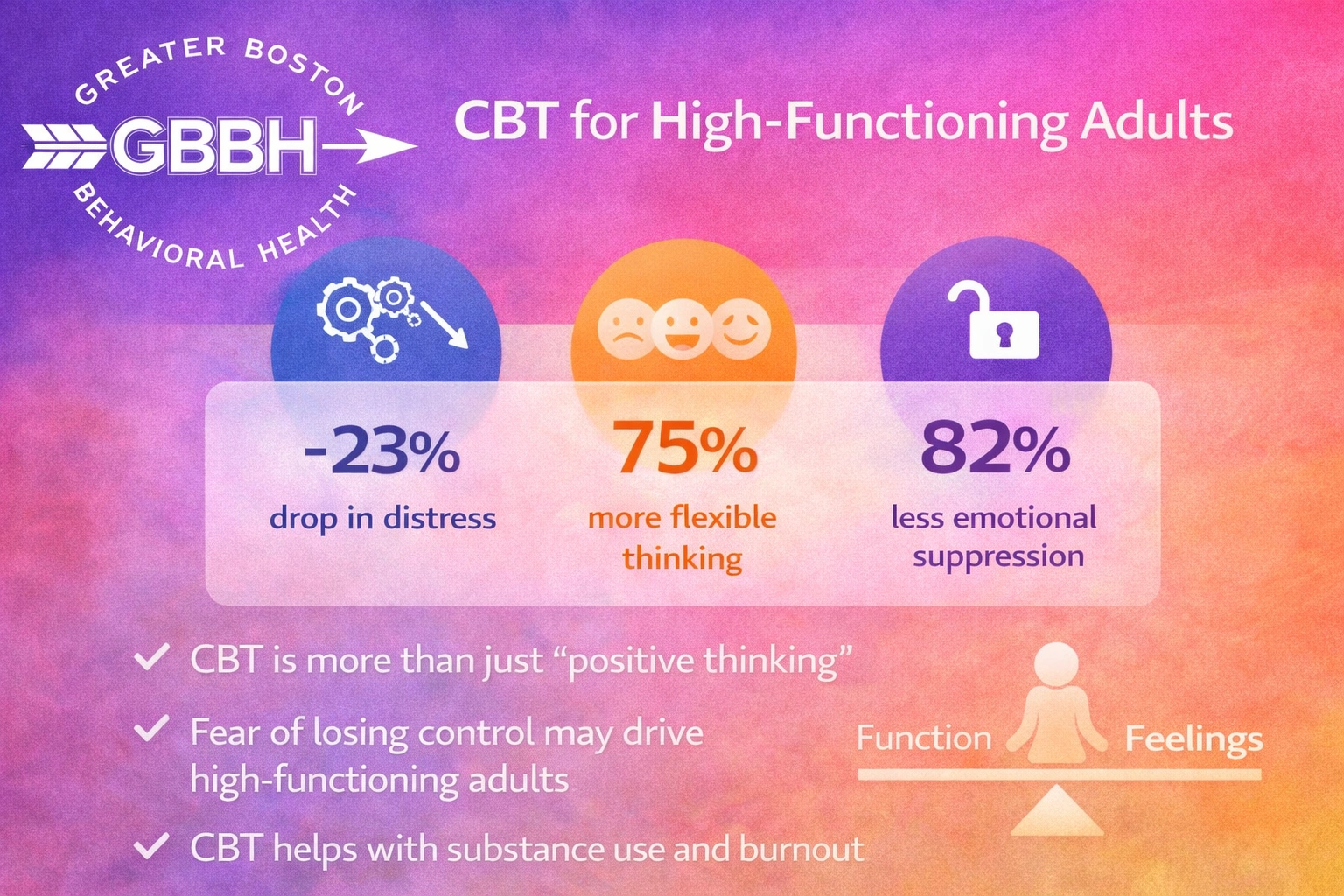
Emotional Agility Beats Emotional Suppression
One of the most common patterns I see in high‑functioning adults is suppression.
Not expression. Not regulation. Suppression.
Suppressing emotions doesn’t mean there’s nothing underneath. It means there is too much happening underneath — and no safe way to express it.
Example:
A client says, “I get annoyed so rarely that when I do, I panic — like it’s evidence of a bigger flaw.”
CBT helps reframe that panic. It teaches:
- Emotions are information, not threats
- Irritation doesn’t mean you’re broken
- You don’t need to fight your way out of every feeling
This is emotional agility — the ability to feel, interpret, and respond with intention instead of reaction.
Why High‑Functioning People Often Miss the Point of Therapy
High‑functioning people often treat therapy like a strategy session:
“What skill will fix me?”
But therapy is not a toolbox you use once and then walk out with a checklist of solved problems. It’s more like learning a new language — one you can use to understand yourself better.
CBT isn’t about:
- Being perfect
- Never feeling bad again
- Having all the answers
It’s about:
- Seeing patterns without judgment
- Testing beliefs rather than obeying them
- Learning strategies that you practice, not just memorize
And that’s a culture shock for people used to problem‑solving everything else in life.
How CBT Helps with Real Behavior Change
Here’s where CBT becomes practical:
Instead of saying:
“I shouldn’t feel this way,”
you learn to ask:
“What is happening right now — really?”
And instead of:
“I should just get over it,”
you learn:
“Let’s test this thought and see if it’s helping or hurting.”
This sounds subtle — but subtly changes everything.
You begin to:
- Notice unhelpful thinking before it snowballs
- Choose responses instead of reacting automatically
- Ease the urgency behind emotional triggers
- Understand patterns instead of being driven by them
And that’s why CBT is one of the most effective evidence‑based therapies out there — especially for people who think they should already be fine.
CBT and Substance Use: You Don’t Have to Be “Out of Control” to Need Support
Many high‑functioning adults with underlying substance use patterns don’t think of themselves as “addicted.”
They think:
- “I’m just relaxing.”
- “I don’t drink every day.”
- “I can stop anytime.”
- “I don’t have a real problem.”
But CBT looks beneath the behavior.
It looks at the why:
- Why do you reach for that drink when stress spikes?
- What thoughts lead to the first sip?
- What belief tells you that this is the best or only coping mechanism?
CBT isn’t about judgment. It’s about awareness.
And once awareness increases, choice becomes possible — even when the drive to control feels urgent.
What High‑Functioning Adults Often Misunderstand About Control
Most high‑functioning adults think:
- “If I let go of control, everything will collapse.”
- “If I don’t manage every detail, something terrible will happen.”
- “If I’m not tough, I won’t survive.”
CBT teaches something different:
Control isn’t strength. It’s the fear that strength must be constant.
Real strength isn’t holding it together. It’s:
- letting some feelings be uncomfortable
- admitting you don’t have all the answers
- practicing flexibility instead of rigidity
- responding rather than reacting
And when you start building that strength, you’re no longer defined by how well you control. You’re defined by how well you adapt.
FAQs About CBT for High‑Functioning Adults
What exactly is CBT?
CBT (Cognitive Behavioral Therapy) is a structured, evidence‑based therapy that helps you identify the links between thoughts, emotions, and behaviors — and change patterns that contribute to suffering.
Is CBT just about positive thinking?
No. CBT isn’t the same as forcing positivity. It’s about accurate thinking — learning to question assumptions instead of letting them run the show.
Do I have to be in crisis to do CBT?
Not at all. CBT helps with chronic stress, anxiety, burnout, perfectionism, substance use patterns, and emotional regulation — even when you’re still functioning well outwardly.
How long does CBT take to work?
Some people notice shifts in weeks. For others, meaningful change happens over months with consistent practice. CBT is most effective when skills are applied outside of sessions, not just talked about inside them.
Can CBT help with substance use if I’m high‑functioning?
Yes. CBT helps you understand why you use substances, what thoughts trigger use, and how to build alternative responses. It supports relapse prevention and emotional regulation.
Where can I find CBT near me?
If you’re in the Boston area and looking for evidence‑based CBT, Greater Boston Behavioral Health offers compassionate, tailored support for high‑functioning adults navigating emotional challenges.
You don’t have to control everything to finally live your life.
Call (888) 450‑3097 to learn more about our CBT services in Boston, Massachusetts. You aren’t alone — and you don’t have to figure it all out yourself.
