


For some people, anxiety feels like a condition. For others, it feels like home.
It’s the internal dialogue that narrates every moment. The reason you never forget a deadline. The way you notice everyone’s tone of voice, every unread message, every silence that lasts just a second too long.
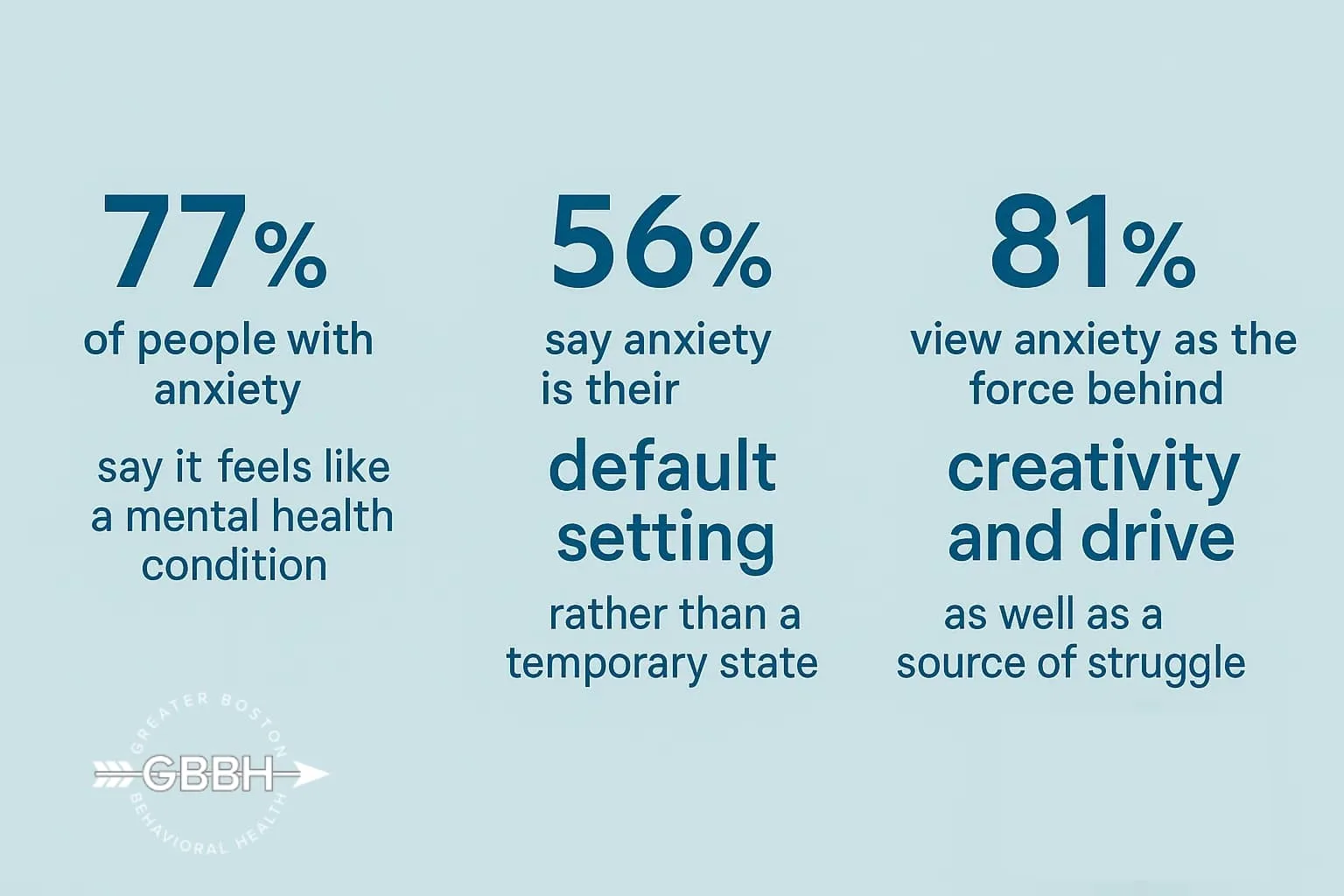
It might even be the force behind your creativity, your sensitivity, your humor, your drive.
So when someone asks if you’ve considered an anxiety treatment program, it doesn’t land like hope. It lands like threat.
“If I treat this… what’s left of me?”
At Greater Boston Behavioral Health, we understand that fear. Not everyone who seeks treatment is falling apart. Some are high-functioning, articulate, and deeply aware of their patterns—but afraid that changing those patterns might flatten them.
This blog is for you—the person who doesn’t want to lose their edge, but also can’t keep living with their mind on fire.
When Anxiety Becomes Your Default Setting
You might not remember when it started. Maybe childhood. Maybe college. Maybe the moment the world proved it could drop out from under you.
Whatever the origin, anxiety isn’t just a reaction now. It’s a rhythm.
You read people faster than they can read themselves. You edit every word in a text three times before sending. You prepare for problems before they arrive. You’re the “organized one,” the “deep thinker,” the “intense but brilliant” one.
And somewhere along the line, anxiety stopped being a burden and became a backbone.
So when someone suggests treating it, it can feel like they’re asking you to cut out your core.
But what if treatment isn’t subtraction? What if it’s permission—to keep the depth, but lose the distortion?
You Don’t Have to Suffer to Be Interesting
Let’s dismantle a myth many creatives and high-achievers carry: that the struggle is the source.
That if you’re not battling your thoughts, you won’t be sharp. That if you lose your edge, you lose your voice. That healing will sand you down into something average.
It’s not true.
Your anxiety may have taught you how to see more, feel more, produce more. But it doesn’t own those gifts. You do.
And in our anxiety treatment program in Boston, we help you separate the tools from the torment. To keep the creativity, but release the chaos. To keep the insight, but let go of the insomnia.
You don’t have to suffer to be you.
What Happens in an Anxiety Treatment Program?
Our program is designed to meet you where you are—not where others think you should be.
Here’s what you can expect:
- Structured support through intensive outpatient (IOP) or partial hospitalization (PHP) levels
- Individual therapy tailored to anxiety, overthinking, perfectionism, and self-doubt
- Group therapy with peers navigating similar identity fears and emotional intensity
- Skills training to regulate your nervous system without numbing your mind
- Optional psychiatric care to explore whether medication could reduce symptoms while preserving clarity
- Creative outlets and expressive therapies in some tracks
Whether you’re local to Dedham or Needham, our clinicians create spaces where emotional intelligence isn’t pathologized—it’s honored.
How Healing Looks for the High-Functioning Anxious Person
You might not scream in panic. You might not miss work or struggle to shower.
Instead, your anxiety might look like:
- Constant inner rehearsals of conversations
- Never feeling “caught up” no matter how much you do
- Feeling like your personality is your anxiety
- Battling imposter syndrome while excelling outwardly
- Over-intellectualizing emotions to avoid vulnerability
Sound familiar?
Anxiety treatment isn’t about making you calm and simple. It’s about giving you the option not to be in hyperdrive all the time.
Because even high-functioning people need rest. Even gifted minds need quiet. Even the “resilient” deserve relief.
You Don’t Need to Be “Worse” to Seek Help
One of anxiety’s cruelest lies is: It’s not bad enough to get help.
You might tell yourself:
- “I’m just being dramatic.”
- “Other people have it worse.”
- “I function fine—I don’t need a program.”
But functioning isn’t the same as thriving. And struggling doesn’t have to be catastrophic to be worth addressing.
In fact, the earlier you seek support, the less entrenched the patterns become.
You don’t need a breakdown to justify care. You just need a whisper of desire: I want to feel different. That’s enough.
What If I Don’t Want to Be Fixed?
That’s not what we’re here for.
We don’t see you as broken. We see you as exhausted from carrying everything alone. We’re not here to strip you down. We’re here to lighten the load.
The goal isn’t to erase your personality. It’s to help you exist within it—without it hurting so much.
When clients go through our anxiety treatment program in Boston, they often say things like:
“I didn’t know how loud it was until it got quiet.”
“I thought I’d lose myself, but I just found space.”
“I still care. I still think deeply. I just don’t live in panic about everything anymore.”
That’s what’s possible.
FAQ: Choosing an Anxiety Treatment Program When You’re Attached to Your Anxiety
Q: Will I lose my personality in treatment?
A: No. Treatment is about creating space around your anxiety—not erasing it. Many clients find they actually reconnect with parts of themselves they lost along the way.
Q: What if anxiety is part of how I get things done?
A: That’s common. We’ll help you identify where anxiety is useful versus where it’s harming you—and build alternate tools so you’re not relying solely on stress to function.
Q: Can I stay creative or high-performing without anxiety?
A: Absolutely. Many of our clients are artists, leaders, and innovators. Anxiety might have fueled your success, but treatment helps you find sustainable motivation instead.
Q: Is medication required in your program?
A: No. We offer psychiatric care as an option, not a requirement. Our approach is collaborative, and we respect your values and concerns.
Q: What if I’m not in crisis—am I still eligible?
A: Yes. Many of our clients are working professionals, students, or creatives who are functioning outwardly but struggling internally. You don’t need a crisis to start healing.
Call (888) 450-3097 or visit our Anxiety Treatment program in Boston, Massachusetts to learn more about the services we offer. Whether you’re afraid of changing, curious about what’s possible, or just done feeling hijacked by your own mind—we’re here to help.
You’re not too much. You’re not overreacting. And you don’t have to keep doing this alone.
