


You’re lying in bed, and your brain won’t stop. One small worry turns into ten. Then a hundred. Suddenly everything feels like it’s falling apart.
If you’ve seen clips of therapy online, you might think the fix is simple—just “challenge the thought” and move on. But if it were that easy, you wouldn’t still be stuck in the spiral.
Let’s talk about what’s actually going on—and what real support looks like.
In our experience, many people who struggle with this pattern eventually find relief through approaches like cognitive behavioral therapy, but not in the oversimplified way social media makes it seem.
Why Your Brain Feels So Convincing at Night
Spiraling thoughts don’t feel like guesses. They feel like warnings.
Your brain is trying to protect you. It scans for risk, fills in gaps, and assumes the worst—just in case.
That’s where catastrophic thinking anxiety shows up.
Not as a dramatic meltdown, but as a quiet, persistent voice saying: “But what if everything goes wrong?”
And at night, when distractions disappear, that voice gets louder.
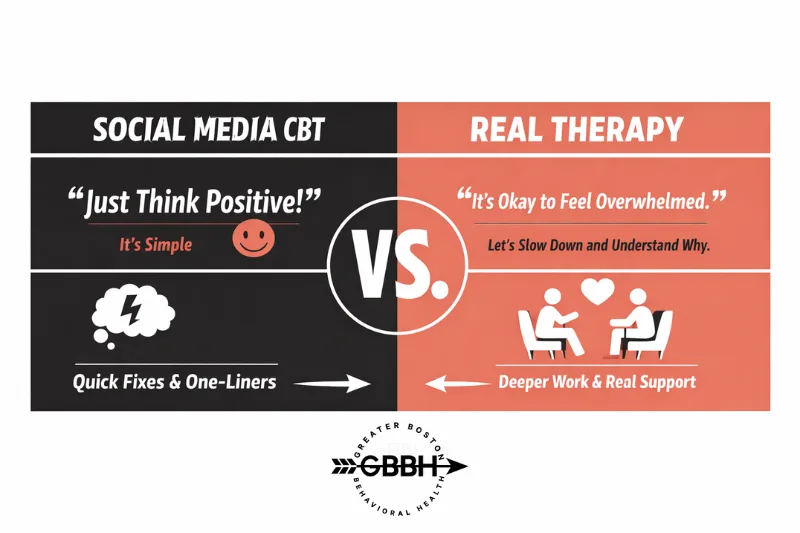
The Version of Therapy You See Online
If you’ve come across therapy content online, you’ve probably seen something like this:
- “Just reframe the thought.”
- “Replace it with a positive one.”
- “That’s not logical—think differently.”
It sounds clean. Quick. Almost mechanical.
But here’s the problem:
When your nervous system is activated, logic alone doesn’t land.
It’s like trying to argue with a smoke alarm that’s already going off.
What Real Therapy Actually Feels Like
Real therapy doesn’t rush to fix your thoughts.
It slows everything down first.
Instead of jumping straight to “that’s irrational,” we might explore:
- What triggered the spiral
- What your body felt in that moment
- What that thought is trying to protect you from
Because underneath most spirals is something real—fear, uncertainty, pressure, or even exhaustion.
You’re not “overreacting.”
Your system is overwhelmed.
It’s Not About Forcing Positive Thinking
One of the biggest misconceptions is that therapy replaces negative thoughts with positive ones.
That’s not the goal.
Real cognitive work helps you:
- Notice the thought without immediately believing it
- Create a little space between you and the spiral
- Respond instead of react
Sometimes the shift is small.
From “This will definitely happen” to “This feels real, but I’m not sure it is.”
That space matters more than forced positivity ever will.
Why It Takes More Than a One-Liner
If you’ve tried “just think differently” and it didn’t work, that doesn’t mean you failed.
It means the approach was incomplete.
Real therapy is:
- Repetitive (in a helpful way)
- Personalized to how your mind works
- Grounded in practice, not just insight
It’s less like flipping a switch…
and more like learning how to steady yourself in a storm.
A Different Way to Experience Your Thoughts
There’s a moment that happens for many people in therapy.
The thought still shows up—but it doesn’t take over.
It passes through instead of pulling you under.
That moment doesn’t come from forcing yourself to “be positive.”
It comes from understanding your mind well enough to not fear it.
And that’s a very different kind of relief.
You Don’t Have to Keep Fighting Your Own Mind
If your thoughts feel loud, constant, or exhausting, there is a way to change how you experience them.
Not by shutting them off.
But by learning how to move through them without getting stuck.
If you’re ready to explore what that could look like, Call (888) 450-3097 or visit our cbt services in Greater Boston to learn more.
