


A lot of people imagine sitting in a chair, talking about feelings, and leaving.
There is therapy but there’s also something more grounding: structure.
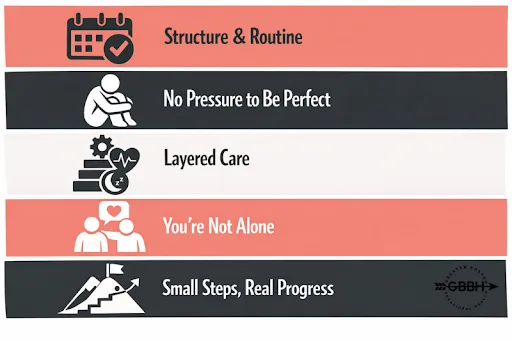
Your days begin to have shape again. You show up at a set time. You’re met by people who already understand what you’re carrying. There’s rhythm to it like someone gently helping you rebuild a routine your mind has been too tired to hold.
And that structure? It often becomes the first real relief.
If you’re curious how that looks in practice, you can explore our structured depression care options early on.
You’re Not Expected to “Perform” Recovery
A quiet fear many people carry:
What if I don’t do it right?
There’s no script you have to follow here.
Some days you’ll talk. Some days you won’t have the words. Some days you’ll feel hopeful—and others, completely flat. All of that is allowed.
We don’t expect you to be fixed, positive, or even fully open right away.
We expect you to show up as you are. That’s enough to start.
Care Happens in Layers—Not All at Once
Instead of everything hitting you at once, support tends to unfold in layers.
- One part might focus on understanding your thoughts
- Another helps regulate your sleep or energy
- Another helps you reconnect with daily life—slowly, realistically
Think of it less like a single solution and more like a team working on different pieces of the same weight you’ve been carrying.
Nothing is rushed. Nothing is forced.
You’ll Meet People Who Actually Get It
Depression can be incredibly isolating. Even in a crowded room, it can feel like no one really understands.
Then something shifts.
You hear someone describe a feeling you thought only existed in your head.
You realize you’re not the only one struggling to get through a morning.
That moment—“Oh… it’s not just me”—can be quietly life-changing.
Healing doesn’t only come from professionals.
It often comes from being seen.
Small Wins Start to Matter Again
At first, progress might feel invisible.
But then:
- You get out of bed a little earlier
- You respond to a message you’ve been avoiding
- You laugh—and it surprises you
These aren’t small things. They’re signals.
Recovery doesn’t usually arrive all at once. It builds in moments that seem almost too subtle to notice—until one day, you realize you’re carrying things differently.
It Helps You Rebuild a Life—Not Just Reduce Symptoms
This is where people are often surprised.
Yes, support helps with symptoms.
But more importantly, it helps you reconnect with yourself.
What you care about.
What drains you.
What still feels possible.
It’s not about becoming someone new.
It’s about finding your way back to someone familiar.
You Don’t Have to Be Sure—Just Willing
You don’t need to have everything figured out before you start.
You don’t need confidence.
You don’t need certainty.
You just need a small opening—
a willingness to try something different than what you’ve been carrying alone.
That’s where most people begin.
A Quiet Reminder Before You Decide
If part of you is still unsure, that’s okay.
Most people who walk through our doors feel the same way at first—nervous, uncertain, quietly hopeful.
And many of them later say the same thing:
“I wish I had done this sooner.”
Ready to Take the First Step?
You don’t have to commit to everything today—just the next step.
Call (888) 450-3097 or explore our depression treatment program services to learn more about your options.
We’re here to meet you exactly where you are.
