


You ghosted. You dropped out. You stopped showing up.
Maybe it was midweek, mid-session, or mid-sentence. Maybe you swore you’d be back next Monday but never made the call. Maybe you shut it all down because it felt like nothing was working—or because everything inside you felt like too much.
Now you’re sitting in the space between then and now, wondering how to trust yourself again.
If this is you, start here: you’re not too far gone. Trust isn’t built on perfection. It’s built on repair. And yes, you’re allowed to rebuild—even if you walked away, even if you don’t know where to begin.
At Greater Boston Behavioral Health, we’ve worked with dozens of clients who thought they “blew it.” The truth? Quitting intensive outpatient doesn’t mean you’re broken. It usually means something overwhelmed you—and now you’re ready to look at it differently.
Here’s how to start again by rebuilding the most important relationship you have: the one with yourself.
1. Own What Happened—Without Judging It
Before you can trust yourself again, you need to get honest about what really happened when you left.
Did you leave because you were burned out?
Did something trigger you and you didn’t feel safe?
Did you tell yourself “this isn’t working” as a way to protect yourself from trying and failing?
None of those reasons make you weak. They make you human.
And here’s the deal: trust doesn’t grow from pretending. It grows from honesty. The more clearly you can name what happened—without spin, without shame—the more clearly you can move forward.
2. Identify What You Were Learning Before You Quit
You might think quitting IOP means you lost all the progress you made. Not true.
Even if you didn’t complete the program, there are things you did learn, feel, or glimpse:
- Maybe it was one coping skill that helped on your hardest days
- Maybe it was a therapist’s question that’s still echoing in your mind
- Maybe it was realizing for the first time that your story mattered
These things don’t go away just because you left early. They’re still in you—and they can be part of the foundation you rebuild from.
We once had a client return months after leaving and say, “I didn’t get everything the first time, but I got something. And that something is why I’m back.” That’s what trust sounds like.
3. Rebuilding Starts With Small Daily Acts
When you don’t trust yourself, it’s tempting to make grand declarations:
- “I’m really going to stick with it this time.”
- “I’ll show up for everything, no matter what.”
- “I won’t screw this up again.”
But trust isn’t built in declarations. It’s built in consistency—the quiet kind.
Brush your teeth. Drink a glass of water. Make your bed. Tell yourself the truth once a day.
These might sound trivial. But they’re not. Every small follow-through proves to your brain: I can count on myself to do one thing at a time.
And that’s how we rebuild: not with dramatic comebacks—but with steady re-entry.
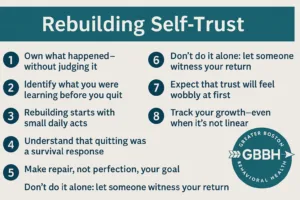
4. Understand That Quitting Was a Survival Response
Before you beat yourself up again, hear this:
Ghosting a program, skipping a session, disappearing for a while—those are often survival responses, not acts of sabotage.
When your nervous system is overwhelmed, when trauma is flaring, when the emotional work feels too raw—your brain might scream: Just leave. Go quiet. Shut it all down.
And that’s exactly what happened. You protected yourself the only way you knew how.
Now? You can learn a new way to stay—one that doesn’t mean ignoring your limits or overriding your fear, but one that lets you hold both truth and tenderness in the same hand.
5. Make Repair, Not Perfection, Your Goal
Most people think self-trust is about never messing up.
It’s not.
Self-trust is about knowing that when you do fall off, you’ll come back. That you’ll notice. That you’ll repair. That you won’t ghost yourself forever.
Maybe you return to group. Maybe you text your old therapist. Maybe you journal through a day instead of numbing out.
That’s repair. And it’s the foundation of self-trust.
6. Don’t Do It Alone: Let Someone Witness Your Return
One of the most healing things you can do is let someone else see you coming back.
Not for approval. Not for praise. But for proof—that you are not alone, that you are still worth showing up for.
If you’re looking for an intensive outpatient program in Waltham, MA or nearby, we’ll walk with you. Quietly. Gently. No shame attached.
You don’t need a perfect explanation or a five-step plan. You just need a moment of courage. We’ll meet you there.
7. Expect That Trust Will Feel Wobbly at First
It might feel weird to try again. You might second-guess every step.
You’ll wonder:
- “Can I really commit this time?”
- “Will they take me back?”
- “What if I leave again?”
That’s okay. Wobbly steps still count.
One client told us, “I didn’t believe in myself, but I believed that I didn’t want to keep feeling stuck. That was enough.”
You don’t have to believe all the way. You just have to believe enough to take the next step.
8. Track Your Growth—Even When It’s Not Linear
Recovery isn’t a straight line. It’s messy. It loops. It doubles back. It pauses.
But you are growing. Even when you feel like you’re not.
- The fact that you’re reading this? Growth.
- The fact that you’re considering coming back? Growth.
- The fact that you feel anything about what happened? Growth.
Write it down. Say it out loud. Give yourself credit. That’s how trust grows—one honest reflection at a time.
FAQ: Quitting and Rebuilding After IOP
Is it normal to feel ashamed after quitting?
Yes—and also unnecessary. Shame is common, but it doesn’t mean you’re bad. It just means you care. That’s a good sign.
Can I rejoin IOP even if I ghosted?
Absolutely. You are not banned, judged, or disqualified. We welcome clients back all the time—quietly, respectfully, and without pressure.
What if I need something different this time?
That’s fair. Maybe a lighter schedule. Maybe one-on-one sessions. Maybe more trauma-informed support. Let’s talk about what works for you.
Do I have to explain everything to come back?
Nope. You can say as much or as little as you want. You don’t owe anyone a perfect story. We’re more interested in how you’re doing right now.
What if I relapse again after rejoining?
You’re still worthy of support. Relapse is part of many people’s healing arc. We won’t shame you. We’ll help you reset and keep going.
Ready to try again—on your own terms?
Call (888) 450-3097 or visit our intensive outpatient program services in Boston, Massachusetts. Whether you’re coming from Boston, Dedham, Needham, or somewhere nearby, we’re here to help you do that work safely, supportively, and without judgment. We’re here to support you—without shame, pressure, or judgment.
