

There was the version of me that showed up.
And there was the version that almost didn’t make it.
From the outside, I was fine—functioning, responsible, quick to make people laugh. Inside, though? I was a storm. Quiet but constant. Managing my emotions like they were radioactive. Hiding behaviors I couldn’t control. Wondering how long I could keep up the act.
DBT didn’t fix everything overnight. But it gave me something better: the tools to stop splitting myself in two and start living like a whole person.
I Didn’t “Look Sick,” So I Didn’t Think I Deserved Help
That’s the trick about being high-functioning. You keep your job, show up for your family, hit deadlines—and you convince yourself you’re fine.
I wasn’t fine.
I was coping with everything—stress, shame, grief, boredom—by numbing and escaping in private. Drinking more than I admitted. Isolating emotionally. Feeling like a fraud no matter how much I achieved.
But I had no language for that pain, and even less tolerance for admitting it.
The first time someone suggested I try DBT, I actually laughed. “Isn’t that for people with, like, major issues?”
Spoiler: It is. And I had them.
What Living Two Lives Looked Like for Me
I’d wake up, show up, perform.
Smile. Work. Respond.
But at night, I’d shut the door and just… fall apart. My behaviors weren’t always dramatic—but they were compulsive. The wine bottle emptied too quickly. The scrolling never stopped. I said yes to things I hated just to avoid conflict. I couldn’t feel proud of anything I did because I was terrified people would find out who I “really” was.
It wasn’t that I didn’t want to be healthy. I just didn’t know how to stop needing two versions of myself to survive.
What Made DBT Different
Most advice I got boiled down to “calm down,” “be grateful,” or “just set boundaries.”
Which sounds nice—until your nervous system doesn’t know how.
Dialectical Behavior Therapy met me where I actually was: burned out, emotionally dysregulated, and ashamed to admit it.
The program I joined at Greater Boston Behavioral Health didn’t just give me therapy—it gave me structure, validation, and a sense of not being the only one. Which was a first.
Here’s what I learned:
Emotional Regulation
I used to think emotions were problems to solve. DBT helped me learn how to feel without spiraling or numbing. How to pause instead of panic.
Distress Tolerance
I learned how to survive discomfort without self-destructing. Sounds dramatic, but honestly? Learning to sit with a bad feeling for five minutes instead of reacting saved my life more than once.
Interpersonal Effectiveness
I stopped ghosting people, stopped faking agreement just to avoid tension. I learned how to say, “This matters to me,” without thinking I had to prove why.
Mindfulness
Mindfulness wasn’t about breathing or sitting still. For me, it was about noticing I was dissociating—mid-meeting, mid-dinner—and gently calling myself back.
The Moment It Shifted for Me
There was one group session where someone said, “I’m exhausted from performing okay-ness.”
Everyone nodded. So did I.
That was the first time I realized I wasn’t broken—I was just over-practiced at pretending.
I didn’t need to become someone new. I needed help becoming someone whole.
What DBT Gave Me That Other Therapies Didn’t
Other forms of therapy helped me talk about my past.
DBT helped me deal with my present.
Every skill I learned was practical. Specific. Repeatable. I could practice it at work, at home, in traffic, at 2am when the walls felt too loud.
And because the program was based in Boston, I didn’t have to go far. I could live my life and still show up for the care I needed. (If you’re local, I’d recommend checking out Greater Boston Behavioral Health’s DBT program. They get it.)
If You’re Still Living Two Lives, You’re Not Alone
You don’t have to be in crisis to be in pain.
You can be high-achieving and deeply unhappy. You can meet deadlines and still dread every morning. You can be loved and still feel alone in your own head.
If any of that feels familiar, I want you to know: you’re not weak, broken, or failing. You’re tired. And you deserve rest—not shame.
For me, DBT wasn’t about fixing what was wrong. It was about learning how to live with all of myself—not just the parts I thought were acceptable.
And that changed everything.
FAQ: DBT for High-Functioning Adults
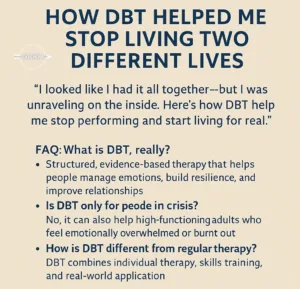
What is DBT, really?
Dialectical Behavior Therapy is a structured, evidence-based therapy that helps people manage emotions, build resilience, and improve relationships. Originally developed for borderline personality disorder, it’s now used for a wide range of mental health challenges—including emotional dysregulation, anxiety, trauma responses, and more.
Is DBT only for people in crisis?
Not at all. DBT is incredibly useful for high-functioning individuals who feel emotionally overwhelmed, burnt out, or stuck in patterns they can’t seem to change. You don’t have to be in crisis to benefit from the skills DBT teaches.
How is DBT different from regular therapy?
DBT combines individual therapy, skills training, and real-world application. It focuses on both accepting yourself and changing behaviors that cause suffering. It’s especially effective if you’ve tried talk therapy but still struggle with emotional regulation or relationships.
What kind of support is available in Boston?
Greater Boston Behavioral Health offers a structured DBT program right here in Massachusetts. Whether you’re exploring outpatient options or need something more intensive, their DBT clinicians can help you find the right level of care. And for those in Needham, Waltham, Newton, or West Roxbury, we have nearby locations to make care accessible.
How do I know if DBT is right for me?
If you:
- Feel like your emotions run the show behind the scenes
- Struggle with setting or keeping boundaries
- Live with quiet anxiety, burnout, or hidden shame
- Perform well publicly but fall apart privately
…then DBT might be the support you’ve been missing.
Ready to stop performing and start healing?
Call (888) 450-3097 or visit Greater Boston Behavioral Health’s DBT program page to learn more about our DBT services in Boston, Massachusetts. You don’t have to live two lives anymore.
