

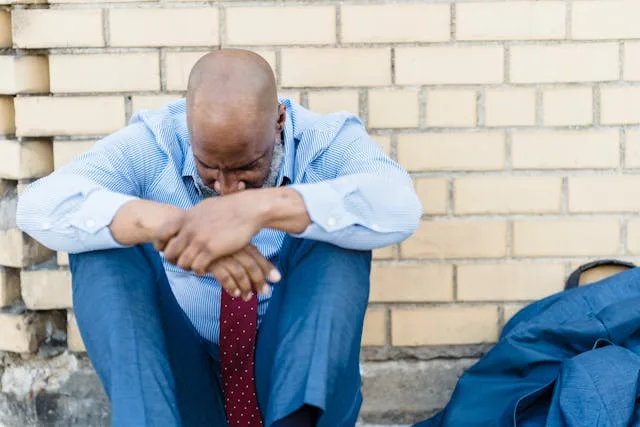
You went through the treatment. You showed up—even on the days you didn’t want to. You practiced grounding skills, explored your triggers, maybe even cried in front of strangers. And for a while, it helped.
But now, the holidays are here, and suddenly your chest feels tight again. Sleep is restless. Social plans feel like traps. Old worries are back like they never left. And part of you is quietly asking:
“Did the anxiety treatment program even work?”
This feeling—like you’re somehow back at square one—can be demoralizing. But let’s get one thing clear: it’s not a sign of failure. It’s a sign that anxiety doesn’t disappear just because you checked the “treatment complete” box.
At Greater Boston Behavioral Health, we work with clients in Boston and surrounding areas like Newton and Dedham who face this exact situation: post-treatment and suddenly unraveling again. And we’re here to say, this doesn’t mean you’re broken.
Post-Treatment Anxiety Is Real—And It’s More Common Than You Think
Let’s bust a myth right away: finishing an anxiety treatment program doesn’t mean you’ll never feel anxious again.
Anxiety isn’t something you cure—it’s something you learn to live with differently. And during certain seasons (like the holidays), your brain and body might slip into old patterns. That’s not regression. That’s reality.
What you’re feeling isn’t proof that treatment didn’t work. It’s a signal. And signals deserve attention—not shame.
Why the Holidays Hit Different—Even When You’re Doing “Better”
Anxiety feeds off unpredictability, overstimulation, and emotional baggage. The holidays have all three.
You may be dealing with:
- Overloaded social calendars that drain your energy
- Family dynamics that feel like landmines
- Financial pressures that raise your baseline stress
- Travel disruptions that throw off your routine
- Memories—some joyful, some painful—that rise whether you’re ready or not
It’s a perfect storm. And even if your day-to-day anxiety was manageable in September, December can feel like stepping back into a version of yourself you thought you’d outgrown.
You Didn’t Imagine Your Progress. The Holidays Just Push Harder.
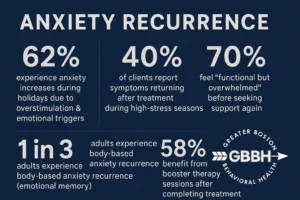
There’s a cruel trick the brain plays: when symptoms come back, it erases the memory of how far you’ve come.
But anxiety recovery isn’t linear. It’s cyclical. And it often revisits old terrain to show you what’s still healing.
That doesn’t mean you failed. It means your system is under new pressure—and what once worked may need to evolve.
That’s where post-treatment care comes in.
The Myth of “One-and-Done” Mental Health
We don’t expect people to go to the gym for six weeks and stay fit for life.
We don’t tell people to take antibiotics once and never get sick again.
So why do we expect anxiety treatment to be permanent after one round?
Mental health care isn’t a product—it’s a process. It adapts to new life phases, new stressors, and new awareness. If the holidays are pushing you harder than expected, it might be time to reconnect with care—not because you’re back at zero, but because you’re at a new layer.
What Does Ongoing Support Actually Look Like?
You don’t need to start over. In fact, we rarely recommend that. But reconnecting with support—especially during intense seasons—can make a major difference.
At Greater Boston Behavioral Health, we offer flexible follow-up care, including:
- Short-term therapy refreshers to recalibrate your tools
- Holiday-specific group therapy for boundary setting, grief, and social stress
- Seasonal anxiety intensives if symptoms spike fast
- Local options for Needham, Dedham, Waltham and other Boston suburbs
This kind of support isn’t about starting over—it’s about strengthening what you already built.
The Body Remembers What the Mind Wants to Move On From
You might be frustrated that you’re triggered again by your mother’s comment about your life choices, or by that one cousin who never stops talking over you.
But here’s what we know as clinicians: emotional memory lives in the body. The body holds tension, even when your conscious brain says “let it go.”
Holiday environments often replicate the very conditions that shaped your anxiety. So if your shoulders are creeping up to your ears again—it’s not regression. It’s memory.
And it’s okay to need support as those old signals come back online.
What Clients Tell Us (And What We Tell Them Back)
“I was so proud to finish treatment, and now I feel like I can’t even breathe through dinner with my in-laws. I hate that this is happening again.”
— Alumni Client, 2023
We hear this all the time. And here’s what we say back:
You haven’t undone anything. You’re just being asked to use your skills in a more intense environment. And you don’t have to do it alone.
Coming back for support doesn’t erase your progress—it builds on it.
Quick Reminders for the Treatment Skeptic
Let’s speak plainly. You might be thinking:
- “I shouldn’t still need help.” → You’re allowed to.
- “I already did the work.” → This is part of it.
- “I can’t face going back—it’s embarrassing.” → We get it. But we’ll meet you without judgment.
Therapy isn’t a diploma. It’s a relationship. One you can come back to when life demands more from you than usual.
Frequently Asked Questions About Post-Treatment Anxiety
Is it normal for anxiety to come back during the holidays?
Yes. The holidays are high-stress for most people, but especially for those with a history of anxiety. Increased obligations, emotional triggers, and even seasonal affective issues can all contribute.
Do I need to redo my entire anxiety treatment program?
Not at all. We often recommend a few “booster” sessions or a short-term check-in plan. The goal is to reinforce—not restart—your coping strategies.
What if I feel ashamed that I need help again?
Shame thrives in isolation. Needing support again is not a moral failure—it’s a sign of awareness. It means you’re paying attention to your needs instead of pushing them down.
How quickly can I get back into care?
At Greater Boston Behavioral Health, we prioritize returning clients and those experiencing seasonal spikes. Many times, we can reconnect you within a week. If you’re looking for an anxiety treatment program in Newton, MA, we have options close to home.
Your Anxiety Doesn’t Invalidate Your Progress—It Just Reminds You That You’re Human
There’s no finish line in healing. Only checkpoints, deepening insight, and more chances to come home to yourself.
If the holidays are stirring up old symptoms, that’s not your fault. And it’s not a sign that your work didn’t matter. It’s just a sign that you’ve reached another opportunity to deepen your support.
You’ve done this before. You can do it again. And this time, you don’t have to do it in silence.
Ready for Support That Meets You Where You Are?
Call (888) 450-3097 or visit our Anxiety Treatment Program page to learn more about services in Boston, Massachusetts. Whether it’s your first session or a follow-up call—we’re here when life asks for more than coping alone.
