


There are moments when a parent realizes something deeper is wrong.
Maybe your son stopped answering texts. Maybe your daughter hasn’t left her room in days. Maybe the person who used to laugh easily now looks tired all the time.
When depression takes hold in young adulthood, life can feel like it’s quietly falling apart. The good news is that stability can be rebuilt often step by step with the right kind of support.
For many families, structured care like a depression treatment program becomes the turning point where things begin to shift.
When Depression Starts Disrupting Everyday Life
Depression in young adults rarely shows up all at once.
Instead, parents often notice small changes that slowly grow heavier:
- College classes suddenly feel impossible
- Sleep patterns flip upside down
- Social withdrawal becomes the norm
- Motivation disappears
- Basic routines – eating, showering, leaving the house feels overwhelming
What can look like “laziness” or avoidance is often something much more painful: a brain and nervous system that feel stuck in survival mode.
Young adults frequently describe it like trying to walk through deep water while everyone else moves freely on land.
Why Structure Matters More Than Motivation
One of the hardest parts of depression is that it steals the very energy someone needs to get better.
Waiting for motivation rarely works.
What helps more is gentle structure.
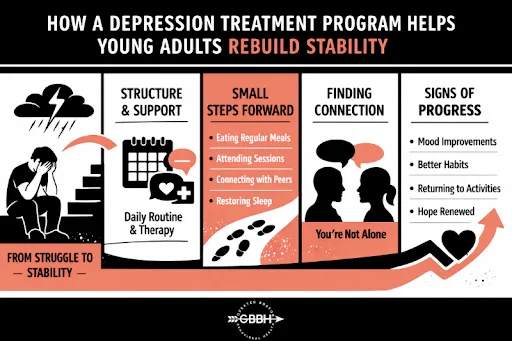
Structured mental health care creates a steady rhythm to the week regular therapy, skill-building sessions, peer support, and clinical guidance. That rhythm becomes a scaffold when someone’s internal stability is fragile.
Instead of expecting a young adult to “figure it out,” support is already built into the day.
Over time, that structure helps the brain relearn patterns of stability.
Rebuilding Small Pieces of Life
Recovery for young adults rarely begins with huge breakthroughs.
It usually starts much smaller.
A client might begin by:
- Showing up three days in a row
- Eating a full meal
- Talking honestly in therapy for the first time
- Sleeping through the night
- Reaching out to a friend again
These moments might seem ordinary from the outside.
But for someone in a depressive spiral, they are real progress.
Stability grows through repetition of these small wins.
The Power of Not Feeling Alone
Young adults often believe they are the only person struggling this way.
Group therapy gently breaks that illusion.
When someone hears another person say, “I thought I was the only one who felt like this,” something shifts.
Shame loosens its grip.
Connection starts to replace isolation.
And for many young adults, that moment realizing they are not broken or alone becomes a quiet turning point.
What Progress Often Looks Like (From a Clinician’s Perspective)
As clinicians, we rarely look for instant transformation.
Instead, we watch for signs that stability is returning:
- Mood swings becoming less extreme
- More consistent sleep and eating patterns
- Re-engagement with school or work
- Healthier ways to cope with stress
- A future that starts to feel possible again
These changes don’t happen overnight.
But when the right supports are in place, the trajectory often begins to shift.
A Story We See Again and Again
Many parents arrive feeling terrified.
They worry their child will never get back on track.
Yet we regularly see young adults who seemed completely stuck begin to rebuild their lives over time. Classes resume. Friendships return. Confidence grows slowly but steadily.
One parent once told us something that stayed with me:
“It wasn’t one big change. It was watching my child slowly come back to themselves.”
That’s often what healing looks like.
Not a sudden fix but a gradual return.
When Parents Start to Feel Hope Again
If your young adult is struggling, you’re not alone in feeling frightened or unsure what to do next.
Structured care like a depression treatment program can provide the stability, guidance, and community many young adults need to regain their footing.
Sometimes the most important step isn’t having all the answers.
It’s simply reaching out.
Call (888) 450-3097 or explore our depression treatment program services to learn how Greater Boston Behavioral Health supports young adults rebuilding stability and hope.
