


Sometimes people do the hardest part, they reach out for help and then walk away thinking, “That didn’t do anything.”
If that’s where you are right now, you’re not alone. Many people come to us after trying support elsewhere and feeling disappointed. And before anything else, we want to say something simple: that experience is real, and it deserves to be taken seriously.
If you’re reconsidering options, you can learn more about our approach to support for anxiety and depression and how care can look different the second time around.
When “It Didn’t Work” Is Actually a Common Experience
A lot of people assume that if therapy or structured support didn’t change things the first time, it means the whole idea is flawed.
But mental health support isn’t a single method. It’s more like trying different keys for the same locked door.
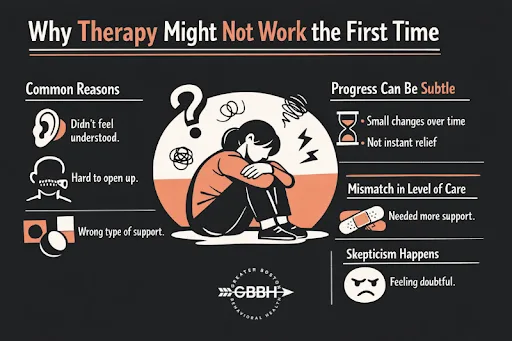
Some people leave early because they didn’t feel understood.
Others attend sessions for weeks but never feel safe enough to open up fully.
And sometimes the structure simply wasn’t the right fit for what they were dealing with.
None of those outcomes mean you failed. They often mean the match wasn’t right yet.
The Quiet Truth: Progress Doesn’t Always Feel Dramatic
Movies make healing look like a breakthrough moment. One powerful conversation, and everything changes.
Real life is rarely that neat.
Sometimes progress looks like:
- Sleeping slightly better
- Catching anxious thoughts sooner
- Having one calm afternoon instead of none
Those shifts can be subtle enough that people miss them entirely. Especially when they were hoping for immediate relief.
One former client once described it this way:
“I thought nothing was happening… until I realized I hadn’t had a panic spiral in two weeks.”
Why the Right Environment Matters More Than People Expect
Support programs differ widely in structure and intensity.
For some people, a weekly conversation simply isn’t enough support when their thoughts are racing daily. Others benefit from environments where they can work on things several days each week and build momentum.
When the level of care doesn’t match the level of distress, people often leave believing nothing works, when in reality the structure just wasn’t strong enough.
It’s like trying to fix a deep injury with a bandage.
Skepticism Is a Reasonable Response
If you’ve tried before and felt disappointed, skepticism makes sense.
Many people who eventually improve arrive with the same mindset:
“I’m only here because someone convinced me to try one more time.”
They’re not optimistic.
They’re not inspired.
They’re just willing to see if something might be different.
And surprisingly often, that’s enough to begin.
Real Change Usually Starts With One Honest Conversation
Not a speech. Not a dramatic commitment.
Just one honest conversation where someone says something like:
“I tried getting help before, and it didn’t do much.”
That moment matters more than people realize. It gives clinicians a clearer picture of what didn’t work and what might need to change this time.
Because when care is adjusted to the person, not the other way around, things can start to shift.
What People Often Discover the Second Time
People who try support again after a disappointing experience often say the same thing later:
Not that the process became easy.
But that it finally felt relevant.
The conversations made sense.
The structure matched their daily struggles.
And the work started connecting to their real life, not just the therapy room.
Sometimes the difference isn’t trying harder.
Sometimes it’s simply trying somewhere that listens differently.
If you once walked away feeling like nothing helped, you’re not alone and your experience matters.
Call (888) 450-3097 or visit our page about Anxiety Treatment to learn more about our services at Greater Boston Behavioral Health.
