


You’ve done everything a parent is supposed to do.
You’ve set boundaries. You’ve backed off. You’ve leaned in. You’ve cried in the car. You’ve stayed up refreshing their location. You’ve paid for therapy. You’ve cleaned up messes.
And still—your child is struggling.
Maybe they’re 20 now, technically an adult, and you’re watching them spiral. Again. Maybe it’s not full-blown relapse—but it’s familiar enough to twist your stomach.
If you’re here, you’re probably looking for something that isn’t just “more therapy.” You want something that helps them actually move through whatever’s underneath this.
That’s where EMDR comes in.
Not a magic wand. But not talk therapy as usual, either.
It’s one of the most requested services we offer at Greater Boston Behavioral Health. And for a lot of families who feel stuck, it’s the beginning of something new.
EMDR Helps the Brain Heal—Without Needing to Rehash Every Detail
EMDR stands for Eye Movement Desensitization and Reprocessing. But don’t let the long name intimidate you.
Here’s what matters:
It’s a type of therapy designed to help people process difficult memories, thoughts, and beliefs that are “stuck”—memories that feel like they’re still happening, or that keep getting triggered in daily life.
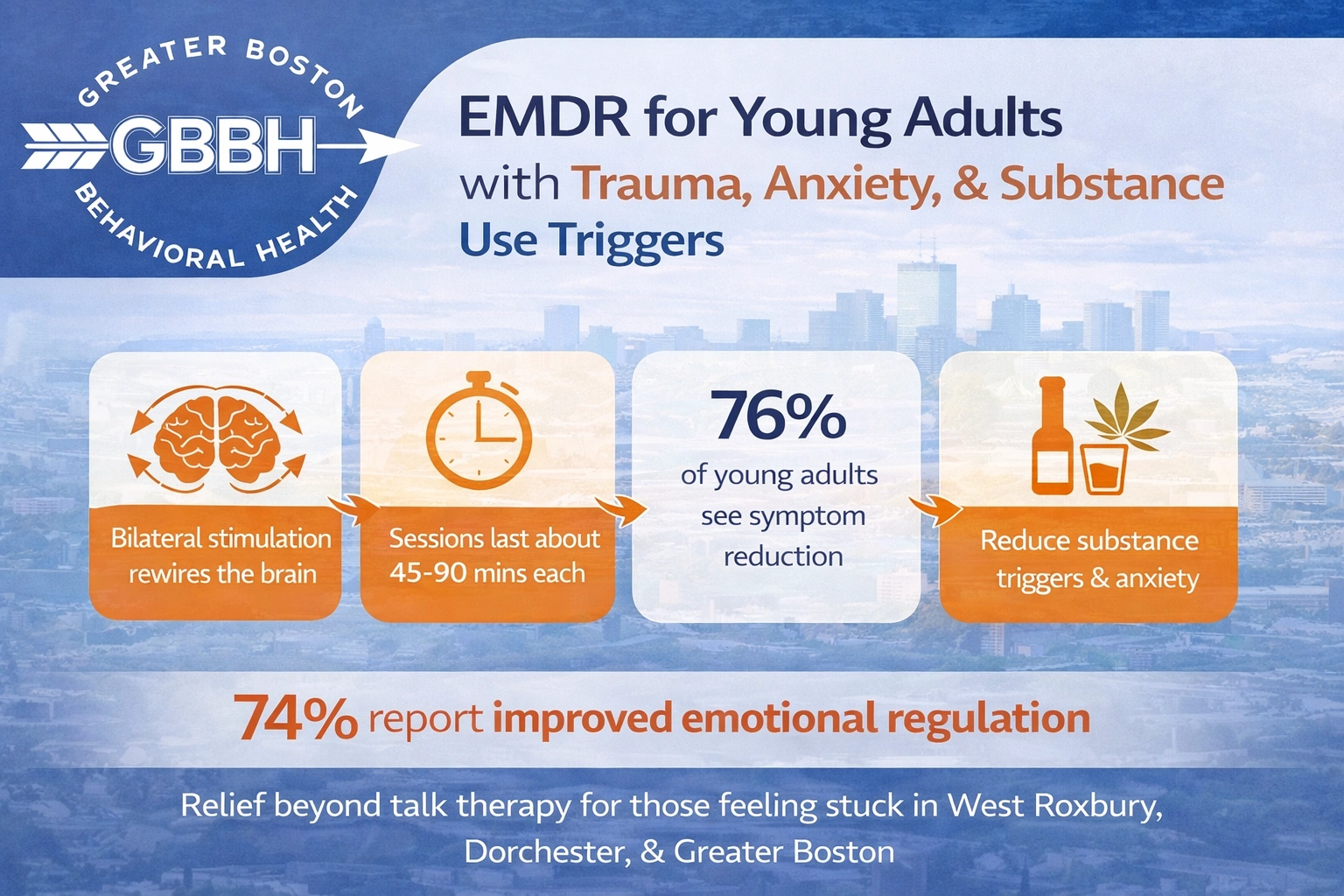
EMDR uses bilateral stimulation (like guided eye movements, tapping, or tones alternating left and right) to help the brain reprocess these memories in a more adaptive way. This lets the nervous system finally move out of crisis mode.
The goal? Keep the memory. Lose the panic. Reclaim peace.
Why EMDR Helps When Talk Therapy Isn’t Enough
You may have tried therapy before. Your child may have nodded through sessions, said “fine” when asked about feelings, and left unchanged.
That’s not your fault. And it’s not theirs either.
Sometimes, trauma doesn’t respond well to words. Especially if:
- Your child can’t explain what’s wrong
- They shut down when asked about the past
- Talking about things makes symptoms worse
- They don’t trust easily—or are too numb to feel anything
- They’re using substances to cope with feelings they don’t understand
EMDR bypasses the need to explain everything.
It works with the brain’s wiring—not just logic or language.
How EMDR Works (In Human Terms)
Think of your brain like a filing system.
When something painful happens, your brain is supposed to store it in a “past” folder. But sometimes—especially during trauma—the file doesn’t get stored correctly. Instead, it floats, open and raw. Your body keeps reacting like the danger is still present.
EMDR helps move that file where it belongs.
Here’s a simplified breakdown of the process:
- Identify the target. A memory, feeling, or belief that’s causing distress.
- Set up the session. Use a technique like eye movement or tapping while briefly recalling the experience.
- Let the brain process. Clients follow the sensations, images, or emotions that arise—without getting stuck in them.
- Reprocess and replace. Over time, the brain naturally shifts how it stores that memory. We also help install positive beliefs in its place.
Your child doesn’t have to relive every second. They don’t have to share every detail out loud. They just have to be willing to engage—and we meet them gently from there.
EMDR Is Built for the Kind of Pain That Doesn’t Have Words
What I tell parents is this:
If your child has ever said something like:
- “I don’t want to talk about it.”
- “It’s not that big of a deal.”
- “I don’t remember exactly what happened.”
- “I feel numb all the time.”
- “Why can’t I just move on?”
…they might benefit from EMDR.
We see this a lot in young adults with trauma, anxiety, substance use, or mood swings that seem to come out of nowhere. EMDR can’t solve everything—but it often helps unlock the part of healing that regular therapy alone can’t reach.
What an EMDR Session Looks Like
Each EMDR session is tailored to the person. But the rhythm usually includes:
- Grounding and resourcing. We don’t go straight into trauma. First, we build safety.
- Target selection. Together, we identify what’s causing distress—this could be a memory, belief, or physical feeling.
- Desensitization. While guided through bilateral stimulation, your child focuses on that target briefly, then reports what comes up.
- Reprocessing. Their brain begins to shift how it relates to the experience.
- Closure and stabilization. We always end by helping them return to calm.
Sessions are deeply structured. We never push someone into a memory they’re not ready for. The client sets the pace. We provide the safety net.
EMDR Isn’t Just for Trauma Survivors
Yes, EMDR was first used with trauma and PTSD. But today, it’s used for much more.
At Greater Boston Behavioral Health, we use EMDR for:
- Childhood trauma
- Emotional neglect
- Sexual abuse or assault
- Panic attacks
- Shame-based patterns
- Anxiety and compulsive behaviors
- Substance use triggers
- Low self-worth and chronic self-criticism
- Loss, grief, or ambiguous trauma
Many of our EMDR clients don’t have “a big trauma.” But their nervous systems are still reacting like something bad is about to happen. That’s what we work with.
Is EMDR Right for Your Family?
Here’s how we talk about it with parents:
If your child…
- Has been to therapy but still feels stuck
- Gets overwhelmed or emotionally numb
- Avoids certain places, people, or feelings
- Uses substances to avoid emotional pain
- Reacts intensely to seemingly minor things
- Has unprocessed grief, trauma, or shame
…then EMDR is worth exploring.
We work with many families looking for EMDR in West Roxbury, MA or Dorchester, MA as well. If you’re near Boston and your child needs a different path into healing—this might be it.
Parents Need Healing, Too
We can’t leave this part out.
Watching your child suffer can be traumatic in itself. It’s common for parents to come in for their child and realize they’ve been carrying years of grief, fear, guilt, and helplessness.
That’s valid. And you deserve support, too.
Many parents begin EMDR themselves—to work through:
- Sleepless nights
- Emotional numbness
- Trauma from past crises
- Feeling like “a bad parent”
- Long-term anxiety that’s become their normal
Getting support doesn’t mean you’ve failed them. It means you’re showing them what healing looks like.
FAQs About EMDR for Parents
Does EMDR involve hypnosis?
No. EMDR is not hypnosis. The client is awake and fully aware during the entire session. They remain in control and can stop at any time.
How long does EMDR take to work?
Some clients experience relief after a few sessions. Others take longer, depending on the complexity of their history. EMDR is often part of a broader treatment plan, not a one-time fix.
Is it safe for teens or young adults?
Yes. EMDR is safe and effective for adolescents and young adults. We tailor the approach to match their developmental stage and emotional capacity.
Do I need to do EMDR with my child?
No. EMDR is typically an individual therapy. That said, parents can pursue their own EMDR treatment if needed—and it often benefits the whole family dynamic.
Will my child have to talk about everything?
No. That’s one of the benefits of EMDR. They don’t have to narrate every memory or share every detail with the therapist. The healing happens in their brain, not just their words.
You don’t have to know exactly what’s wrong to start exploring what’s possible.
Call (888) 450-3097 to learn more about EMDR services in Boston, Massachusetts. Your family’s pain matters. So does your hope.
