


You wake up exhausted, even after a full night’s sleep.
You answer emails. You show up for your family. You get through meetings. From the outside, you look functional.
But inside, you feel like you’re disappearing.
If you’ve been carrying depression quietly for a long time, you may not just want symptom relief. You may want your energy back. Your personality back. Your ability to feel something other than numbness.
At Greater Boston Behavioral Health’s depression treatment program, we focus on emotional recovery — not just helping you manage the day, but helping you reconnect with yourself in a real and lasting way.
For individuals and families in Dedham, Massachusetts and Needham, Massachusetts, that kind of deeper support can make the difference between surviving and slowly coming back to life.
It’s Not Just Sadness. It’s Emotional Burnout.
When people think of depression, they often picture visible sadness. Crying. Staying in bed. Obvious despair.
But for many emotionally exhausted adults, depression feels different.
It feels like:
- Moving through your day on autopilot
- Cancelling plans because everything feels like too much effort
- Feeling detached during conversations
- Irritability that surprises you
- Forgetting what it feels like to look forward to something
It’s less dramatic than crisis. But it’s heavier in a quieter way.
Emotional burnout can feel like carrying an invisible weight that never comes off. Even joy feels muted. Even rest doesn’t restore you.
Over time, you might start to wonder:
“Is this just who I am now?”
We want to say clearly — no.
That exhaustion is not your personality. It’s untreated emotional strain.
Why Symptom Management Isn’t Enough
Many people come to us after trying to “push through.” They’ve tried self-help strategies. They may have started medication. They’ve told themselves to be grateful, to try harder, to stay busy.
And sometimes those steps help — temporarily.
But depression often runs deeper than surface-level symptoms.
It can be rooted in:
- Years of chronic stress without true recovery
- Unprocessed grief
- Caretaking roles that left you last on your own list
- Burnout from high-functioning perfectionism
- Life transitions that quietly shook your identity
If treatment only aims to improve sleep, reduce tearfulness, or increase productivity, something important can get missed.
You are not just a checklist of symptoms.
Emotional recovery asks different questions:
- What happened to you?
- What have you been carrying alone?
- What parts of yourself went quiet in order to survive?
Real healing happens when we create space for those answers.
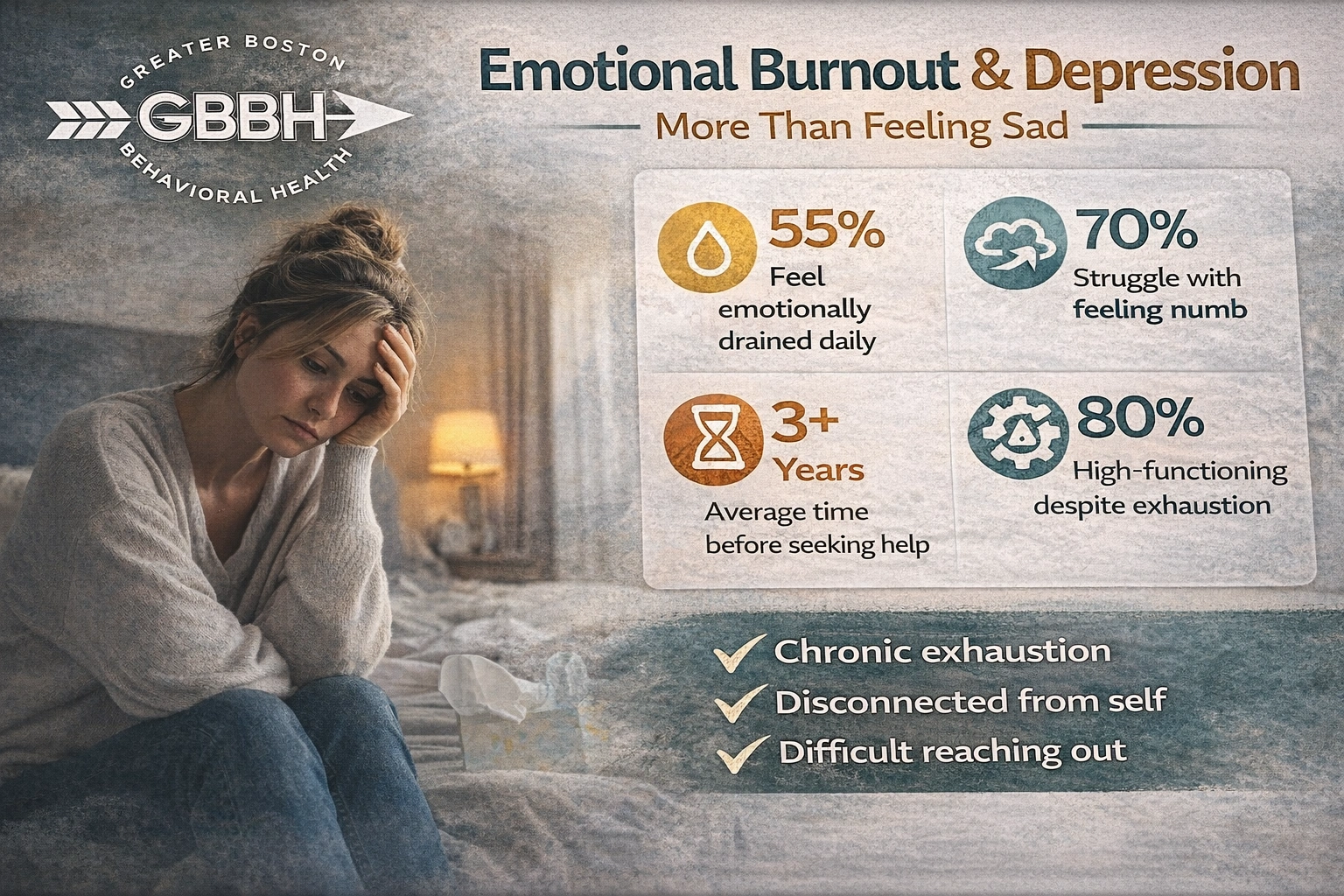
Emotional Recovery Means Feeling Again — Safely
For someone who’s emotionally exhausted, the idea of “feeling more” can sound terrifying.
You may already feel overwhelmed. Or worse, you may feel nothing at all.
Emotional recovery doesn’t mean flooding you with intensity. It means gently, gradually restoring access to your emotional range — at a pace that feels safe.
That might look like:
- Recognizing anger instead of immediately suppressing it
- Allowing sadness without judging yourself
- Rebuilding trust in your own reactions
- Learning how to regulate stress instead of bracing against it
Sometimes, the first sign of healing is subtle. A client laughs unexpectedly during group therapy. Someone notices they stayed present in a difficult conversation. Another person realizes they felt genuinely connected for a moment.
Those small shifts matter.
They are signs that your nervous system is softening. That you’re no longer operating in constant survival mode.
The Power Of Structure When You’re Running On Empty
When you’re emotionally burned out, even small decisions feel exhausting.
What should I cook?
Should I answer that call?
Can I handle one more responsibility?
Structured therapeutic support removes some of that mental load.
A consistent weekly rhythm of therapy sessions, group support, and clinical guidance creates predictability. Predictability creates safety. And safety allows your brain and body to rest.
In a depression treatment program, structure isn’t about control. It’s about containment.
It offers:
- A set time to process what you’ve been holding in
- A place where you don’t have to perform
- Clinical insight that helps make sense of your internal patterns
- Community that reduces isolation
When you stop carrying everything alone, your emotional system finally has room to breathe.
You Don’t Have To Fall Apart To Deserve Help
One of the most damaging myths about depression is that you must hit a breaking point before seeking treatment.
You don’t.
Many of the people we work with are high-functioning. They are professionals. Parents. Caregivers. Students. Leaders.
They are not in crisis.
They are simply tired.
Tired of pretending.
Tired of pushing through.
Tired of feeling flat and disconnected.
If you are waking up each day feeling like you’re bracing for impact, that’s enough.
If you’re starting to feel emotionally distant from the people you love, that’s enough.
If you don’t recognize yourself anymore, that’s enough.
You deserve support before everything unravels.
What Healing Actually Feels Like (And What It Doesn’t)
Healing is rarely dramatic.
It’s not usually a single breakthrough session where everything clicks. It’s slower and steadier than that.
Recovery often looks like:
- Waking up with slightly more energy than last month
- Catching a negative thought and choosing not to believe it
- Feeling present during dinner instead of checked out
- Having a difficult day — but not spiraling
It’s color returning gradually to a faded photograph.
At first, you barely notice the change. Then one day, you realize you laughed without forcing it. You felt hopeful without talking yourself into it.
That’s emotional recovery.
It’s not about becoming a different person.
It’s about returning to yourself.
Frequently Asked Questions
How Do I Know If I Need More Than Weekly Therapy?
If you feel stuck despite ongoing therapy, or if your emotional exhaustion is interfering with daily functioning, a more structured level of care may provide the consistency and depth needed to create momentum.
This doesn’t mean you’ve failed. It simply means your nervous system may need more support right now.
Will I Have To Share Everything In Group Therapy?
No. Emotional recovery works best when you feel safe. Participation is encouraged, but you are never forced to disclose before you’re ready.
Often, hearing others speak honestly about similar struggles reduces shame and isolation long before you share your own story.
What If I’ve Tried Treatment Before And It Didn’t Help?
Not all treatment experiences are the same.
Sometimes timing matters. Sometimes the therapeutic approach wasn’t aligned with your needs. Sometimes you weren’t emotionally ready.
If previous support didn’t feel helpful, that doesn’t mean you’re beyond help. It may mean you need a different environment, pace, or level of structure.
Can I Continue Working While Receiving Care?
Many people do. Structured programs are designed to support individuals who are balancing responsibilities while prioritizing their mental health.
Your treatment plan can be discussed in a way that honors both your need for recovery and your real-life obligations.
Is It Normal To Feel Numb Instead Of Sad?
Yes. Emotional numbness is a common response to prolonged stress or depression. It’s often a protective mechanism.
Numbness doesn’t mean you don’t care. It means your system has been overloaded for a long time.
Healing helps restore your emotional range without overwhelming you.
What If I’m Afraid To Hope Again?
That fear makes sense.
When you’ve been disappointed — by yourself, by circumstances, or even by previous treatment — hope can feel risky.
In our work, we don’t demand optimism. We create space for cautious possibility. Hope is rebuilt slowly, through experience — not pressure.
You don’t have to keep living in emotional survival mode.
If you’re tired of pretending you’re okay, tired of pushing through exhaustion that doesn’t go away, and tired of feeling disconnected from yourself, there is another way forward.
Call (888) 450-3097 to learn more about our depression treatment program in Boston, Massachusetts.
