


Sometimes the hardest part of starting therapy isn’t the fear of talking—it’s the fear that once you start, something inside you won’t stop.
If you’ve been researching EMDR and feeling curious, cautious, or quietly hopeful, that makes sense. Many first-time treatment seekers arrive knowing something is happening in their body or mind—but not fully understanding why insight alone hasn’t fixed it yet. EMDR isn’t mysterious once you understand what it’s actually designed to do.
For many people, learning how EMDR Therapy works offers relief before the first session even begins.
EMDR Was Designed for Experiences the Brain Never Finished Processing
EMDR exists because the brain sometimes gets interrupted mid-job.
Under normal conditions, stressful experiences are processed during sleep, rest, and emotional regulation. The memory is stored. The nervous system stands down. Life continues.
But when something overwhelms the system—trauma, loss, chronic stress, sudden fear—that process can stall.
The memory doesn’t disappear. It stays active. And it keeps sending signals long after the danger is gone.
EMDR is designed to help the brain complete that unfinished work.
Why “Knowing Better” Doesn’t Always Stop the Reaction
Many people come into treatment frustrated with themselves.
They know the trauma is over. They know they’re safe. They’ve talked it through. They’ve analyzed it. And yet their body reacts anyway.
That’s not weakness. It’s neurology.
Trauma is stored in networks that operate faster than logic. EMDR works directly with those networks instead of trying to talk over them.
Think of it this way: insight speaks to the mind. EMDR speaks to the system underneath it.
What EMDR Is Doing Inside the Brain During Processing
EMDR uses bilateral stimulation—often eye movements, taps, or tones—to activate both sides of the brain.
This mimics the brain’s natural processing rhythm, similar to what happens during REM sleep.
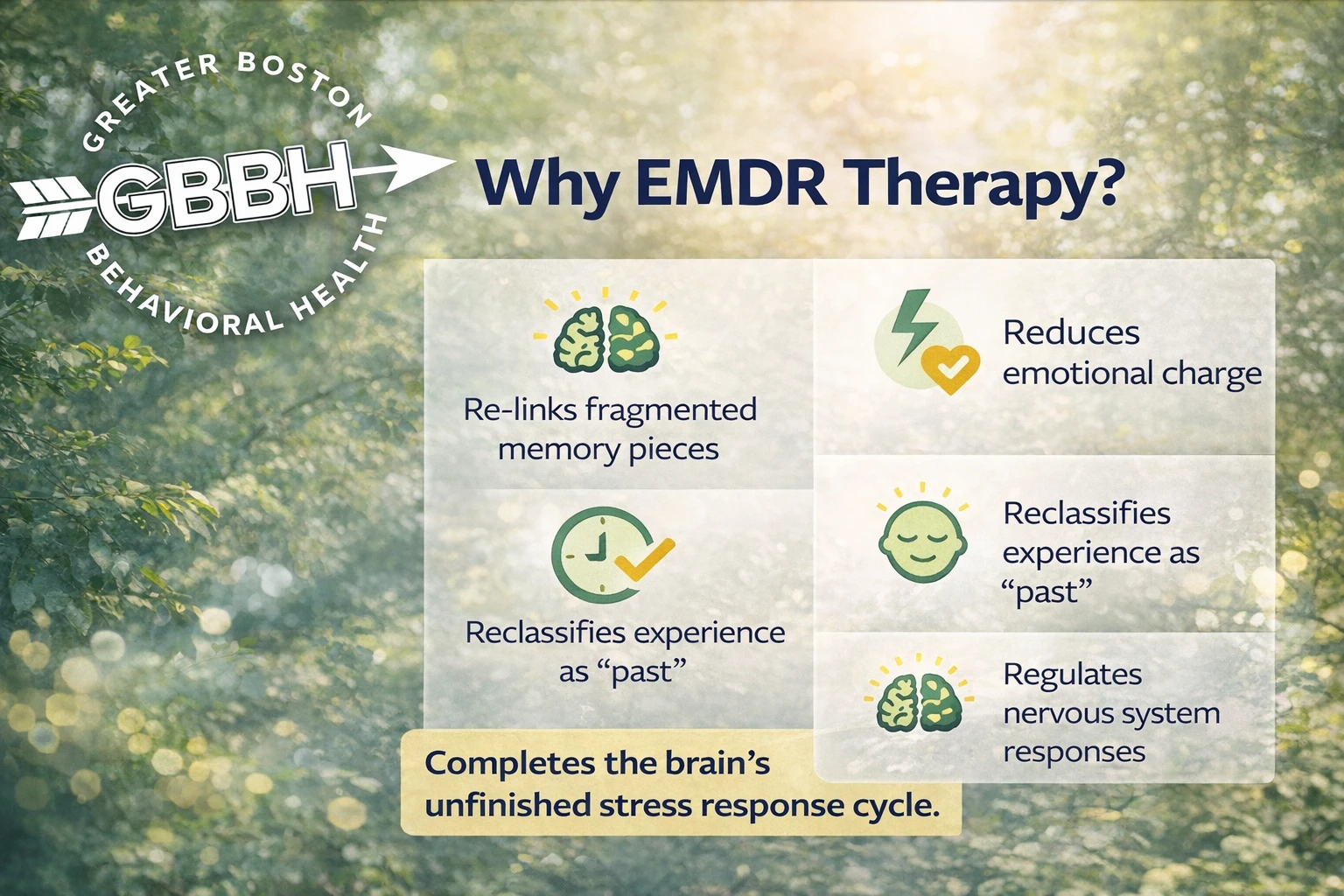
When this happens, the brain can:
- Re-link fragmented memory pieces
- Reduce emotional charge
- Reclassify the experience as “past”
- Integrate new, safer information
The memory doesn’t vanish. But it stops behaving like it’s happening right now.
That shift alone can change everything.
EMDR Works With the Body Because Trauma Lives There Too
Trauma isn’t just remembered—it’s held.
People often come to EMDR because their symptoms don’t make sense logically:
- Sudden panic
- Tight chest
- Numbness
- Irritability
- Shutdown
- Chronic vigilance
These aren’t character flaws. They’re survival responses.
EMDR allows the nervous system to release patterns it no longer needs. As processing unfolds, the body often responds first—breathing slows, muscles loosen, posture changes.
Many clients notice something subtle but powerful: their body stops bracing before they consciously feel “better.”
That’s regulation returning.
EMDR Is Structured to Keep You Grounded, Not Overwhelmed
A common fear is that EMDR will force someone to relive trauma.
That’s not how it’s designed.
EMDR maintains one foot firmly in the present. You’re not asked to retell everything or stay in distress longer than your system can tolerate.
Processing happens in brief sets, with frequent grounding and orientation to safety.
A useful metaphor: EMDR doesn’t throw you back into the fire. It helps your nervous system realize the fire is already out.
What Changes When EMDR Starts Doing Its Job
The changes are rarely dramatic at first.
They’re quieter. More internal.
People often notice:
- Less reactivity to triggers
- Fewer intrusive thoughts
- Improved sleep
- Increased emotional space
- A sense of distance from old pain
One client described it as, “The memory stopped leaning forward.”
That’s EMDR doing exactly what it was designed to do.
Why EMDR Helps When Other Therapies Felt Incomplete
This doesn’t mean other therapy failed.
It means it worked at a different level.
Talk therapy helps you understand meaning, context, and patterns. EMDR helps resolve the physiological imprint that talk alone can’t always reach.
EMDR is especially helpful for people who:
- Feel stuck despite insight
- Experience physical symptoms tied to stress
- React in ways that feel disproportionate
- Know the past is influencing the present but can’t stop it
At Greater Boston Behavioral Health, EMDR is integrated thoughtfully—never rushed, never isolated from support.
Where EMDR Fits Into a Broader Healing Process
EMDR isn’t a shortcut. It’s a targeted tool.
It works best when paired with:
- Stabilization
- Emotional safety
- Skilled guidance
- Ongoing support
For individuals receiving care in Waltham, Massachusetts, EMDR often becomes a turning point—not because it changes who they are, but because it allows their system to finally exhale.
Others beginning therapy in Wellesley, Massachusetts describe EMDR as the moment their body started believing what their mind already knew.
What EMDR Is Not Trying to Do
EMDR is not designed to:
- Erase memories
- Force emotional breakdowns
- Push you faster than you’re ready
- Replace all other therapy
It’s designed to help your brain complete what stress interrupted.
Healing isn’t about rewriting your story.
It’s about letting your nervous system stop guarding it.
For the First-Time Treatment Seeker
If you’re reading this and feeling both hopeful and unsure, that’s normal.
EMDR doesn’t require you to be “ready” in a perfect way. It meets you where your system is now.
Sometimes the most powerful shift isn’t emotional release—it’s relief.
And that’s often where healing begins.
Frequently Asked Questions About EMDR
Does EMDR work if I don’t remember everything clearly?
Yes. EMDR does not require detailed memory recall. The brain can process sensations, emotions, and fragments without a full narrative.
Will EMDR make me relive my trauma?
No. EMDR is designed to prevent flooding. Processing occurs in controlled, tolerable segments with grounding throughout.
How many EMDR sessions are needed?
It varies. Some people notice change within a few sessions, while others benefit from longer integration. There’s no forced timeline.
Can EMDR help with anxiety or depression?
Yes. EMDR is often used when anxiety or depression is linked to unresolved stress or trauma stored in the nervous system.
What if EMDR feels intense?
Intensity is monitored carefully. A skilled clinician adjusts pacing so your system stays regulated, not overwhelmed.
Is EMDR evidence-based?
Yes. EMDR is widely recognized as an evidence-based treatment for trauma and related conditions.
Ready to Learn More?
If you’re curious whether EMDR could help you feel more grounded, supported care matters. Call (888) 450-3097 to learn more about our EMDR Therapy in Boston, Massachusetts.
