


You’re getting everything done. Deadlines met. Bills paid. Family responsibilities handled.
But the truth is quieter than that.
If you’ve been holding your life together while leaning harder and harder on alcohol or drugs, you’re not alone—and you’re not the only one who’s exhausted by the act.
Some people discover real change when they step into structured support like the care described in this guide to recovery options in Boston. But before that decision happens, there’s usually a long stretch of silent struggle.
Let’s talk about that part.
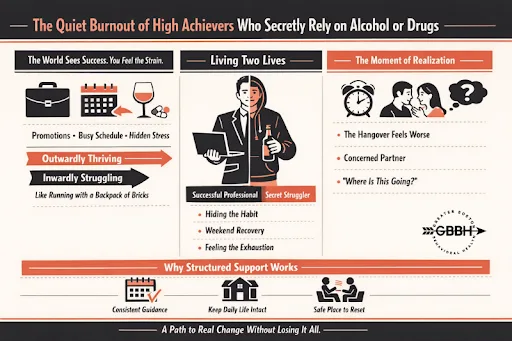
The World Sees Success. You Feel the Strain.
High-functioning addiction hides in plain sight.
From the outside, everything looks stable. Promotions. A busy calendar. A full life.
Inside, it often feels like running a marathon while carrying a secret backpack full of bricks.
The drink at night becomes two.
The pills that helped you focus start to feel necessary just to get through the day.
Weekends quietly revolve around recovering from the week.
No one calls it a problem because nothing has “collapsed.”
But something inside you knows the balance is getting harder to maintain.
The Exhaustion of Living Two Lives
Most high-achieving people struggling with substances aren’t reckless.
They’re controlled. Strategic. Careful.
That’s part of why the problem lasts so long.
You manage the optics:
- You never miss work.
- You keep up appearances socially.
- You promise yourself tomorrow will be different.
But maintaining two identities—the capable professional and the private struggler—takes energy.
Eventually the pressure builds.
Not because you’re weak.
Because no one can carry that much tension forever.
The Moment People Realize Something Has to Change
For many people, there isn’t a dramatic rock-bottom moment.
Instead, it’s a quiet realization.
A Tuesday morning when the hangover feels heavier than usual.
A conversation with your partner where you suddenly hear concern in their voice.
Or the unsettling thought:
“If I keep going like this, where does it end?”
That moment doesn’t mean your life is ruined.
It usually means your awareness is catching up to reality.
And awareness is where real change begins.
Why Structure Helps High-Functioning People Reset
People who are used to managing their lives rarely respond well to chaos.
They respond to structure.
That’s why many professionals and parents do well in programs that offer consistent weekly support while allowing them to keep their responsibilities.
In settings like an intensive outpatient program, people continue working, caring for families, and living at home while receiving focused therapeutic support several days each week.
Instead of blowing up your life to fix the problem, the goal is learning how to rebuild stability within it.
For high-functioning people, that balance often makes recovery feel possible instead of overwhelming.
Real Change Doesn’t Look Like Losing Everything
There’s a myth that people only get help after everything falls apart.
But many of the most successful recoveries start earlier.
They start when someone says:
“I don’t want to keep living like this.”
We’ve seen executives, nurses, parents, teachers, and entrepreneurs walk through our doors carrying the same quiet fear:
“What if I’ve waited too long?”
They haven’t.
And neither have you.
What Success Looks Like on the Other Side
Recovery for high-functioning people doesn’t mean becoming a different person.
It usually means becoming the person you were before exhaustion took over.
Clients often tell us the biggest change isn’t dramatic—it’s relief.
Relief from hiding.
Relief from constantly managing the next drink or pill.
Relief from the quiet anxiety of wondering when everything might finally slip.
Life becomes lighter when you’re not secretly fighting yourself every day.
You Don’t Have to Carry This Alone
If you’re tired of managing everything while quietly struggling, there is another way forward.
Call (888) 450-3097 or explore our intensive outpatient program services in Boston to learn how Greater Boston Behavioral Health helps professionals, parents, and high-functioning individuals find real stability again.
You’ve held everything together for a long time.
You don’t have to do it alone anymore.
