


I didn’t lose what I learned—I just stopped using it.
And coming back to it felt… strange. Not like starting over. More like reopening a door I quietly closed on myself.
Somewhere in that space is where this lives.
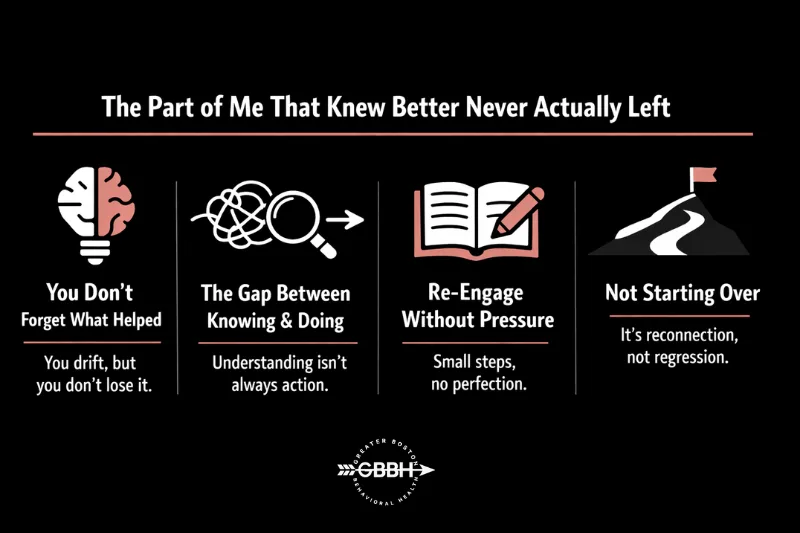
You Don’t Forget What Helped—You Just Drift From It
There’s a version of you that learned how to pause before spiraling.
That could catch a thought mid-sentence and say, “That’s not fully true.”
That version doesn’t disappear.
But life gets loud. Stress builds. Old habits slip back in quietly, not dramatically. And one day, you realize you’re reacting the way you used to—without even noticing when it started.
That doesn’t mean you failed. It means you’re human.
And it might mean it’s time to revisit something that once worked.
Coming Back Feels Different Than Starting
The first time, everything feels new. Structured. Almost mechanical.
This time, it’s more personal.
You’re not just learning tools—you’re recognizing them.
You hear a phrase, and part of you goes, “I remember this.”
And sometimes that comes with resistance.
Because if you already know what helps…
why haven’t you been doing it?
That question can sting. But it’s not the right one.
A better one is: What got in the way?
The Gap Between Knowing and Doing Is Real
Knowing how to challenge your thoughts doesn’t mean you always will.
Especially when:
- You’re overwhelmed
- You’re tired of “working on yourself”
- You thought you’d be further along by now
Sometimes the tools feel like effort. And effort feels like pressure.
So you stop.
Not because they didn’t work—but because you needed a break from trying so hard.
That Version of You Isn’t Gone
The version of you who learned how to question negative thinking?
Who practiced slowing things down instead of believing every thought?
They’re still there.
Not in a perfect, polished way—but in a quiet, accessible way.
Coming back to those skills doesn’t mean you’re back at square one.
It means you’re picking something back up—with more life experience than you had before.
What It Looks Like to Re-Engage (Without Pressure)
Coming back doesn’t have to be intense.
It can look like:
- Noticing one thought instead of ten
- Writing things down again, even if it feels repetitive
- Letting yourself be a little messy with it
You don’t need to “do it right.” You just need to re-open the door.
If you’re looking for more structure again, something like therapy for negative thoughts can help reconnect those patterns in a way that feels steady—not overwhelming.
You’re Allowed to Return Without Explaining Yourself
There’s no rule that says you only get one chance to use what helped you.
No timeline you’re behind on.
No version of you that’s disappointed you didn’t stay “on track.”
If anything, the version of you who learned those tools would probably understand exactly why you drifted.
And maybe even respect that you came back anyway.
This Isn’t Regression—It’s Reconnection
It’s easy to label this feeling as going backward.
But it’s not.
It’s remembering something that worked—and choosing to try again.
That takes honesty. And a certain kind of quiet courage.
You’re not starting over.
You’re continuing—just from a different place than before.
If you’re ready to reconnect with tools that once helped you feel more grounded and clear, support is still here.
Call (888) 450-3097 or visit our page to learn more about our cbt services in Massachusetts.
