


You see it happening again. The quiet withdrawal. The missed calls. The version of them that feels just out of reach.
If you’re here, you’re not overreacting—you’re paying attention. And that matters more than you think.
Early on, many families start searching for answers like why does it feel like they have no motivation to do anything anymore? What you’re noticing isn’t a failure of willpower. It’s often a signal that the approach needs to shift.
Within the first steps of exploring care, many parents find clarity through options like depression treatment programs. Not because it “fixes” everything overnight—but because it changes how we respond to what’s actually happening.
What You’re Seeing Isn’t Just “Slipping”—It’s a Pattern Trying to Be Understood
From the outside, it can look like they’re giving up again.
From the inside, it often feels like:
- Everything is heavy
- Simple tasks feel impossible
- Even things they used to care about don’t register anymore
Depression doesn’t always look like sadness. Sometimes it looks like absence.
And when that absence keeps returning, it’s not because they aren’t trying. It’s because the underlying drivers haven’t been fully addressed yet.
Why Traditional “Push Through It” Approaches Fall Short
A lot of well-meaning advice sounds like:
- “They just need structure”
- “They need to get back on track”
- “They have to want it”
But depression doesn’t respond well to pressure alone.
In fact, pushing harder can sometimes deepen the shutdown.
Modern treatment shifts away from forcing momentum—and instead builds the conditions where motivation can slowly come back online.
That’s a very different philosophy than what many families have experienced before.
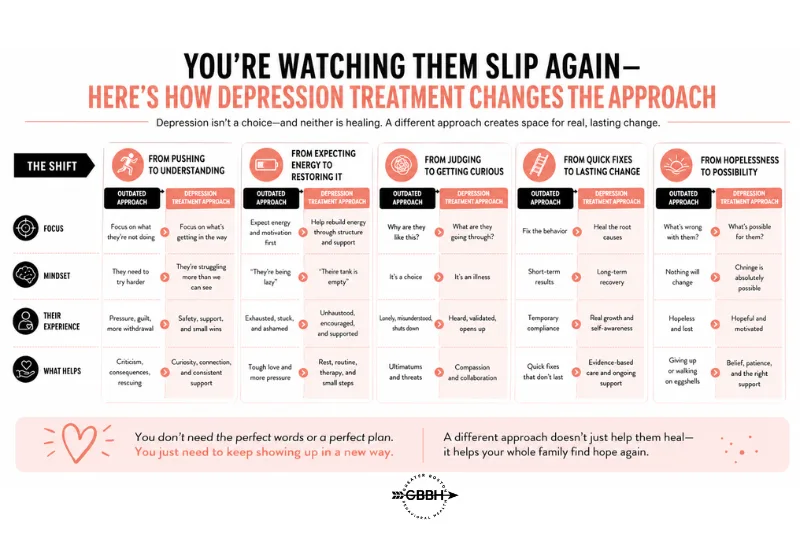
How Depression Treatment Changes the Approach
This is where things begin to look different—in a way that can feel unfamiliar, but often more effective.
Instead of asking, “Why aren’t they doing more?”
Treatment asks, “What’s getting in the way of them being able to?”
That shift opens the door to:
- Identifying emotional burnout vs. avoidance
- Addressing underlying anxiety, shame, or hopelessness
- Rebuilding energy in small, sustainable ways
Care might include structured daytime support, multi-day weekly treatment, or more consistent therapeutic contact—not as punishment, but as scaffolding.
Think of it less like pushing someone uphill… and more like steadying them while their footing returns.
What Progress Actually Looks Like (It’s Quieter Than You Expect)
Parents often expect big turning points.
But real progress with depression is usually subtle at first:
- They respond to a text
- They show up, even if they’re quiet
- They start expressing something—anything—about how they feel
One parent once said:
“I kept waiting for him to become himself again. I didn’t realize he was slowly rebuilding someone new.”
That’s the work.
And it doesn’t always announce itself loudly.
A Different Kind of Hope (Backed by Real Outcomes)
We’ve seen young adults come in feeling completely shut down—flat, disconnected, convinced nothing would help.
Not all at once, but over time:
- They begin engaging again
- Their emotional range returns
- They start making decisions instead of avoiding them
It’s not about becoming a different person.
It’s about removing what’s been weighing them down long enough for them to re-emerge.
That kind of change doesn’t happen through pressure. It happens through the right support, delivered consistently.
What You Can Do Right Now (Without Pushing Them Away)
This part matters.
Because your instinct might be to fix, to act, to say the right thing.
But what helps most often sounds like:
- “I see you’re struggling. I’m here.”
- “We don’t have to solve everything today.”
- “Would you be open to looking at support together?”
You don’t need the perfect words.
You just need to stay connected—without making connection feel conditional.
You’re Not Failing Them—You’re Still Showing Up
That matters more than you realize.
It’s easy to carry quiet guilt as a parent in this situation. To wonder if you missed something, or should have done more.
But being here, searching, trying to understand… that’s not failure. That’s love, still in motion.
And sometimes, the next step isn’t doing more.
It’s doing something different.
If you’re exploring options for your child, you can learn more about available support and what care actually looks like through depression-focused programs in Boston.
Call (888) 450-3097 or visit depression treatment services in Boston, Massachusetts to learn more about our Depression treatment services in Boston, Massachusetts.
