


You’re disciplined. Focused. Reliable.
You get things done.
So when it comes to drinking—or any habit you’ve quietly started questioning—you assume the same rule applies: try harder.
Cut back.
Be stricter.
Have more self-control.
And yet here you are.
Still negotiating with yourself at night.
As a clinician, I work with high-functioning professionals every day who feel blindsided by this. They’ve built entire lives on grit. Many live and work in places like Wellesley, Massachusetts, where achievement is the norm and pressure is subtle but constant.
They tell me the same thing in different words:
“I can run a company. Why can’t I run my own behavior?”
If you’ve started looking into structured approaches like dialectical behavior therapy, it’s probably because willpower alone hasn’t worked.
Let’s talk honestly about why.
The Private Moment No One Sees
It doesn’t happen in chaos.
It happens in quiet.
You’ve finished the emails. Closed the laptop. Got the kids to bed. Wrapped up the responsibilities.
And then there’s this drop.
A kind of internal exhale that feels less like relief and more like collapse.
That’s when the drink makes sense.
Not because you’re reckless.
Because you’re depleted.
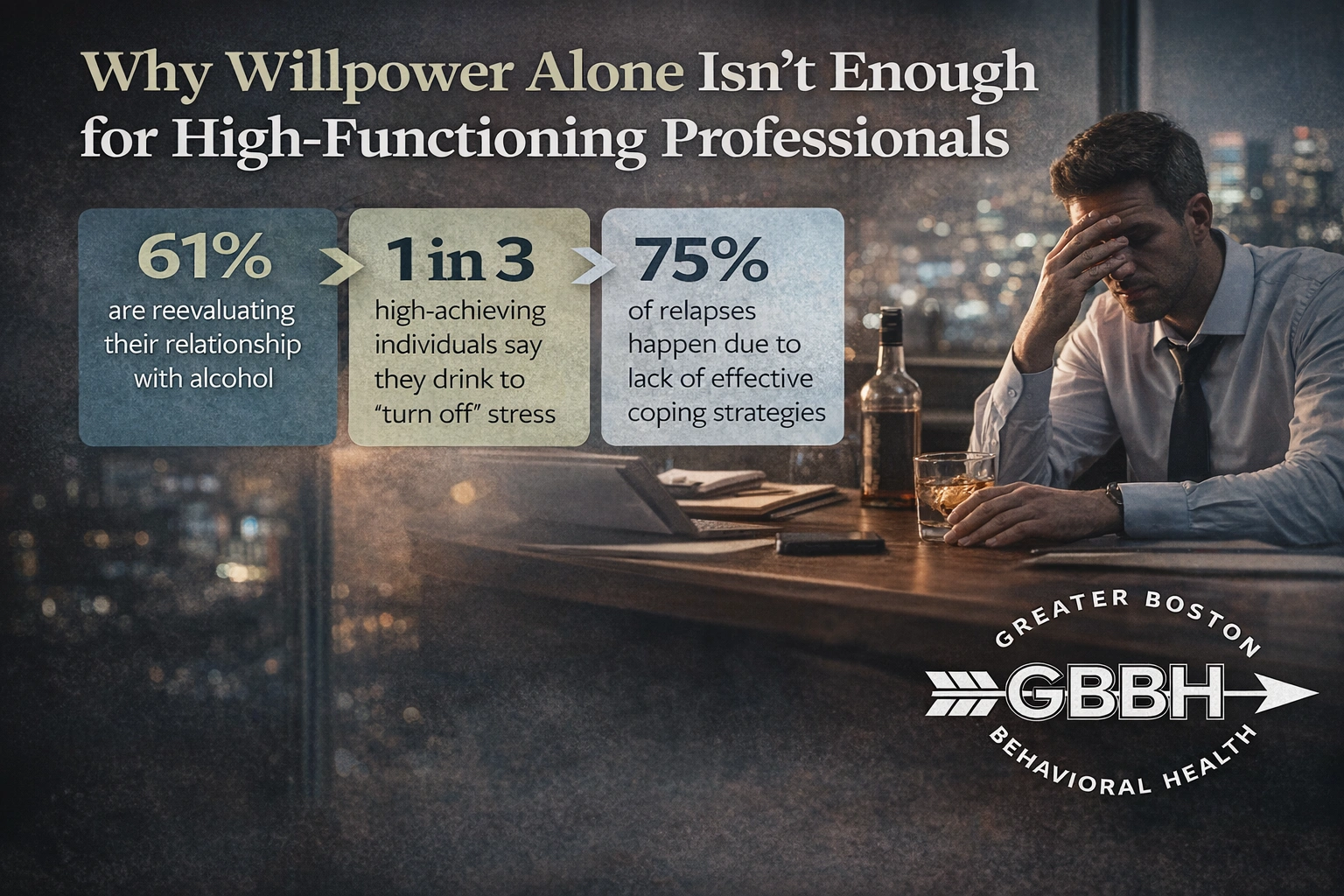
High-functioning people don’t usually drink to party. They drink to turn off.
Willpower is excellent at pushing through a day.
It is terrible at helping you land safely at night.
Why Discipline Isn’t Designed for Emotion
Willpower is a performance tool.
It helps you override discomfort long enough to meet a goal.
It tells you to ignore distraction.
It rewards achievement.
But it doesn’t teach you how to sit with anxiety.
It doesn’t show you how to process shame.
It doesn’t teach you what to do with loneliness or pressure.
If alcohol or another behavior has become your fastest route to relief, that relief is solving something.
And when you try to remove it using sheer force, your nervous system rebels.
You can outwork stress.
You cannot indefinitely out-discipline your own biology.
That’s not weakness. That’s physiology.
The Hidden Burnout Underneath “I’m Fine”
Many high-functioning clients look calm on the outside and feel like they’re vibrating internally.
They say things like:
“I’m always on.”
“I don’t know how to relax without it.”
“If I stop, everything I’ve been avoiding will catch up.”
That’s the real fear.
It’s not about losing the drink.
It’s about losing the off-switch.
In communities like West Roxbury, Massachusetts, where people juggle family, career, and community roles, high standards become second nature. But when the pressure is constant, numbing starts to feel practical.
Here’s the hard truth:
If you remove the numbing without building emotional regulation, the discomfort spikes.
And that’s why relapse happens.
Not because you lack character.
Because you removed the coping tool before installing a better one.
The Night Willpower Fails
Let me tell you about a client—successful, sharp, strategic.
He came into my office frustrated.
“I can white-knuckle it for a few days. Then something stressful happens, and I’m back where I started.”
That’s predictable.
White-knuckling depends on adrenaline.
Adrenaline is not sustainable.
Eventually, stress drains the battery.
He thought the solution was stronger resolve.
The real solution was skill.
We started identifying what actually triggered him. Not just external stress—but internal pressure. Perfectionism. Self-criticism. Fear of slowing down.
Once he learned how to tolerate those feelings without reacting, the urge lost power.
Not overnight.
But steadily.
Why Skills Change What Willpower Cannot
Structured, skills-based approaches like dbt don’t rely on force.
They focus on three core shifts:
- Increasing awareness of emotional triggers
- Building tolerance for distress without impulsive action
- Replacing numbing with regulated response
High-functioning individuals often excel in this format because it feels practical.
It’s not vague.
It’s not inspirational fluff.
It’s measurable.
You learn to pause before reacting.
You learn to notice when your body is escalating.
You learn how to ride out an emotional surge without escaping it.
That’s not self-control.
That’s self-regulation.
They are different.
The First Time It Feels Real
The first time someone delays the habit, it doesn’t feel glamorous.
It feels uncomfortable.
But there’s a subtle shift:
Instead of reacting automatically, you choose.
Even if you still make the same choice, the pause matters.
Choice is where empowerment begins.
Over time, that pause lengthens.
Five minutes becomes fifteen.
Fifteen becomes a full evening.
Eventually, the emotional spike that used to demand relief starts to flatten.
That’s not suppression.
That’s nervous system recalibration.
Why High-Functioning People Resist Asking for Help
You’re used to being the competent one.
The dependable one.
The solver.
Admitting you need help in one area feels like it threatens the entire identity.
But needing emotional regulation skills doesn’t cancel your intelligence. It enhances it.
You built success by mastering systems.
Emotional regulation is just another system—one you were never formally taught.
Once high-achieving clients understand that, the shame decreases.
They stop asking, “What’s wrong with me?”
They start asking, “What tool am I missing?”
That question changes everything.
When Mental Health and Substance Use Collide
High-functioning individuals often minimize anxiety or depression because they’re still performing.
But performance doesn’t equal stability.
Substances often mask:
- Chronic stress
- Imposter syndrome
- Unresolved trauma
- Social exhaustion
- Fear of not being enough
When mental health and substance use collide, willpower becomes even less effective.
You’re trying to override chemistry and emotion simultaneously.
That’s a losing battle.
Skill-building interrupts the cycle at its source.
And that’s why approaches like dbt work differently than sheer determination.
The Myth of “I’ll Stop When It Gets Bad Enough”
You don’t need catastrophe to justify change.
You don’t have to lose your job.
You don’t have to implode your marriage.
You don’t have to hit a public breaking point.
Sometimes the quiet internal exhaustion is enough.
If you’re tired of negotiating with yourself every night—
If you’re tired of promising tomorrow will be different—
If you’re tired of feeling in control everywhere except here—
That’s reason enough.
Waiting for rock bottom is just another form of denial dressed up as discipline.
What Empowerment Actually Looks Like
It’s not dramatic.
It’s not loud.
It’s steady.
It looks like:
- Ending a stressful day without reaching for a numbing agent.
- Feeling anxious and staying present.
- Saying no without spiraling.
- Experiencing disappointment without escaping it.
- Waking up clear-headed and calm.
It’s not about perfection.
It’s about not being hijacked by your own nervous system.
That’s power.
The Shift From Shame to Strategy
Shame keeps you isolated.
Strategy connects you to progress.
When high-functioning individuals realize they aren’t morally flawed—they’re under-equipped in one specific skillset—momentum builds quickly.
You’re not broken.
You’ve just been using a hammer on a lock.
Once you learn how to regulate emotion instead of suppress it, willpower becomes a support—not the sole defense.
And the internal war quiets.
FAQs
Why can I control everything else but not this?
Because work and responsibilities rely on structure and external accountability. Substance use is tied to internal emotional regulation. Different system. Different tools required.
Is it possible to change without losing my edge?
Yes. Emotional regulation does not dull ambition. In many cases, it sharpens it because you’re no longer managing internal chaos.
How long does it take to see progress?
Many clients notice subtle shifts within weeks when consistently practicing regulation skills. Sustainable change builds over months, not days.
What if I’ve tried to quit before and failed?
That likely means you relied on willpower alone. Without replacing the coping mechanism, the brain defaults to what works fastest.
Will therapy make me dig into everything from my past?
Not necessarily. While past experiences matter, much of the work focuses on present-moment skills and behavioral patterns.
Do I have to label myself to get help?
No. You don’t need a label to deserve support. If something feels misaligned, that’s enough.
What if my life doesn’t look “bad enough”?
External success doesn’t erase internal strain. You’re allowed to seek stability before consequences escalate.
If you’re ready to replace willpower with real skill—and stop negotiating with yourself every night—we’re here.
Call (888) 450-3097 to learn more about our dbt services in Boston, Massachusetts.
