


There wasn’t a dramatic exit.
No big speech. No slammed doors.
You just stopped going.
Maybe it was one missed day in your depression treatment program. Then another. Then the guilt kicked in. Then the longer you stayed away, the harder it felt to return.
If that’s where you are right now, I want to say this gently:
You are not the only one who’s done this.
And it is not too late.
I’ve been the person who ghosted. The one who avoided the emails. The one who told myself, “I’ll restart when I feel better.”
Here’s what actually helped me continue after losing momentum — and what can help you too.
Step 1: Separate Fatigue From Failure
Depression drains momentum.
It drains motivation. Energy. Follow-through. Even the will to respond to a text.
When I stopped showing up, I told myself I was weak. Lazy. Inconsistent.
But depression isn’t laziness.
It’s exhaustion that goes beyond sleep. It’s mental heaviness that makes basic tasks feel enormous.
Losing momentum doesn’t mean you didn’t care.
Sometimes it means the work started touching something real — and real feels overwhelming.
That’s not failure. That’s vulnerability.
Step 2: Shrink The Restart To One Manageable Action
The mistake I made was thinking I needed a full comeback plan.
A perfect explanation. A renewed commitment. A promise that I’d never miss again.
You don’t.
You need one action.
For me, it was a short message:
“Hi. I stopped coming. I’m not doing great. Can I restart?”
That’s it.
You don’t owe a dramatic story. You don’t need to defend your absence.
Just reopen the door.
Programs like the one outlined in this depression treatment program understand that people pause. They struggle. They disappear and reappear.
You are not the first.
Step 3: Expect Discomfort — Not Rejection
The hardest part wasn’t reaching out.
It was walking back in.
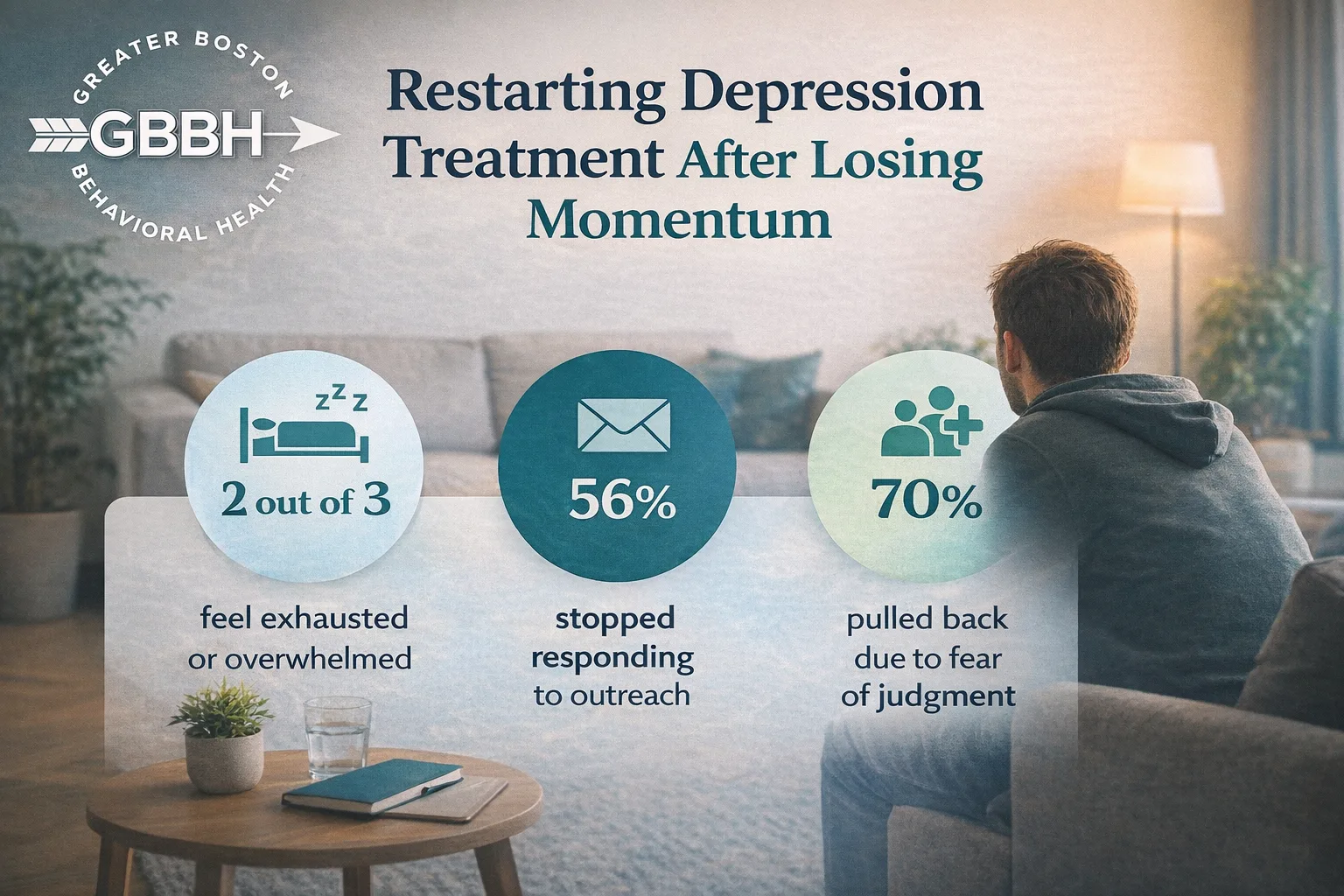
I imagined everyone remembering I left. I pictured judgment. Disappointment. An awkward silence.
Instead, I got:
“We’re glad you’re back.”
That was it.
Most structured mental health programs expect momentum dips. Depression itself makes consistency difficult.
If you’re near Needham, Massachusetts, and you’re sitting in your car outside a building wondering if you should turn around, know this:
Your brain is magnifying the awkwardness. The actual room is usually calmer than your imagination.
Discomfort is normal.
Rejection is rare.
Step 4: Let Go Of “All Or Nothing” Thinking
Depression loves extremes.
“If I can’t do this perfectly, I shouldn’t do it at all.”
“If I missed one week, I ruined everything.”
“If I feel unsure, it must not be working.”
That mindset kept me stuck longer than necessary.
Recovery doesn’t require perfection.
It requires re-engagement.
Showing up inconsistently is still showing up.
And imperfect participation is better than isolation.
Step 5: Be Honest About Why You Drifted
When I returned, I could have pretended nothing happened.
Instead, I said, “I got overwhelmed.”
That one sentence changed everything.
Maybe you drifted because:
- Sessions started getting emotionally intense.
- You felt exposed in group.
- Your schedule got chaotic.
- You were waiting to “feel better” before returning.
- You thought progress should be faster.
Say it out loud.
Programs can adjust pacing. Structure can shift. Support can be tailored.
But only if you’re honest.
If you’re in or around Newton, Massachusetts, and you’re wondering whether it’s acceptable to admit you struggled with consistency, the answer is yes.
Honesty builds trust faster than pretending ever will.
Step 6: Stop Waiting For Motivation
This one took me the longest to understand.
I kept telling myself:
“I’ll go back when I feel ready.”
“I’ll restart when I have more energy.”
Motivation rarely comes first.
Action comes first.
Structure helps carry you when your internal drive is low.
In structured care, you don’t have to negotiate with yourself daily. The schedule holds you accountable when your brain can’t.
Some days you’ll participate fully.
Some days you’ll sit quietly.
Both count.
Momentum rebuilds through repetition, not inspiration.
Step 7: Redefine What Progress Looks Like
I thought progress meant feeling good.
Smiling more. Sleeping better. Feeling lighter.
Sometimes it does.
Sometimes progress looks like:
- Identifying a distorted thought.
- Catching yourself before spiraling.
- Speaking up when you’d normally shut down.
- Showing up despite not wanting to.
If you left because you thought, “This isn’t working,” consider this:
Progress is not always emotional relief.
Sometimes it’s awareness.
And awareness can feel uncomfortable before it feels freeing.
Step 8: Remember Why You Started
Before you drifted, something pushed you to seek help.
Maybe it was:
- Not being able to get out of bed.
- Persistent negative thoughts.
- Numbness that scared you.
- Irritability you couldn’t control.
- A quiet sense that you weren’t okay.
Those reasons didn’t disappear.
They just got buried under avoidance.
Avoiding treatment doesn’t resolve depression.
It isolates you inside it.
There are real treatment options in Massachusetts designed for people who don’t show up perfectly. For people who need second starts. For people who lose momentum and find it again.
You’re not the only one who’s restarted.
You’re just in the middle of it.
Step 9: Release The Shame Narrative
Shame says:
“You blew it.”
“They won’t take you seriously.”
“You wasted everyone’s time.”
Shame is loud.
But it’s not factual.
Treatment professionals understand that depression affects attendance, consistency, and energy.
If anything, returning after losing momentum demonstrates insight.
It says:
“I still want to feel better.”
That matters.
Step 10: Accept That Restarting Is A Strength
There’s a quiet courage in coming back.
Not dramatic. Not flashy.
Just steady.
Every time you return instead of disappearing permanently, you strengthen resilience.
You build proof that setbacks aren’t endings.
You rewrite the story from “I quit” to “I paused.”
That difference is powerful.
Frequently Asked Questions
Is it common to drop out of treatment temporarily?
Yes. Depression often impacts motivation and consistency. Many people experience pauses and later re-engage successfully.
Will they judge me for leaving?
Most programs are accustomed to attendance fluctuations. Clinical teams typically respond with support, not punishment.
What if it’s been months?
It’s still possible to restart. You may need an updated assessment, but that doesn’t mean you’re disqualified.
What if I’m embarrassed?
Embarrassment is normal. It’s also temporary. Relief often follows quickly once you re-engage.
How do I explain my absence?
Keep it simple. “I got overwhelmed.” “I struggled with consistency.” You don’t owe a dramatic explanation.
What if I lose momentum again?
That possibility doesn’t mean you shouldn’t try. Each return builds skill and resilience.
If You’re Still Hesitating
You might be thinking:
“I’ll wait until I feel stronger.”
“I’ll restart next week.”
“I’ll try on my own first.”
If you could have powered through alone, you probably would have by now.
Losing momentum doesn’t erase the work you did.
It just paused it.
You are allowed to resume.
Call (888) 450-3097 to learn more about our depression treatment program in Boston, Massachusetts.
You don’t have to pretend you never left.
You just have to take the next step forward.
