


If you’re the parent of a young adult who’s using again—or simply spiraling—you know what it’s like to live in a body that’s always braced for bad news.
You wait for the text that doesn’t come.
You see an unknown number and your stomach drops.
You get through the day, but you’re not really in it.
This is what chronic fear feels like. It’s not always loud. Sometimes it’s quiet and endless. And the worst part? You can’t fix the person you love—but you also can’t shut off the panic.
That’s why at Greater Boston Behavioral Health, we often recommend EMDR therapy for parents—not because you are the problem, but because your nervous system deserves support, too.
You’re not crazy. You’re not overreacting. You’ve been carrying too much, for too long, without a break. And EMDR helps the body finally come off high alert—even if the situation hasn’t fully changed.
What EMDR Therapy Actually Does (and Doesn’t Do)
EMDR stands for Eye Movement Desensitization and Reprocessing. It’s a therapy model designed to help people heal from overwhelming experiences by processing memories differently—through both hemispheres of the brain, using a method called bilateral stimulation.
But what does that mean for you?
It means your body doesn’t have to keep living like every day is the day something might go horribly wrong.
It means those racing thoughts, clenched jaws, frozen silences, and middle-of-the-night jolts can soften—without forcing you to “move on.”
It means you can still be a loving parent… just not a drowning one.
EMDR doesn’t make you numb. It makes you available again—to yourself, your family, your own sense of peace.
Your Body Has Been in Emergency Mode for Years
Many parents say, “I don’t think I have trauma—I’m just anxious.”
But chronic fear is trauma. Especially when it’s tied to watching someone you love destroy themselves, disappear, relapse, or swing between progress and chaos.
You’ve probably:
- Cried silently in the kitchen while making dinner
- Faked normal at work while barely breathing inside
- Checked their social media at 2 a.m. just to make sure they’re alive
- Gone numb, then guilted yourself for not reacting “enough”
This is not just worry. This is your nervous system stuck in survival. EMDR helps it unstick.
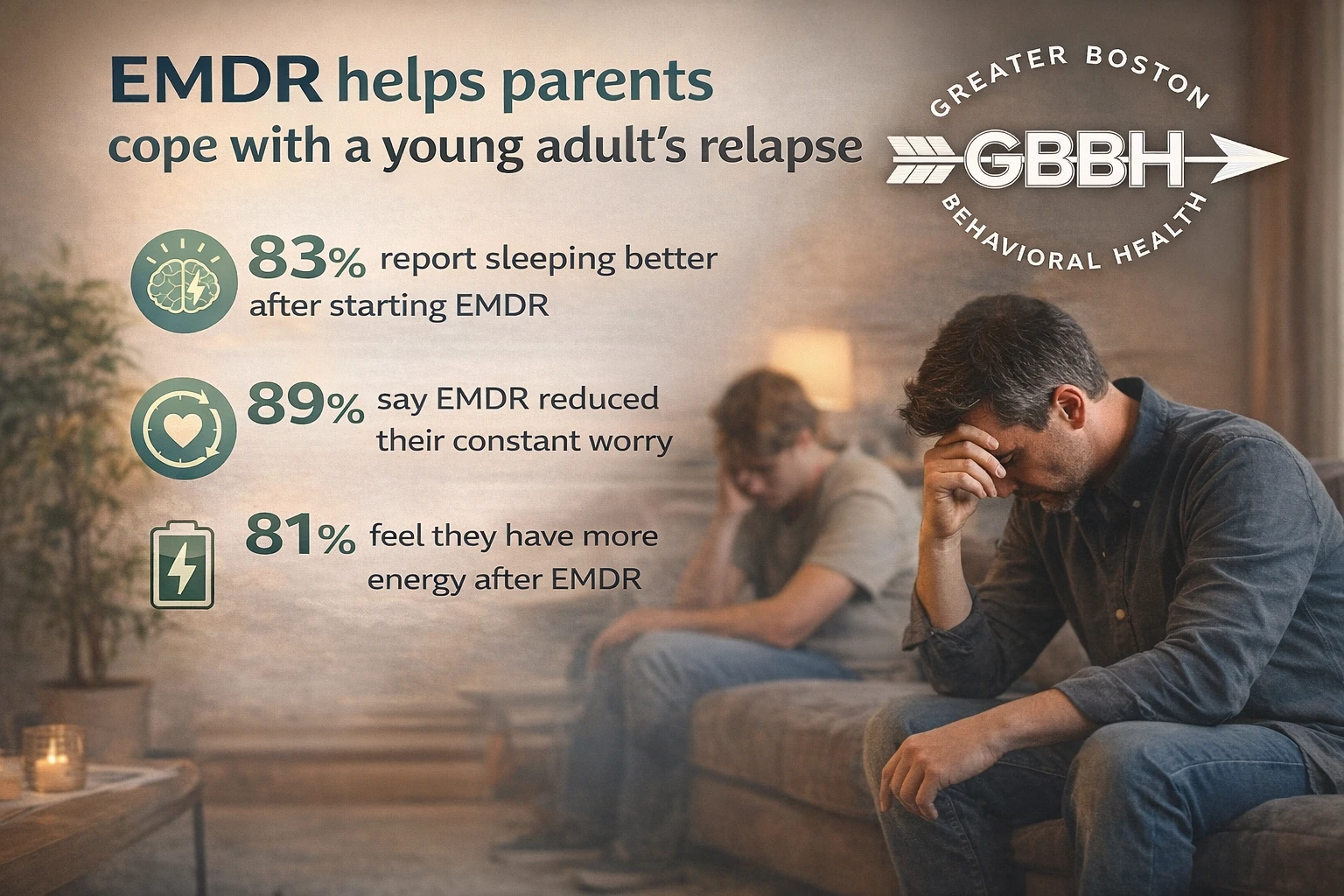
We’ve worked with parents in Waltham, Massachusetts who said, “I thought I’d never sleep again without panic meds.” But after EMDR? They did. Not because everything was fixed—but because they were no longer hostage to their own terror.
EMDR Doesn’t Erase What Happened—It Shifts How It Lives in You
There’s a difference between memory and re-experiencing.
You might “know” that what happened is in the past. But your body doesn’t. It still flinches. Still braces. Still tightens when your kid’s name pops up on your phone.
EMDR helps the body catch up to the mind.
Through structured sessions, your brain is guided to reprocess distressing memories—so they no longer feel like live wires. So you can think of the overdose scare, the phone call, the moment they screamed “I hate you!”—without your heart racing like it’s happening again.
This doesn’t mean you’ll forget. It means you’ll finally remember without reliving.
You Don’t Have to Talk About Everything to Benefit
One of the biggest misconceptions about EMDR is that you have to unpack every painful detail out loud.
You don’t.
Your therapist will help you identify a memory or emotion that feels stuck. You’ll focus on it while following a set of bilateral stimulations (like eye movements or tapping). You won’t be forced to explain it all.
In fact, some of our clients find it freeing:
“I didn’t have to perform my pain. I just got to feel it, move it, and let it go.”
The process respects your privacy. It honors your pace. And it doesn’t ask you to be anyone but human.
Healing Doesn’t Mean You Stop Loving
Many parents hold back from their own healing because they believe suffering is the price of love.
“If I feel better, does that mean I’ve given up?”
“If I stop worrying, what kind of parent does that make me?”
“If I let go, do they think I don’t care anymore?”
Here’s what we tell them:
Healing doesn’t mean you stop showing up.
It means you show up without losing yourself.
It means you hold boundaries with love—not burnout.
It means you parent from clarity, not crisis.
In Wellesley, Massachusetts, we’ve seen this shift change everything for parents—without requiring their child to change first. They reclaimed calm not because the storm ended, but because they found shelter inside themselves.
How EMDR Sessions Are Structured
The process is methodical—not chaotic. And we always begin with stabilization.
Here’s a general outline:
- Assessment – We learn what’s been weighing you down and where your nervous system is stuck.
- Resourcing – We help you build emotional safety before touching hard material.
- Targeting – You choose a memory, belief, or pattern to work on.
- Reprocessing – Using bilateral stimulation, you revisit that target in small pieces, letting the nervous system shift how it’s held.
- Closure – Each session ends with grounding, clarity, and support.
You are never pushed beyond your readiness. You’re guided—not dragged—through each step.
You Deserve Support That’s About You
It’s easy to make your child’s crisis the entire family’s identity. But here’s what we’ve seen:
When the parent heals, the entire family dynamic begins to shift.
EMDR gives you a chance to breathe. To reclaim your peace, even in the middle of uncertainty. To stop waiting for the other shoe to drop—and live a day without flinching.
You don’t need permission. You don’t need your child to get better first. You just need to know this:
Your fear is valid.
Your story matters.
And your healing is possible—even if they’re not ready for theirs yet.
FAQs About EMDR for Parents in Crisis
Will EMDR make me forget what happened?
No. EMDR doesn’t erase memories. It helps your body stop reacting to them as if they’re still happening.
Do I need a diagnosis to qualify for EMDR?
Not at all. If you’re feeling stuck, overwhelmed, or flooded by your child’s situation, EMDR may be helpful regardless of diagnosis.
Is this just another therapy trend?
EMDR is backed by decades of clinical research. It’s used by the VA, hospitals, and trauma specialists worldwide. It’s not a fad—it’s evidence-based care.
What if I don’t want to talk about my child?
That’s okay. EMDR doesn’t require detailed storytelling. We can work with feelings, sensations, or even just emotional patterns you’re noticing.
How soon will I feel better?
Some parents notice a shift within 2–3 sessions. Others take longer. Relief often comes gradually—but many feel something shift early on.
If you’re holding your breath every day, let EMDR help you exhale—without waiting for the next crisis to give you permission.
Call (888) 450-3097 to learn more about our EMDR Therapy in Boston, Massachusetts.
