


Sometimes the hardest part of healing isn’t admitting you need help—it’s admitting you need help again.
You’ve already been to treatment. You’ve already told your friends and family you were feeling better. Maybe you even felt hope in your chest again. The kind that lets you breathe a little easier, make plans, smile without forcing it. And then, somewhere along the way, the light dimmed.
If that’s you—if you’re an alum of a mental health program who’s feeling the weight return—you are not alone. At Greater Boston Behavioral Health, we want you to know something important:
Needing another round of support doesn’t mean you failed. It means you’re still trying. And that is strength.
Our Depression Treatment program in Boston, Massachusetts was built not just for new clients, but for alumni who need to return. Whether it’s been three months or three years, you’re welcome here.
You Didn’t Mess Everything Up—You’re Just Human
If you’re reading this with a lump in your throat or a knot in your stomach, we get it. The voice in your head might be saying things like:
“You had your chance.”
“People will think you’re broken.”
“You should be over this by now.”
But those thoughts aren’t the truth. They’re symptoms. And symptoms don’t make you weak. They make you human—and in need of care.
Depression, especially for those with a history of chronic or treatment-resistant symptoms, isn’t always a “one and done” condition. It ebbs and flows. Sometimes it hits harder after the pressure to “stay better” sets in.
Coming back to treatment doesn’t erase your progress. In fact, it builds on it. This time, you’re walking in with more awareness, more insight, and more willingness to speak up sooner. That’s not regression. That’s wisdom.
We Know Returning Can Feel Hard—We Make It Easier
There’s a special kind of shame that comes with re-entering treatment as an alum. And unless you’ve lived through it, it’s hard to explain.
You’re not walking in for the first time, wide-eyed and unsure. You’re walking in with memories, relationships, and a fear that maybe you’re disappointing someone—even yourself.
Our staff understands that fear. Some of us have lived it ourselves. That’s why the first thing you’ll receive from us isn’t paperwork or a lecture. It’s a welcome back.
No questions like “What happened?” or “Why didn’t you call sooner?”
Just: “We’re glad you’re here. Let’s figure out what you need.”
Whether you’ve recently relapsed into depressive symptoms, or life changes have triggered something new, we’ll meet you where you are—not where someone thinks you should be.
A Depression Treatment Program That Grows With You
At Greater Boston Behavioral Health, we don’t believe in cookie-cutter care—especially not for returning alumni.
That’s why our depression treatment program offers:
- Customized clinical re-assessments to reflect what’s happening now—not what happened before
- Flexible levels of care to meet your current needs
- Continuity of staff and therapy when possible, so you’re not starting from scratch
- Options for group therapy, individual counseling, medication management, or a blend
For some alumni, re-entry means rebuilding structure with a familiar group. For others, it’s reconnecting with a therapist who already knows their story. And sometimes, it’s starting a new chapter with different support. All of that is valid. All of that is available.
If you’re looking for a depression treatment program in Needham, MA or neighboring areas like Dedham or Newton, our Boston-based center provides compassionate care that respects your history and your present.
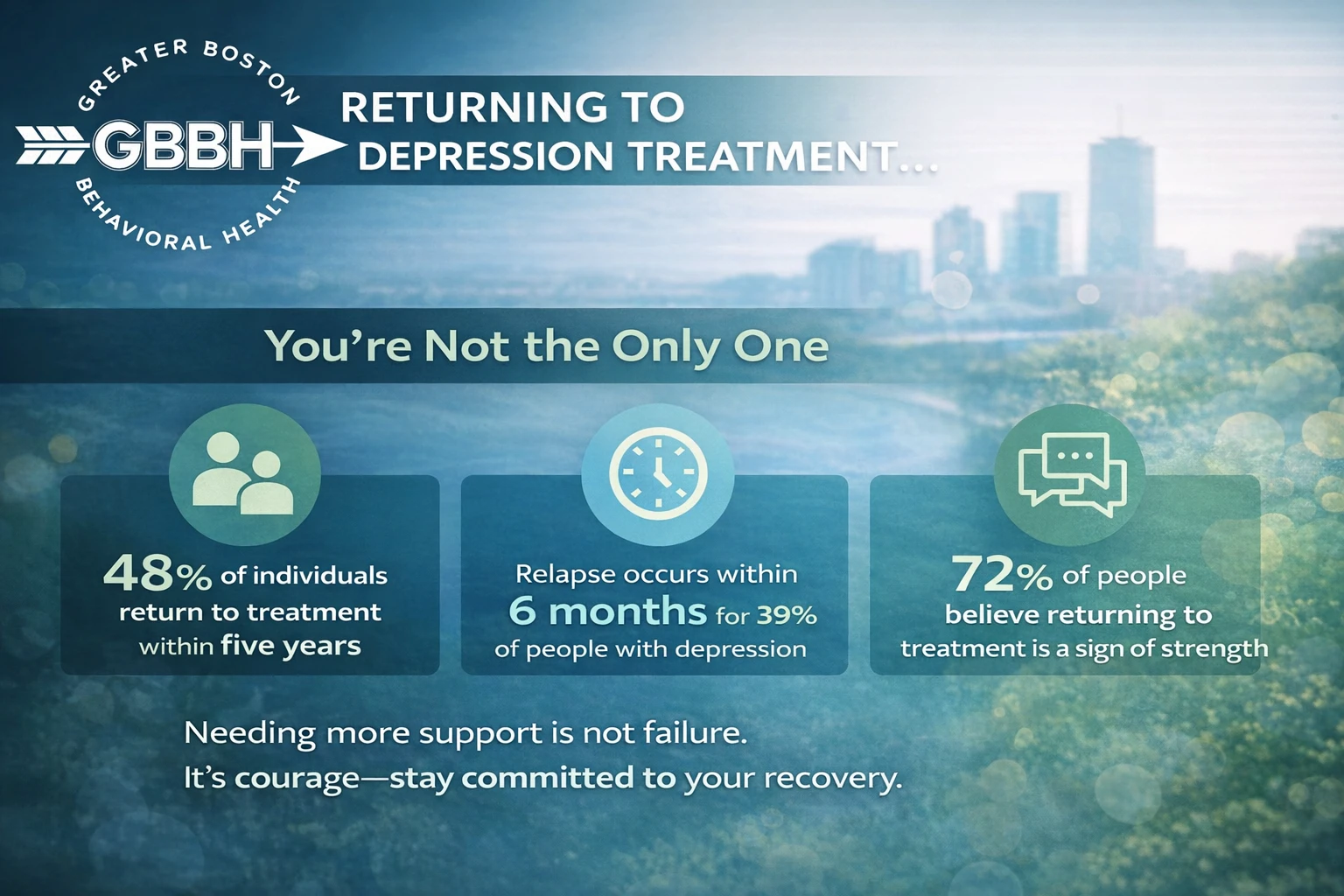
You’re Not the Only One
One of depression’s most isolating lies is: “Everyone else is doing fine. It’s just you.”
But the truth is, many of our alumni return for more support at some point—and not one of them is a failure.
They’re parents, students, professionals, caregivers. People who’ve tried, and then tried again. And each of them has taught us that the second (or third) time around often looks different—but can go deeper.
“Coming back to GB Behavioral Health felt like stepping into safety. No one made me feel like I messed up. It was just… welcome back, how can we help?”
– Alumni, 2023
We don’t expect you to be perfect. We just want you to keep showing up.
Depression Doesn’t Watch the Calendar
Some alumni struggle with the belief that because it’s been “so long” since treatment, they don’t deserve to return. Or worse—they convince themselves that they should be over it by now.
But depression doesn’t follow your schedule. It doesn’t care how long it’s been since you “graduated” from therapy. It can resurface after loss, stress, illness, or for no clear reason at all.
You might have held it together for months. You might have gone back to work, handled responsibilities, smiled for pictures. And yet—inside, you know something’s not right.
That is not weakness. That is a call for care.
And if you’re seeking a depression treatment program in Newton, MA, you don’t have to look far. We’re right here, and we understand the courage it takes to return.
What Makes This Time Different?
Sometimes, alumni worry that if treatment “didn’t work” the first time, it won’t work now.
But often, what’s needed isn’t a different program—it’s a different moment.
This time, you’re walking in with more lived experience. You know what helped last time—and what didn’t. You know where you shut down. Where you held back. Where you might be ready to try something new.
And we’re here to adjust with you.
Whether it’s exploring different therapy modalities, rethinking your support network, or simply offering a space to feel seen again—you won’t be walking in empty-handed. You’ll be walking in wiser.
FAQs About Returning to Depression Treatment
Can I come back even if I “ghosted” or left early last time?
Yes. You don’t need to explain or justify anything. We understand that life happens—and that sometimes, people leave before they’re ready. The door stays open. Always.
Will I have to do everything over again from the beginning?
Not at all. Your treatment plan will reflect where you are now. We’ll reassess your needs and goals together, and create a plan that builds on your existing strengths.
Do I have to go back into a full-time program?
No. Many returning clients opt for part-time therapy, medication management, or group support. We offer multiple levels of care to fit your life and needs.
What if I feel ashamed to come back?
That’s normal—and it fades quickly once you’re welcomed in. Our staff is trained to meet returning alumni with warmth and respect, not judgment. You won’t be alone in how you feel, and we’ll never make you feel bad for needing more support.
I live outside of Boston—can I still attend your depression treatment program?
Yes. We work with clients from across Massachusetts, including Waltham, West Roxbury, and Dorchester. If in-person care isn’t possible, reach out to discuss telehealth options.
You Deserve Support As Many Times As You Need It
It’s okay to come back.
It’s okay to need more support.
It’s okay to be someone who’s still figuring things out.
At Greater Boston Behavioral Health, we don’t measure your worth by how few times you needed help. We see your willingness to keep going as the very heart of recovery.
If your depression has crept back in—or never fully left—this might be your moment to return. Not as a failure. Not as a disappointment. But as someone brave enough to try again.
Ready to reconnect?
Call (888) 450-3097 to learn more about our Depression Treatment program services in Boston, Massachusetts. We’re here when you’re ready.
