


I’ve seen the way people walk back into treatment after a relapse. It’s not just heavy—it’s haunted. Like they’re wearing every mistake on their shoulders and waiting for someone to confirm what they already fear:
You messed up. You lost everything. You shouldn’t be here.
But I’ll tell you what I tell every returning client: You didn’t forget what you learned. You just forgot you were still allowed to use it.
And that’s where DBT comes in—not as a shield that failed, but as a lifeline still waiting to be picked up.
At Greater Boston Behavioral Health, we use Dialectical Behavior Therapy (DBT) not just to prevent crisis, but to meet people in it. DBT was built for the relapse, the regret, the raw middle where you think you’ve lost everything but still want to try again.
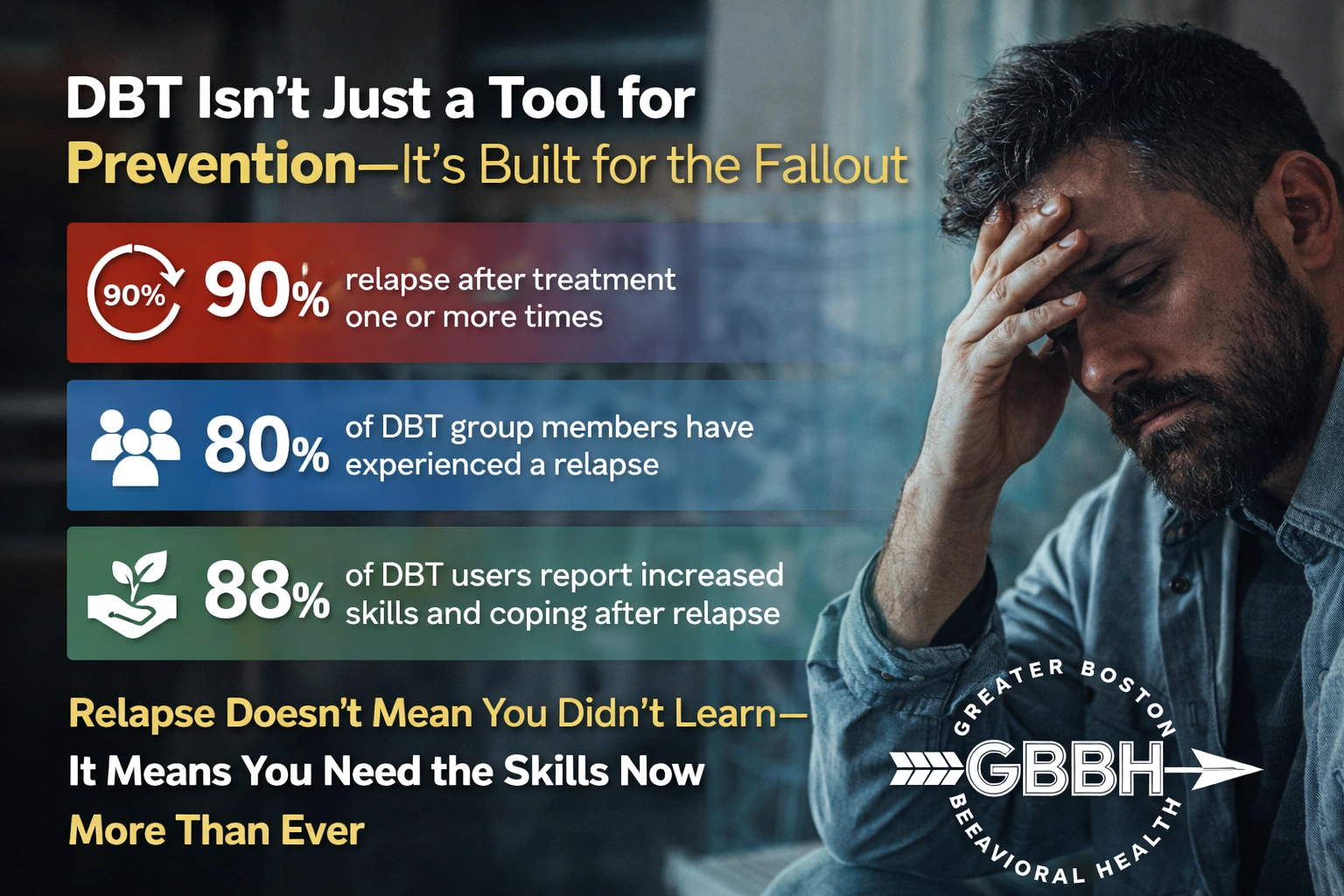
DBT Isn’t Just a Tool for Prevention—It’s Built for the Fallout
People often think DBT is about discipline. Control. Emotion regulation. And yes, it teaches those things—but not to make you flawless.
It teaches them because life gets messy. You get overwhelmed. Your nervous system goes haywire. Someone doesn’t text back. You isolate. You drink. You spiral. Then you wake up wondering, What the hell happened to me?
That’s the moment DBT is made for.
It’s not a theoretical model. It’s practical. Crisis-born. If you’re sitting in the aftermath of a relapse, wondering if you’re even worth the effort again—DBT doesn’t judge you. It sits beside you and says, “Okay. Let’s figure out what to do next.”
Relapse Doesn’t Mean You Didn’t Learn—It Means You Need the Skills Now More Than Ever
One of the most common myths I hear is: “If I relapsed, I must not have been trying hard enough.”
Wrong.
Relapse is usually a sign that you were trying—and hit something too big to navigate alone. Emotional flooding. Burnout. A grief that didn’t go away with time. The skill didn’t fail. The connection did.
DBT skills like distress tolerance, radical acceptance, and opposite action don’t disappear during relapse—they just get buried under shame. We help you unbury them. Slowly, compassionately, in a space where “I messed up” doesn’t cancel out everything good you’ve built.
DBT Groups Welcome People Who’ve Slipped—Because Most People Do
You might be telling yourself, “I can’t go back to group. They’ll judge me.” But here’s the truth: half the people in group have been where you are.
Some relapsed last year. Some last week. Some might be hanging on by a thread and haven’t said it out loud yet.
DBT groups aren’t confession booths. They’re learning labs. And when someone walks back in with tear-streaked eyes and says, “I thought I was past this,” we don’t roll our eyes—we hand them a chair.
You don’t have to earn your seat again. You just have to sit down.
Skills Start Small—Even Mid-Relapse
People picture DBT skills as these perfectly executed scripts: “I used DEAR MAN in a conflict and now everyone respects my boundaries!”
But sometimes the skill is not sending the second angry text. Sometimes it’s brushing your teeth instead of going back to bed. Sometimes it’s calling the IOP even though your hands are shaking.
Skills don’t have to be flawless to count.
We work with clients who start back mid-relapse—still using, still self-harming, still dissociating. And even there, we begin. We talk about urges. About emotional reasoning. About how to notice the moment right before everything spins out.
One skill. One choice. One moment of not giving up.
DBT Doesn’t Ask You to Be Better—It Asks You to Be Honest
You don’t have to walk in motivated.
You don’t have to say, “I’m ready.”
You just have to say, “I can’t do this alone anymore.”
That’s enough.
Some of our clients from Waltham, Massachusetts return to group not because they’re convinced they can recover—but because they remember how it felt to be supported even when they didn’t believe in themselves. And that memory is what brings them back.
You can be cynical. Resistant. Exhausted. As long as you show up and tell the truth about where you’re at, we’ll meet you there.
Pain Isn’t Proof You’ve Failed—It’s Proof You’re Still Human
DBT doesn’t promise you won’t feel pain.
It teaches you how to respond to pain without destroying yourself. That might sound simple—but for many of our alumni, it’s revolutionary.
Relapse often comes from emotional intensity that doesn’t have anywhere to go. DBT creates that space. A way to name the urge without feeding it. A way to regulate without numbing. A way to suffer without spiraling.
Even clients who feel stuck in hopelessness find traction through skills like mindfulness of current emotion or pros and cons work—skills that don’t ask you to feel better immediately, just to stay with yourself long enough to try something different.
Returning to DBT After Relapse Is Not Going Backward—It’s Starting Fresh
You’re not redoing the same chapter. You’re rereading it with new eyes.
One client recently told me, “I’m actually understanding the skills more now than I did the first time—because I finally know what I need them for.”
That’s the paradox of relapse: it hurts. It feels like failure. But it can deepen your clarity. Strengthen your willingness. Shatter illusions and invite real growth—not because the pain is noble, but because you’re willing to come back from it.
Clients in Wellesley, Massachusetts who re-enter our DBT program often say the second time is when the work really starts to land. Not because it’s easier—but because it’s real.
Frequently Asked Questions From Alumni Returning to DBT
Is DBT still helpful if I’m actively using or struggling?
Yes. You don’t need to be “clean” to benefit from DBT. Skills can be practiced even in crisis. You just need a willingness to show up and be honest.
Will group judge me if I relapsed?
No. Many clients in DBT groups have relapsed or struggled after treatment. Group culture is built around compassion, not shame.
Do I have to start over from the beginning?
Not necessarily. We’ll meet you where you are. Some clients rejoin ongoing groups; others benefit from restarting the full curriculum. We’ll decide together.
Can I return to DBT even if I left on bad terms?
Yes. We understand that leaving mid-treatment or after a relapse is part of many people’s path. We don’t hold it against you. The door is open.
What if I’m not sure I even want to be in recovery anymore?
That’s okay. We work with ambivalence all the time. You don’t have to be 100% in. You just have to show up and talk about it. That’s where healing starts.
If this is the part where you think about quitting—don’t. If this is the part where your shame screams louder than your hope—pause.
You don’t need to believe fully in recovery to reach for it again. You just need a flicker. A crack. A handhold.
Call (888) 450-3097 to learn more about our Dialectical Behavior Therapy in Boston, Massachusetts . If you’re hurting, we’re here. No questions asked. No tally kept. Just a way forward. One skill at a time.
