


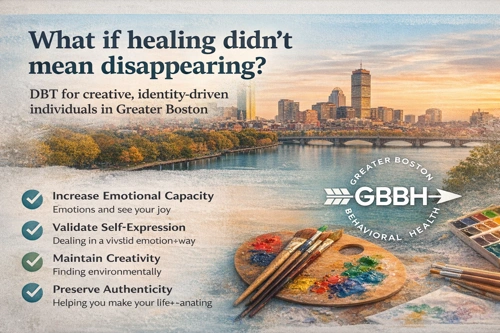
What if healing didn’t mean disappearing?
For many creative, identity‑driven people, starting therapy can feel like a choice between stability and authenticity. The quiet fear often goes unspoken: What if I lose the part of me that feels most alive? But at Greater Boston Behavioral Health, we’ve seen firsthand that Dialectical Behavior Therapy (DBT) doesn’t flatten personality. Instead, it creates space for who you truly are to take shape—more clearly and more confidently.
Our DBT program in Boston, Massachusetts and our satellite services throughout Greater Boston, including Cambridge, Somerville, Quincy, and the South Shore, is designed to meet emotional richness with skillful understanding. If you’ve been afraid that sobriety or emotional growth might erode your identity, this is for you. The fear is real—and so is the hope.
What Creatives and Identity‑Focused People Fear Most
You may be the type who feels intensely, creates with abandon, and lives with a vivid emotional palette. For some, emotions aren’t just experiences—they’re essential parts of identity. When someone suggests “regulating” emotions, it can feel like being asked to mute your essence.
But here’s a vital distinction: DBT doesn’t erase emotion. It teaches you how to use it without being overwhelmed by it. That’s not control born of suppression; it’s skill born of understanding.
In neighborhoods as varied as Jamaica Plain and Brookline, we’ve encountered people who tell us their emotional ups and downs feel like both curse and creative fuel. It makes sense that you’d wonder whether therapy will dull your edge. That’s a fear worth exploring, not dismissing.
Why DBT Isn’t About Suppression—It’s About Capacity
Dialectical Behavior Therapy gets misunderstood when people think “regulation” equals “less feeling.” That’s not the case. DBT is about growing your capacity to hold emotion, not bury it.
Imagine your emotions are colors on a painter’s palette. Right now, some hues are so bright they bleed into each other, making it hard to see the image you’re creating. DBT helps you separate those colors so you can use them more precisely.
That doesn’t mean the colors disappear—just that they become intentional.
Across our service area—Boston, Cambridge, Somerville, and Quincy—people tell us this shift doesn’t feel like numbing. It feels like clarity. You begin to see the difference between what you’re feeling and how you’re reacting. That gap? That’s where choice lives.
Naming the Fear: “What If I Lose Myself?”
Let’s be honest: many folks walk into therapy worried that healing will dilute their essential self. Creativity, mood swings, passion, intensity—these may feel inextricable from identity. And so the promise of stability can feel like a threat.
If that resonates with you, listen to this: your fear makes sense. Your emotional experience has been a survival tool, a connection point, a way to interpret the world. It hasn’t just been something you endure—it’s been who you are.
DBT doesn’t ask you to abandon that. It asks you to understand it.
Here’s a question we often talk about during DBT in Boston and surrounding communities:
What parts of your experience are meaningful to your identity, and what parts feel stuck—repeating unhelpfully and hurting you?
That question is the beginning of transformation, not erasure.
How DBT Translates Emotion into Self‑Expression
One of the gifts of DBT is teaching language for your inner world. Not words that hide feeling, but words that shape it.
You might learn how to say:
- “I’m overwhelmed right now, and here’s what I need.”
- “I felt criticized, and that triggered me.”
- “My emotions are real, and they don’t control me.”
That kind of expression isn’t suppression. It’s articulation.
For many artists, writers, performers, and thinkers in Boston and Cambridge, learning DBT skills has been like discovering a new medium. Instead of emotion spilling over and sabotaging relationships or creativity, it becomes a tool you wield with intention.
Better yet, you stop confusing intensity with identity. One is a resource; the other is who you choose to be.
DBT Teaches Validation—First, For Yourself
Validation is a cornerstone of DBT. It’s not about agreeing with every feeling. It’s about acknowledging your experience without judgement.
We’ve found that people who’ve spent years hearing “calm down” or “just get over it” are starved for validation. In cities like Somerville and Quincy, we meet individuals who have been told to “tone it down.” They equate emotional regulation with character editing.
But validation isn’t editing. It’s recognizing what’s there.
It says:
“Your experience makes sense, even if it’s hard right now.”
Once you’ve been validated—especially by yourself—you can start building real strategies to respond to your emotions instead of reacting to them.
That shift feels huge. And yes—creative. Because finally, your emotions become material you can work with, not something that hijacks you.
The “Dialectic” in DBT: Holding Opposites at Once
“Dialectical” is a big word, but it simply means holding two seemingly opposite ideas as true at the same time.
Here’s what that means in practice:
- You can feel deeply and learn skills to manage intensity.
- You can pursue creativity and stabilize your life.
- You can be uniquely you and grow emotionally.
That might feel counterintuitive—especially when you’ve lived with chaos for years and equate it with identity.
In groups and individual sessions, we work on recognizing dialectics as creative tension. Just like in art, tension gives depth to expression. DBT uses similar tension to help you grow.
This approach resonates with many of our clients across the Greater Boston area—whether they live in Boston proper, Cambridge, Brookline, or Quincy.
DBT Skills You Use Daily
DBT gives you practical tools you can use in real life—right now.
Mindfulness
Notice what’s happening inside you without being swallowed by it.
Distress Tolerance
Ride intense waves of feeling without making things worse.
Emotion Regulation
Understand what your emotions are trying to tell you—and respond in ways that align with your values.
Interpersonal Effectiveness
Communicate clearly without sacrificing connection or self‑respect.
These aren’t abstract ideas. They’re skills people practice in daily life—at work, in relationships, in the studio, on the stage, in the café.
One client from Somerville described it like learning a new language for their inner world: not foreign, just unfamiliar at first. But with practice, it becomes the language of choice.
Identity Is the Compass—Not the Problem
Here’s a line we say often, because it’s true:
Your identity isn’t a problem to fix—it’s a compass to understand.
DBT doesn’t erase your identity. It helps you see which parts of it serve you and which parts keep you stuck.
For creative, emotionally intense people throughout Boston, Cambridge, Somerville, and Quincy—this distinction is life‑changing.
You begin to notice:
- Which emotional patterns fuel expression
- Which drain energy and steal joy
- Which relationships honor who you are
- Which ones trap you in cycles of conflict
As you get clearer, you can choose how to show up—with confidence instead of fear.
That kind of clarity doesn’t diminish you. It reveals you.
What to Expect in a DBT Program With Us
Our DBT program in Boston, Massachusetts blends compassionate support with practical guidance. Whether you’re joining individual therapy or group skills sessions, we meet you where you are.
Here’s what many participants experience:
- A safe space to talk about fear of losing identity
- Skills you can use immediately
- Validation without judgement
- Growth that feels authentic—not forced
- A community that understands the creative mind
Whether you live in Boston, Brookline, Cambridge, Somerville, or Quincy, we tailor care to match your experience—not flatten it.
Serving You Across Greater Boston
We know that emotional life doesn’t stop at city borders. That’s why our DBT services extend throughout the region. Residents of:
find that the skills they learn here become tools for stability, self‑compassion, and authentic expression.
No matter where you live, your emotional intelligence can become a strength you steer—not a force that steers you.
FAQs: You’re Not Alone in These Questions
Q: Will DBT make me less emotional or creative?
A: No. DBT helps you understand your emotions and use them intentionally. Creativity often blossoms when emotions are clear and contained enough to be shaped rather than overwhelming.
Q: Is DBT only for people with serious mental health diagnoses?
A: No. DBT was developed for intense emotional experience, but its skills help anyone looking to manage feelings and improve relationships.
Q: How long does DBT take?
A: DBT is typically a multi‑month commitment, but many people notice improvements within weeks as they start applying skills in daily life.
Q: Do I need to be in Boston to participate?
A: While our in‑person services are in the Greater Boston area (Boston, Cambridge, Somerville, Quincy, Brookline, and nearby communities), we offer guidance on options that might fit your needs if you’re reaching out from outside the region.
Q: Will therapy change who I am?
A: Therapy doesn’t change who you are at the core. It helps you refine how you navigate life with integrity and intention.
If you’ve read this far, know this: your emotions are part of you, not a threat to you. You don’t have to shrink your identity to find peace. You deserve skills that expand your capacity to feel—and express—without fear.
Call (888) 450‑3097 to learn more about our DBT services in Boston, Massachusetts. Let’s explore what’s possible for you.
