


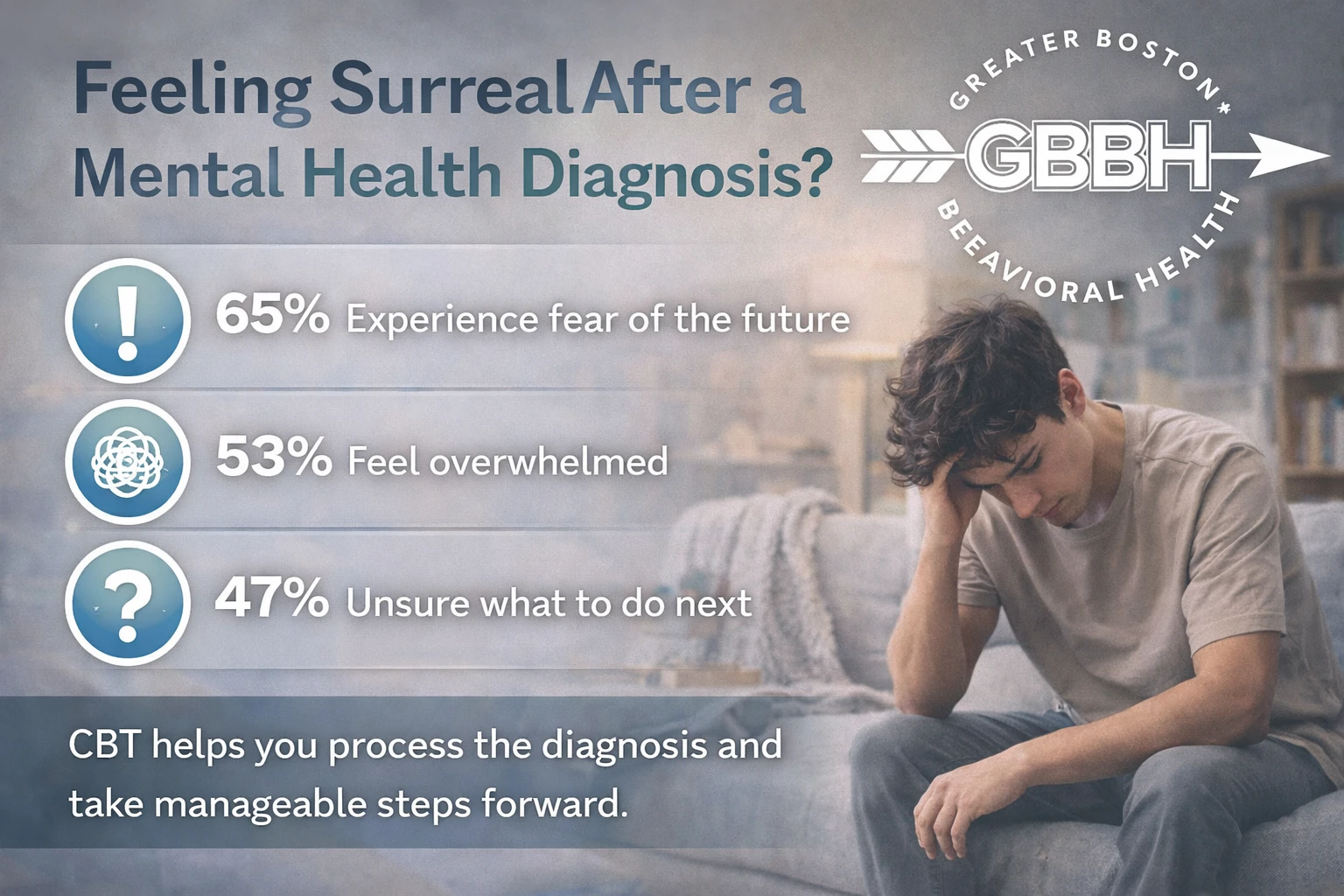
The day you receive a mental health diagnosis can feel surreal. Like an earthquake under your feet. Everything feels shaky — even your sense of self. One moment you’re processing relief, and the next, fear washes over you. What does this mean for my future? Do I have to change everything? What about medication? What if it changes me?
If you’re reading this, you might be in that space — scared, unsure, maybe even exhausted from trying to make sense of it all. You don’t have to decide everything today. Not now. Not this week. Not even this year.
At Greater Boston Behavioral Health, our Cognitive Behavioral Therapy Program is designed to meet you exactly where you are — not where you think you’re supposed to be. CBT helps newly diagnosed clients slow down, make sense of their thoughts, and take manageable steps forward without pressure.
The Diagnosis Didn’t Take Your Voice
Being diagnosed can feel like being handed a label you didn’t ask for. Suddenly, there are terms you’ve never heard, recommendations you didn’t expect, and decisions that feel monumental. It’s easy to feel like you lost control.
Here’s a truth that matters: a diagnosis doesn’t define you — you do.
CBT doesn’t start by telling you what to do. It begins by listening to what you already know about yourself. You bring your fear, your questions, and yes, even your resistance — and we work with that. You don’t have to hide your uncertainty to be worthy of care.
What CBT Really Does
Cognitive Behavioral Therapy isn’t about positive thinking or just “feeling better.” It’s a structured, evidence-based method that helps you understand the connection between thoughts, emotions, and behavior.
It gives you tools — not rules — to:
- Observe your thoughts without being controlled by them
- Notice patterns that keep you stuck
- Practice real‑world responses that shift how you feel
- Test new ways of thinking in a safe environment
CBT meets your fear with curiosity, not dismissal.
You Don’t Have to Rush Into Choices
Many people worry about choices like medication vs. no medication or therapy vs. not therapy. In CBT, we honor your pace. You don’t have to decide everything today. Not even the big stuff.
Some clients come in thinking, “I should already know what’s best for me.”
But you don’t need certainty — you need clarity. And clarity takes time.
CBT gives you permission to explore decisions gradually. It lets you ask questions like:
- What feels true for me right now?
- What worries me about medication?
- What fears do I have about starting therapy?
- What am I actually afraid of losing?
These questions aren’t obstacles — they are guides.
How a Session Actually Feels
If you’re afraid therapy will feel like an interrogation or judgment, let’s clear that up. CBT sessions are grounded in partnership.
Your therapist isn’t looking for hidden secrets. They’re asking open questions like:
- “What was that moment like for you?”
- “What were you thinking right before you felt this way?”
- “If you could respond this way instead, what might happen?”
There’s nothing rushed about a CBT session. You talk. You reflect. You practice. You build confidence in small, tangible ways.
It’s not about erasing pain — it’s about giving you choices where you didn’t feel you had any.
One Location, One Personal Experience
Clients who come to us from Waltham, MA often describe CBT like learning a new language. At first it feels foreign. But with practice, it becomes a tool they reach for automatically — a way to navigate emotions they used to feel overwhelmed by.
This metaphor comes up a lot:
CBT is like learning to swim after you’ve spent years submerged. At first, you’re just trying not to panic. Later, you start floating. And then, slowly, you start swimming on purpose.
CBT Is a Map — Not a Mandate
A lot of people assume therapy means changing who they are. That’s not what CBT does. It teaches you to understand who you are — your patterns, your responses, your feelings — and then gives you tools to make intentional choices about your life.
It’s like having a GPS for your inner world:
Not telling you to take every turn, but showing you where the roads go so you can choose your direction.
At first, what seems like small progress feels almost invisible — like barely moving. But over time, those small steps turn into momentum.
You’re Still Becoming — Not Broken
One of the biggest fears people share after a diagnosis is: “If I start therapy or medication, will I lose the real me?”
That fear is valid.
Here’s the gentle truth: CBT doesn’t erase your identity — it strengthens it. It doesn’t take away your emotions — it helps you make friends with them. And it doesn’t flatten your personality — it gives you clarity to choose how you want to show up in the world.
You are not a diagnosis. You are not a list of symptoms. You are a full person with history, hopes, and inner life. CBT honors all of that.
When You’re Unsure — That’s Where Healing Begins
You don’t have to walk in feeling ready. You can walk in curious. Skeptical. Doubtful. Confused. You can even walk in scared.
Those are real places to start. And in CBT, they are valid starting points.
Healing isn’t a straight line. It’s not a checklist. It’s a process — one that you direct, with guidance from a clinician who listens and adapts to your pace.
There is no “wrong way” to take your first step. There’s only your way.
Frequently Asked Questions About CBT
Do I have to take medication if I start CBT?
No. CBT works with or without medication. If you’re unsure about medication, CBT can help you explore your thoughts and feelings about it without judgment or pressure.
How long does CBT usually take?
CBT is typically time‑limited, often between 12 and 20 sessions, depending on your progress and goals. It’s designed to teach skills that you can use long after formal therapy ends.
What if I don’t know what my diagnosis means yet?
CBT can actually help you make sense of your diagnosis in relatable terms — not clinical jargon. You’ll gain insights into how the diagnosis shows up in your thoughts, feelings, and behavior.
Is CBT just talking?
Not exactly. Talking is part of it, but CBT also involves real‑world practice, skill development, and gentle experimentation with new responses to old patterns.
What if I’m scared CBT won’t help?
It’s okay to be unsure. Many people start therapy with doubt. CBT doesn’t require belief up front — just willingness to explore and reflect. That’s enough.
Your Story Continues — One Choice at a Time
A diagnosis can feel like a heavy label. But it doesn’t have to feel like a lifelong sentence. You don’t have to decide everything today. You don’t have to commit to medication before you’re ready. You don’t even have to know if therapy will help — not yet.
You only need to take the next step that feels right for you. And in CBT, that step might be as simple as showing up, asking questions, and being honest with yourself — no judgment.
You are allowed to take this one day at a time. You are allowed to feel scared. You are allowed to change your mind. You are allowed to grow without rushing.
This is healing on your terms — gentle, respectful, intentional.
Call (888) 450-3097 to learn more about our Cognitive-Behavioral Therapy in Boston, Massachusetts.
