


Some people cry when they get a diagnosis. Some get quiet. Some feel validated. Others panic.
But if you’re the kind of person who’s always felt things deeply, who’s always been the “sensitive one,” or the “artistic one,” or the “funny one that uses humor to deflect”—then you might react differently.
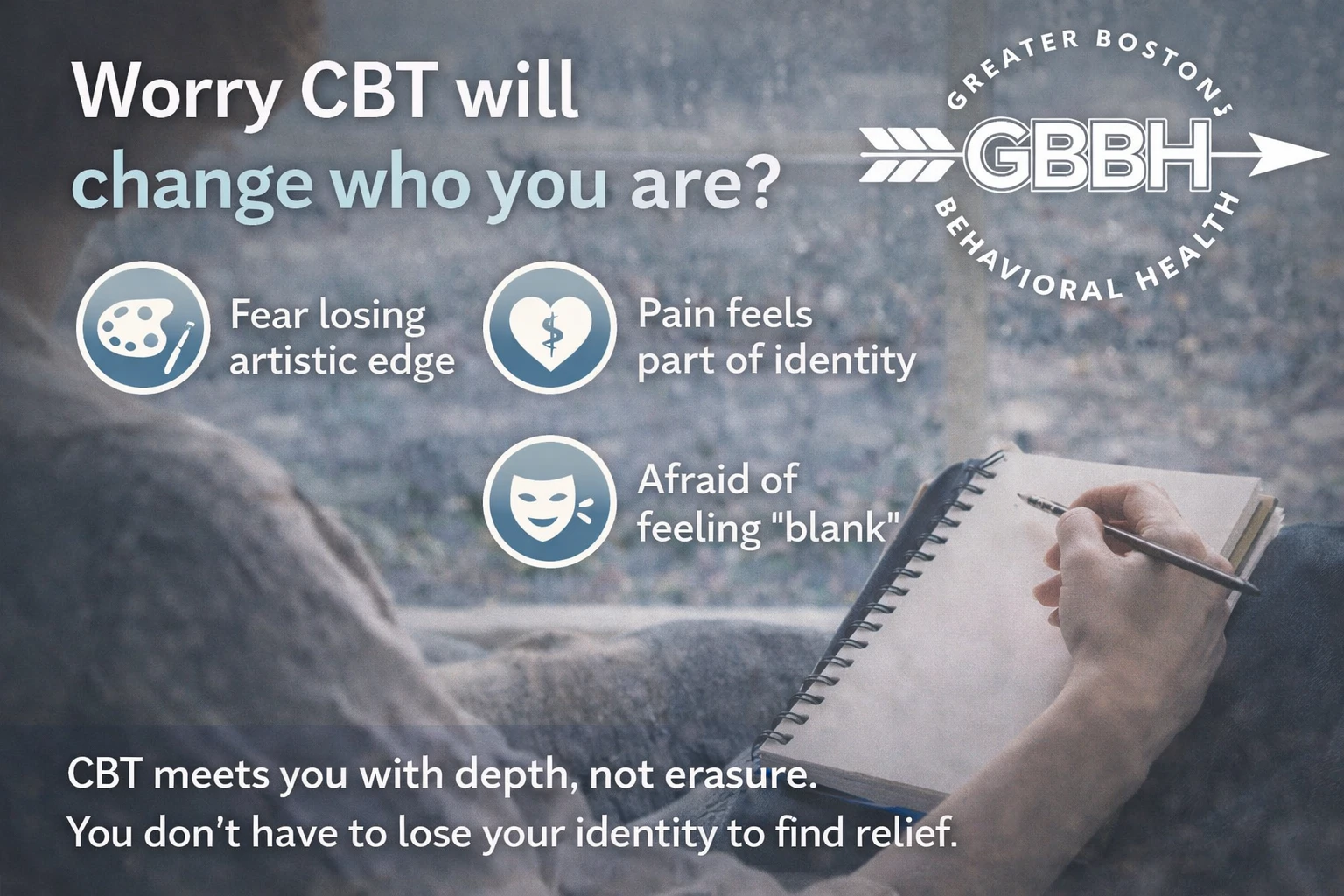
Not with fear of therapy itself, but with fear of what it might take from you.
Because for you, pain isn’t just pain—it’s identity. It’s how you make sense of the world. It’s part of your voice, your relationships, your art, your entire way of being.
So when someone suggests Cognitive Behavioral Therapy (CBT), something in you pulls back.
If I feel better, will I lose the part of me that sees things clearly?
What if the sadness goes away, and I’m just… blank?
What if this pain is the only proof I’m not numb like everyone else?
These questions are real. And they deserve care. At Greater Boston Behavioral Health, we offer CBT that holds space for the parts of you that are scared to heal.
You don’t have to trade your identity for peace. You just don’t have to keep hurting to prove you’re real.
The Pain Got You Through—But Is It Still Carrying You?
Let’s honor the truth: for a long time, your pain was a survival strategy.
- You turned loneliness into independence.
- You used anxiety to stay three steps ahead of being hurt.
- You learned to turn depression into art, panic into humor, overthinking into achievement.
And for a while, it worked. Or at least, it looked like it did.
But lately… maybe it doesn’t.
Maybe it just hurts. Quietly, constantly.
And maybe you’re wondering if there’s a way to stay you—without feeling exhausted all the time.
CBT helps you ask that question honestly, without rushing you to an answer.
What CBT Really Does (And What It Never Will)
Cognitive Behavioral Therapy is often misunderstood. People think it’s about “fixing” thoughts. But that’s not the full story—especially not for someone like you.
CBT helps you recognize the inner monologues you’ve been living with for so long, you forgot they were optional.
- “I ruin everything.”
- “If I’m not suffering, I’m being fake.”
- “No one actually sees me.”
- “I have to stay ahead of the pain or it’ll consume me.”
CBT doesn’t ask you to argue with those thoughts. It teaches you how to witness them.
How to respond with curiosity, not collapse.
What it never does: strip you of your depth, erase your edge, or ask you to become palatable for anyone else’s comfort.
Your Edge Doesn’t Have to Cut You
This is one of the hardest truths to learn:
Being sharp, deep, and perceptive doesn’t have to mean being in pain.
Yes, your ability to feel things deeply is a gift. But when every feeling becomes a threat—when every relationship feels like it could break you—that’s not artistry. That’s unprocessed pain acting like intuition.
CBT helps you discern between truth and trauma. Between what’s real and what’s a reflex.
We’ve had clients in Dorchester, MA who told us they were scared that therapy would make them “bland.” What actually happened? They started to feel their emotions without getting swallowed by them. They started creating again—without needing a breakdown to do it.
You Can Be Complicated and Still Want Peace
There’s a story many of us tell ourselves: “I’m just a complicated person.” And it might be true. But complicated doesn’t have to mean chaotic. It doesn’t have to mean drained. It doesn’t have to mean you’re only worthy of connection if you’re constantly unraveling.
CBT gives you space to explore your own contradictions.
- The part of you that wants to be left alone, and the part that craves closeness.
- The part that’s afraid of being seen, and the part that aches for recognition.
- The part that loves your depth, and the part that’s tired of drowning in it.
There is room for all of that. And CBT helps you live in that space—without having to choose one version of yourself to survive.
Healing Doesn’t Mean Flattening
This is what most people fear deep down:
“If I get better, I won’t be interesting anymore.”
That’s the lie that pain tells us. That we have to be tragic to be worthy. That we have to suffer to be deep.
But what if you could keep your insight, your sharpness, your layers—and feel lighter?
We’ve worked with clients near West Roxbury, MA who came in afraid they’d lose themselves. They left saying, “I didn’t lose anything. I just stopped hurting all the time.”
That’s not erasure. That’s freedom.
What a CBT Session Feels Like When You’re the Deep One
If you’re creative, complex, or emotionally intuitive, you may have felt dismissed in past therapy. Like your fears were minimized. Like your sadness had to be translated.
That won’t happen here.
In CBT at Greater Boston Behavioral Health, we meet your mind with equal depth. We don’t simplify your story—we help you track it with clarity. Sessions are structured but never sterile. Each one is a space where we:
- Explore the origins of recurring thoughts
- Identify how your patterns show up (and when they sabotage you)
- Practice skills that support your complexity, not erase it
You won’t be asked to stop feeling deeply. Just to stop assuming every feeling is a fact.
You Don’t Have to Believe in CBT. Just Be Tired Enough to Try.
You don’t have to walk in ready. You don’t have to feel hopeful. You can show up guarded, skeptical, sarcastic.
That’s fine. That’s allowed.
Most of our clients didn’t believe CBT would work. They believed they were too “unique,” too “broken,” too “self-aware for basic therapy.”
We agreed. They weren’t basic. And CBT met them there—without condescension, without pressure.
Maybe that’s you, too.
Frequently Asked Questions About CBT and Identity
Will CBT make me less emotional?
No. CBT helps you process emotion without drowning in it. You stay emotional—you just suffer less.
Can I still be creative if I stop being depressed?
Yes. In fact, many clients report that therapy helps unblock creativity, giving them more energy and clarity to create without needing crisis as fuel.
What if I’m scared to lose who I’ve always been?
That fear makes sense. CBT helps you unpack which parts of that identity are protective—and which parts are true. You only release what no longer fits.
Is CBT too structured for someone like me?
It’s structured—but flexible. Think of it as a canvas, not a coloring book. There’s room for your own lines, your own voice.
What if I try CBT and it doesn’t work?
That’s okay. Healing isn’t one-size-fits-all. But trying CBT doesn’t lock you in—it opens up options. You lose nothing by exploring. You gain information, support, and maybe even relief.
You Don’t Have to Suffer to Be Real
You’re not fragile. You’re not dramatic. You’re not “too much.” You are someone who feels deeply and wants to live fully—and pain doesn’t have to be the toll you pay for being human.
At Greater Boston Behavioral Health, our CBT program helps you hold your identity with both hands. We don’t trim it down. We help you carry it without breaking under the weight.
Call (888) 450-3097 to learn more about our Cognitive-Behavioral Therapy Near Boston, Massachusetts.
