


Mental health crises don’t come announced. They arrive like earthquakes — sudden, uninvited, and everything you thought was steady shakes. You might be reading this because your young adult is in that moment: overwhelmed, unpredictable, emotionally volatile, maybe talking about things that terrify you. You’re exhausted, scared, and in pain — and you feel like you’re the only one who sees the chaos.
You are not alone. And you do not have to navigate this without support.
Cognitive Behavioral Therapy — CBT — is a structured, evidence‑based approach designed to help young people manage their internal world when emotions feel like wildfire. CBT helps them slow down their thoughts, understand what drives their reactions, and build skills that give families real‑time tools for stability and hope. At Greater Boston Behavioral Health, we walk alongside parents and young adults in crisis, helping them find stability amidst unpredictability— whether you’re in Dedham MA or surrounding areas.
When “Crisis” Has a Face
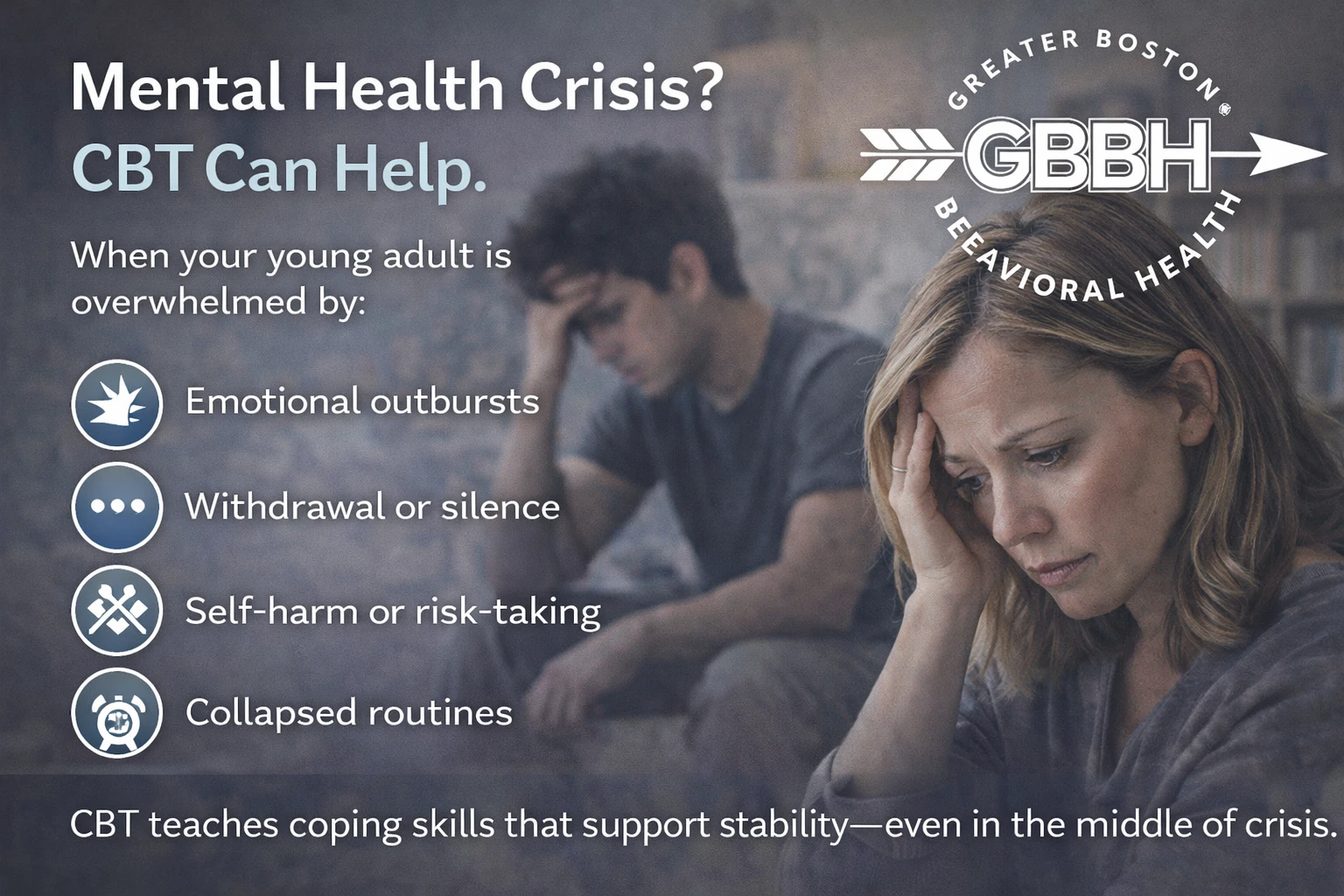
A crisis can look different depending on your child, but often it carries these emotional currents:
- Intense emotional outbursts that feel impossible to calm
- Silence that feels like disappearance
- Self‑harm or thoughts of harm
- Risky behavior that feels impulsive or frightening
- Daily routines collapsing under stress
As a parent, you’re likely juggling fear, anger, helplessness, and hope all at once. You might feel that every choice you make could make things better — or worse. That’s a heavy load.
CBT doesn’t take the weight off instantly. But it does give a framework for understanding the emotional storms your young adult is experiencing and responding in ways that lead toward safety and growth — not just reaction.
What CBT Actually Does in a Crisis
People often think therapy is “just talking,” but CBT is different. It’s practical. It’s targeted. It’s skills‑based.
CBT helps young adults:
- Notice and label what they’re thinking before it triggers an emotional flare‑up
- See how thoughts produce feelings and behaviors — even when it feels automatic
- Practice skills that change reactions in the moment, not someday in the future
- Break cycles that lead to panic, shutdown, or self‑destructive decisions
In crisis, the brain gets hijacked by emotional urgency. CBT gives young adults tools to interrupt that hijacking — not by ignoring feelings, but by understanding them before they explode.
Why CBT Works in the Thick of Emotional Collapse
When someone is in a crisis, rational thinking feels unreachable — like trying to reason while drowning. CBT functions inside that emotional storm: it teaches skills that operate with the emotion, not against it.
These skills include:
- Mindful awareness of thoughts
- Grounding techniques when feeling overwhelmed
- Cognitive reframes that introduce alternatives to distress
- Distress‑tolerance skills for real‑time crisis moments
CBT doesn’t minimize the intensity of feelings. It gives your young adult a new relationship to them — so emotions become signals to work with, not cues to spiral.
How CBT Helps Parents Understand, Not Blame
One of the hardest parts of watching your child in crisis is feeling helpless — like nothing you do or say makes a difference.
CBT can also help parents understand the why behind the behavior:
- Why certain phrases trigger emotional spikes
- Why logic can feel like betrayal in the heat of the moment
- Why support sometimes feels like pressure to your young adult
- Why it’s hard for them to access calm even when they want it
These insights don’t judge you. They equip you. With CBT tools, we help you learn how to:
- Validate your young adult’s emotions without enabling the crisis
- Set boundaries that feel safe, not punitive
- Communicate in ways that reduce defensiveness
- Respond effectively when emotions run high
You don’t have to have all the answers. You just need to understand the emotional patterns well enough to influence them.
A Behind‑the‑Scenes Look at CBT Sessions
CBT is structured, practical, and grounded in real life:
Some things your young adult might work on in session:
- Cognitive mapping: noticing what triggered intense feelings
- Behavioral experiments: testing new responses to emotional stress
- Distress tolerance exercises: staying present without reacting
- Thought challenges: identifying unhelpful thinking patterns
CBT isn’t passive or abstract. It’s skillful. It trains your young adult to notice patterns before they escalate into crisis behaviors.
Imagine a situation that used to erupt into panic or withdrawal. With CBT, your young adult starts to see the triggers earlier — and can apply skills that slow the mind down.
That pause makes all the difference. It’s like being able to hit the brakes before the car runs off the road.
When Your Young Adult Says “Nothing Helps”
Maybe your child has said things like:
- “Therapy never worked before.”
- “Nothing I do makes a difference.”
- “I just don’t feel like anything matters.”
These are common when someone feels stuck. And they don’t mean your young adult is hopeless — they mean they’re exhausted.
CBT doesn’t demand belief. It only asks for a willingness to try understanding how thoughts and feelings connect. And often, doing CBT — even when hope feels scarce — creates hope.
You Don’t Have to Do This Alone
As a parent, carrying the emotional weight of your young adult’s crisis can feel isolating. You worry about saying the wrong thing, or not saying anything at all. You try to be strong, but you’re scared behind the strength — and that fear is real.
CBT doesn’t turn fear off. It turns fear into usable information. It helps your young adult name what they’re feeling and why — and helps you respond in ways that support healing instead of escalating fear.
It gives both of you tools — not just hope, but strategies you can apply right now.
A Story of Shift: When CBT Changes the Narrative
We once worked with a parent who described crisis like drowning on dry land — moments where their young adult would be perfectly fine, then plummet without warning.
In early sessions, the young adult struggled to articulate what preceded emotional explosions. All they could say was “It just hits me.” CBT helped them slow that process down — to trace back the thought that came before the feeling, and the feeling that came before the behavior.
Instead of panic that seemed to come from nowhere, they started saying:
- “When I think this way, I feel that way.”
- “I notice this first, then that happens.”
- “I can try a coping strategy when I feel this building.”
These aren’t dramatic changes. They’re real‑time shifts. And in crisis, real‑time shifts are everything.
Frequently Asked Questions About CBT and Mental Health Crisis
Is CBT Only for Mild Struggles?
No. CBT is effective across a range of challenges — including intense distress, panic, self‑harm behaviors, emotional dysregulation, and crisis episodes. Its strength is practical tools you can use immediately.
How Soon Will We See Changes?
Many families see small shifts within weeks — not because the crisis disappears overnight, but because your young adult starts responding differently to distress.
Can CBT Help My Young Adult Even If They Resist?
Yes. CBT does best when there’s engagement, not coercion. Therapists know how to meet resistance with skillful approaches that build trust and reduce fear.
Do We Need to Talk About the Trauma or Pain First?
CBT can start anywhere your young adult is ready. You don’t need perfect readiness. You don’t need a detailed history. CBT can build skills first — and meaning often follows.
Is CBT Only Talking?
Not at all. Talk is part of it, but CBT also includes real‑world practice, skill implementation, reflection, and learning by doing.
You’re Not Too Late. You’re Not Alone.
When your young adult is in a mental health crisis, it can feel like time is slipping through your fingers — like every second counts and you’re running out of options.
CBT gives you options.
Not miracles. Not instant healing. But structure. Tools. Clarity. And most importantly — a way forward.
If you’re ready to explore how CBT can help your young adult navigate intense emotions, reduce crisis behaviors, and build lasting resilience, support is available.
Call (888) 450‑3097 to learn more about our Cognitive-Behavioral Therapy in Boston, Massachusetts.
