


When I got sober, I thought the hard part was over.
Turns out, the hardest part came after—when I had to face everything I used to numb, deny, or laugh off. There’s no buffer in early sobriety. You feel things sharper, think things deeper, and (if you’re anything like me) spiral over things that don’t even make sense until they do.
And that’s exactly why I ended up in Cognitive Behavioral Therapy (CBT).
Not because I wanted to be “fixed.” But because I needed tools. Real ones. Not platitudes.
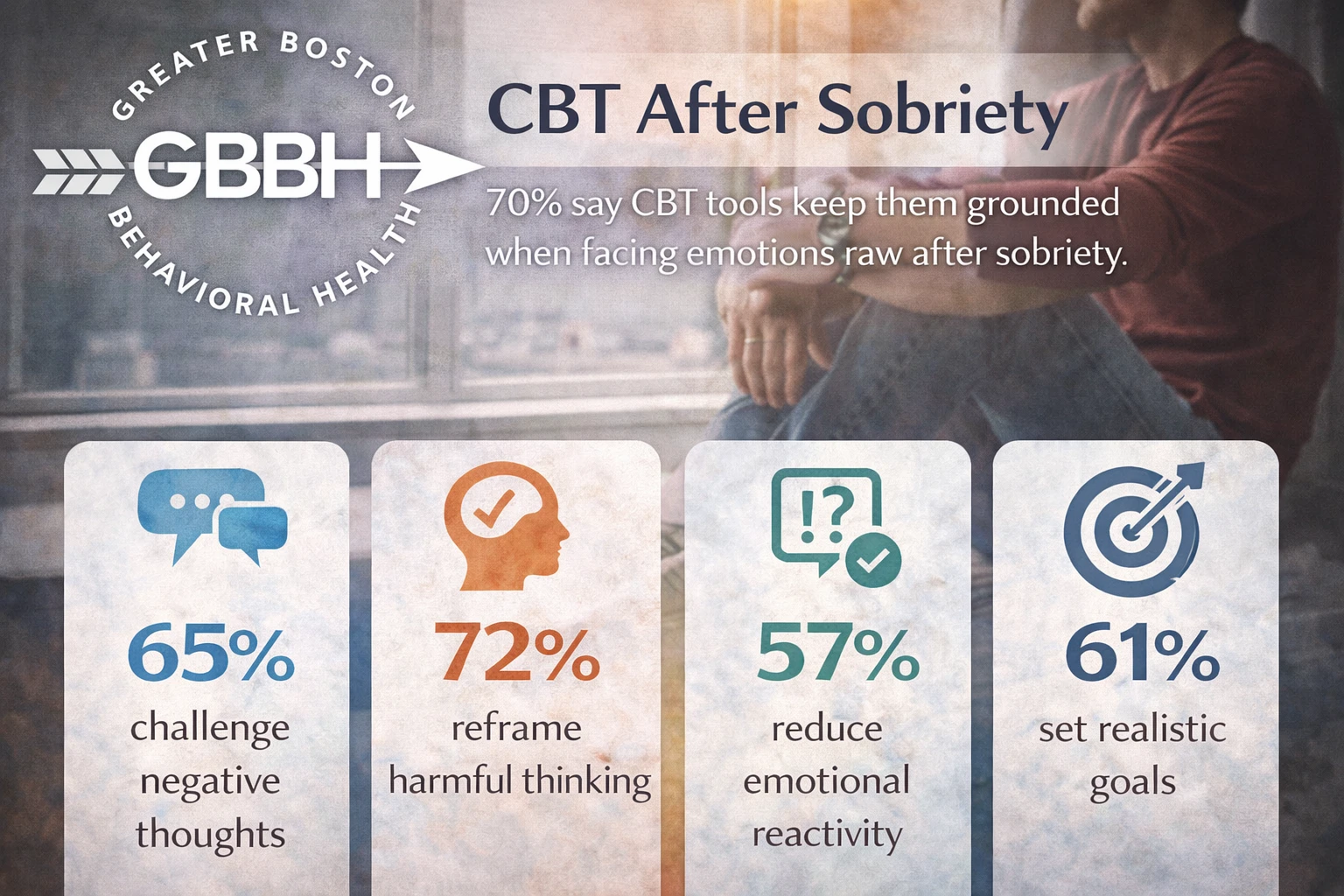
At Greater Boston Behavioral Health, CBT is helping people like me—the awkwardly sober, emotionally overloaded, still-showing-up people who want to stay grounded without pretending we’re fine. And honestly? It’s one of the only things that’s helped me feel like I’m not losing my mind when life gets weird.
Here are seven real, messy, absolutely human moments when CBT pulled me back from the edge.
1. When I Thought a Friend’s Silence Meant They Secretly Hated Me
I sent a message. They left it on read.
By the time two hours passed, I’d rewritten our entire friendship in my head. Every laugh? Fake. Every hangout? Out of pity. My spiral: activated.
CBT reminded me to challenge the automatic thought. I practiced what my therapist called the “alternate hypothesis.”
- Is there evidence they hate me? No.
- Is it more likely they’re just busy? Probably.
- Has this happened before, and it turned out fine? Yep.
That mental reroute didn’t erase the anxiety. But it contained it. And that gave me breathing room.
2. When I Couldn’t Stop Beating Myself Up for Saying Something “Cringe”
You ever replay a conversation 40 times in your head?
Yeah. That’s me after any social event.
I’d obsess over one sentence I said that maybe came out weird. I’d think, “Great, now everyone thinks I’m a loser.”
CBT taught me about cognitive distortions—patterns of thinking that feel true but aren’t. One of mine? Mind reading. I assume people are judging me, but I have zero proof.
Now when the loop starts, I name the distortion, breathe, and ask:
“What would I say to a friend if they were spiraling like this?”
Spoiler: It’s never “Yeah, you totally ruined everything forever.”
3. When I Felt Like I Wasn’t “Recovering Right”
Instagram therapy accounts made it seem like healing should be this beautifully lit journey of reflection and self-care baths.
But some days, I just wanted to scream into a pillow or crawl under the blankets and hide from my own thoughts.
That’s when CBT gave me something unexpected: permission to not be linear.
One of the exercises asked me to track my mood for a week—just track it. No judgment. Seeing my ups and downs on paper? It changed how I saw myself. I wasn’t failing. I was just human.
Someone from West Roxbury, Massachusetts in my group once said, “CBT doesn’t erase the pain, it gives you a railing to hold onto when your brain is slippery.” That line stuck with me.
4. When I Was Convinced My Boss Secretly Hated Me
They were short in an email. Didn’t smile on Zoom. I spiraled.
Old me: “I’m probably getting fired.”
CBT-me: “Let’s run that through the evidence filter.”
Evidence FOR: They seemed tense.
Evidence AGAINST: No history of problems. Email volume’s high. Other people got similar responses.
Result? I didn’t send a weird apology email. I drank water, sent a neutral reply, and kept it moving.
That might not sound huge. But for me? That was emotional sobriety in action.
5. When I Thought My Social Anxiety Made Me Unloveable
Early sobriety stripped away the buffer I used to survive parties. Suddenly, I had to feel every awkward beat of a room—and I hated it.
I’d leave events convinced I was too weird, too shy, too much or not enough.
CBT helped me dig into core beliefs—those old, buried messages we carry that shape our self-talk.
Mine? “You have to be entertaining to be liked.”
We challenged that. Rewrote it. Practiced new thoughts like:
“I don’t have to perform to belong.”
“I can be quiet and still matter.”
It took time. But it stuck.
6. When I Couldn’t Sleep Because My Brain Was Busy Blaming Me for Everything
CBT doesn’t just live in session—it shows up at 2am when your thoughts won’t shut up.
There was a night I couldn’t sleep because I remembered something I said in 2016. My brain was convinced it ruined someone’s life. (It didn’t.)
I pulled out a CBT worksheet and practiced thought defusion—writing the thought down, then literally labeling it:
“Just a thought. Not a fact.”
The shame? It didn’t vanish. But it lost its grip.
7. When I Needed a Win That Wasn’t Huge—Just Honest
This one’s quiet. But powerful.
CBT taught me that wins don’t always look like breakthroughs. Sometimes, a win is:
- Not canceling that appointment even when you want to
- Replying “I’m overwhelmed” instead of ghosting
- Naming what’s real instead of pretending you’re chill
One day, I showed up to therapy after a hard week and said, “I didn’t spiral all the way down. I caught it halfway.”
My therapist smiled and said, “That’s CBT working.”
That’s when I knew I wasn’t just surviving—I was learning how to live.
FAQs: If You’re Young, Sober, and Curious About CBT
Do I have to be “mentally ill” to try CBT?
Nope. CBT is for anyone who struggles with thoughts that feel louder than logic. You don’t need a diagnosis to want peace of mind.
Will CBT change my personality?
No. It helps you understand how your thoughts work—so you can respond, not just react. You’ll still be you… just with more control.
Is this therapy boring or lecture-y?
Not at all. CBT is collaborative. You learn tools, test them in real life, and adjust. It’s therapy you actually use, not just talk about.
Can I do it if I’ve already done therapy before?
Absolutely. CBT works well alongside other approaches—or when other methods didn’t quite click.
Is group therapy part of CBT at GB Behavioral Health?
Sometimes, yes. Greater Boston Behavioral Health offers both individual and group CBT options, so you can figure out what feels right for you.
CBT didn’t fix everything. But it gave me something I hadn’t had in a long time: a way to face my thoughts without letting them boss me around.
You don’t have to do it perfectly. You don’t have to do it forever. You just have to be curious enough to start.
A friend from Wellesley, Massachusetts once told me, “CBT helped me stop treating every thought like a crisis.” That’s it. That’s the whole point.
Call (888) 450-3097 to learn more about our Cognitive-Behavioral Therapy in Boston, Massachusetts.
