


Sobriety didn’t solve the loneliness.
You got through the hardest part—stopping. Maybe you went to detox. Maybe you pushed through the first 30 days shaking, scared, and angry. And now?
Now you’re left sitting in a quiet room with no one to text, nowhere you feel fully welcome, and a heart that’s still full of bruises.
Recovery isn’t just about stopping the behavior. It’s about learning how to live again—with people. And if you’re wondering whether DBT can help you repair or rebuild your relationships, the answer is yes. Not instantly. Not perfectly. But absolutely, yes.
At Greater Boston Behavioral Health, we use DBT to help people navigate that raw early-recovery space where connection feels both needed and terrifying. If you’re tired of the silence and the shame, keep reading.
What Is DBT, and Why Does It Help With Relationships?
DBT stands for Dialectical Behavior Therapy. It was originally created to help people who felt emotionally intense, misunderstood, or stuck in painful relationship patterns. Sound familiar?
In early recovery, your nervous system is still learning how to exist without chaos. That means your relationships may feel unpredictable, exhausting, or nonexistent. DBT helps by giving you actual tools for:
- Communicating without exploding or shutting down
- Naming your needs without guilt
- Rebuilding trust without over-apologizing
- Setting boundaries that don’t cost you connection
It doesn’t teach you how to “win people back.” It teaches you how to show up as someone you can be proud of, even when the past still stings.
Can DBT Really Help Me Apologize Without Falling Apart?
Yes—and that’s one of the most powerful reasons to do it.
If you’re in early recovery, chances are there’s someone (or several someones) you want to apologize to. And if you’ve tried, you’ve probably noticed it doesn’t always go the way you imagined.
DBT teaches you how to do what’s called effectiveness-based communication. That means figuring out what your actual goal is (Is it repair? Clarity? Accountability?)—and then giving you a strategy to express it that doesn’t leave you gutted.
We’ve seen clients walk into conversations with shaking hands and leave with new understanding—not because they “got it perfect,” but because they stayed centered.
Even clients from West Roxbury, Massachusetts who thought they’d burned every bridge found ways to reconnect once they could name what they were truly trying to say, and give the other person room to process.
What If the People I Hurt Don’t Want to Talk to Me?
This is one of the most painful truths in early recovery.
Sometimes, people need space. Sometimes they’re protecting themselves. Sometimes they’re waiting to see if the change is real. And sometimes… they don’t come back.
DBT won’t sugarcoat that. But it will give you a way to cope without collapsing.
You’ll learn how to validate your own effort without over-attaching to the outcome. How to grieve what was lost and still believe in your capacity to build something new. You’ll learn to hold pain without letting it define you.
And if the door does reopen, you’ll walk through it as someone steadier, more present, and more emotionally honest.
Does DBT Help With Making New Friends Too?
Yes—especially if you feel like you forgot how.
Making friends in early sobriety is weird. Everyone seems to know each other. You don’t know how much of your story to tell. You’re still not sure who you are.
DBT helps by strengthening what’s called interpersonal effectiveness. That includes:
- How to start conversations without overthinking
- How to deal with rejection without spiraling
- How to set emotional boundaries without isolating
- How to build trust slowly, not all at once
It’s like learning to walk again—but this time, without the need to perform or earn your place.
You start to feel grounded. Like you can let someone in without handing them your whole heart on the first day. Like connection is possible, even after everything.
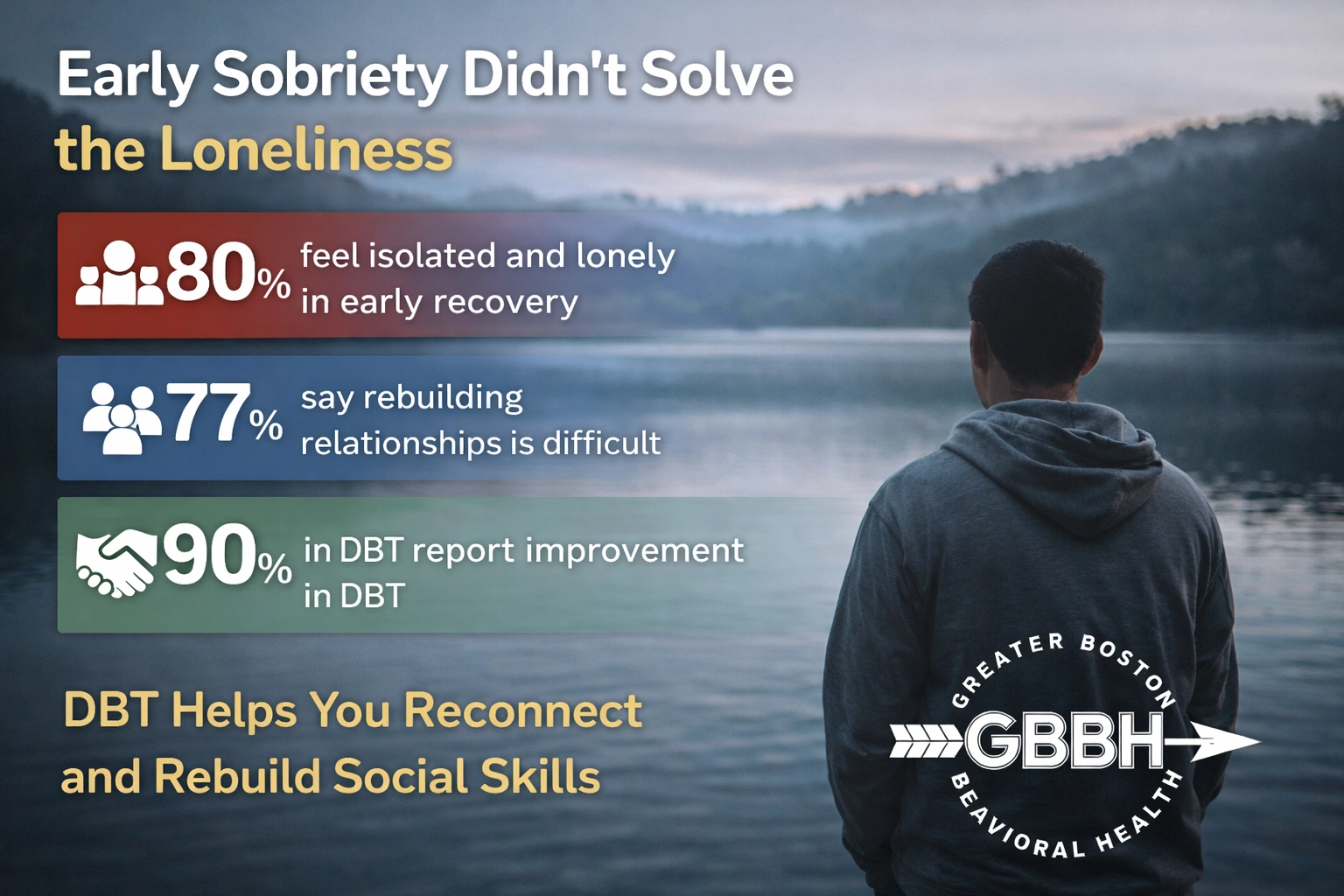
What If I’m Scared I’ll Just Sabotage Everything Again?
That fear is real.
When you’ve hurt people—or been hurt—it’s easy to think that love or friendship isn’t safe. You might worry that one bad mood, one misread text, one slip in emotion will ruin everything.
But DBT gives you a pause button. A moment between trigger and reaction. It helps you practice self-validation and emotional regulation, so that when something hard happens, you don’t immediately fall into “I knew it—I ruin everything.”
Instead, you can say, “That was tough. I’m still learning. I can try again.”
That space between shame and self-respect? That’s where relationships are reborn.
How Does DBT Group Work for Someone Who Feels Deeply Lonely?
Group is often where healing begins—quietly, slowly, but deeply.
At first, it might feel awkward. Everyone seems more confident. People are using words you don’t know yet. You feel exposed just sitting there.
But then someone shares something you’ve felt but couldn’t name. Someone stumbles through a skill and laughs at themselves. Someone shows up again after a bad week.
And suddenly, you’re not alone in your loneliness.
Group isn’t about becoming best friends with everyone. It’s about practicing real connection in a space where everyone is trying. It’s about showing up without the mask. And realizing that maybe, just maybe, you’re not impossible to know after all.
What If I Still Don’t Know How to Let People Love Me?
This is one of the quietest griefs of recovery.
Maybe someone is still here—partner, parent, sibling—and they’re trying to love you. But you flinch. You pull away. You test them. You brace for disappointment before it even arrives.
That’s not weakness. That’s trauma. And it’s treatable.
DBT teaches you how to recognize those patterns and gently interrupt them. How to notice when fear is talking instead of truth. How to say, “I’m scared right now,” instead of pushing them away.
Clients from Dorchester, Massachusetts have told us the most surprising part of DBT wasn’t learning to connect with others—it was finally feeling safe enough to let connection in.
And when that happens, everything changes.
What If I Already Tried Therapy and It Didn’t Work?
Trying again is scary. Especially if your last attempt felt unhelpful, rushed, or like no one really got you.
But DBT is different because it’s skills-based and emotionally validating. That means it’s not just about talking—it’s about doing. Practicing. Rewiring. Getting feedback in real time.
It’s not “Tell me how that made you feel” therapy. It’s “Here’s what you can try next time—and here’s how to survive until next time comes.”
If you’re willing to show up, DBT will meet you where you are. Confused. Defensive. Numb. It’s okay. We’ve seen it all. We’re not asking you to be perfect—just honest.
If you’re in early recovery and the silence feels louder than it should… If you’re tired of walking past old contact names and wondering if you’ll ever feel whole with people again…
There’s help for that.
Call (888) 450-3097 to learn more about our Dialectical Behavior Therapy in Boston, Massachusetts. You don’t have to rebuild everything today. You just have to believe it’s still possible.
