


Sometimes, the hardest part of healing isn’t what happens in therapy—it’s what happens after you leave the session and go home. If you or your partner are working through anger management therapy, but things still feel tense, disconnected, or fragile, it might not mean therapy isn’t working. It might mean it’s time to bring the relationship into the healing process too.
At Greater Boston Behavioral Health, we’ve seen how powerful it can be when partners stop walking on eggshells and start walking forward—together.
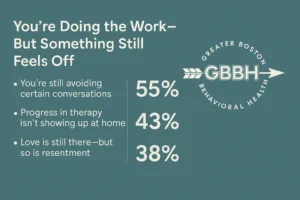
You’re Doing the Work—But Something Still Feels Off
Anger management therapy is often the beginning of real transformation, especially for individuals who’ve spent years trapped in fight-or-flight mode. But for the people who love them—spouses, partners, and family members—the healing journey doesn’t always feel linear.
You might be wondering:
- Why do we still avoid certain conversations?
- Why do I feel shut out of their healing?
- Why does it still feel like I’m holding my breath?
You’re not imagining things. Anger might show up loud, but its roots grow deep—and often, they spread into the emotional soil of the whole relationship. That’s where family dynamics support comes in. It doesn’t replace anger management therapy. It builds on it.
1. You’re Still Avoiding Certain Conversations
Even if the outbursts have stopped, some topics still feel like landmines. Maybe it’s parenting decisions. Or finances. Or memories from that one night you both don’t talk about anymore.
If your home feels peaceful—but tense—that’s a sign something’s unresolved. Often, couples in this space use phrases like:
- “We’re doing better… but we don’t talk about the hard stuff.”
- “It’s not explosive anymore, but it’s also not honest.”
Avoidance doesn’t mean you’re failing. It means your nervous system is still learning what safety feels like. And that can take time—especially when the emotional wounds are shared.
Family dynamics support gives both people room to breathe, speak, and be heard in a space that doesn’t trigger old roles or power struggles.
If you’re looking for anger management therapy in Newton, MA, it’s worth asking your provider if couples or family therapy could be integrated into the next phase.
2. Progress in Therapy Isn’t Showing Up at Home
You’re proud of them for going to therapy. You see the effort. You believe they want to change. But when it comes to your day-to-day relationship… it still doesn’t feel right.
This mismatch is incredibly common. Here’s why it happens:
- Your partner is processing big emotional shifts—but hasn’t yet applied those tools at home
- The relationship dynamic hasn’t had a chance to heal, so old patterns still resurface under stress
- You’ve been living in “survival mode” for so long, it’s hard to trust new behavior
That doesn’t mean nothing’s working. It means healing is happening in stages.
Family dynamics work helps create a bridge between the therapy room and the living room. It turns insight into shared experience—and it gives both people a seat at the table.
3. Love Is Still There—But So Is Resentment
This one might be the hardest to admit. Because love is still there. You’re still showing up. You’re still trying. You still see their effort.
But you’re also still angry. Still scared. Still unsure if your needs even matter anymore.
You might find yourself thinking:
- “They’re working on their anger—but who’s helping me?”
- “I’ve forgiven so many times, I don’t know what’s left to give.”
- “What about all the times I had to hold everything together?”
That pain deserves a place in the healing process too.
When family dynamics support is included, the focus shifts from who caused what to how do we move forward with truth and care? It validates the emotional labor you’ve done. And it opens space for repair—not just behavior management.
Why Family Dynamics Matter in Anger Recovery
Anger rarely forms in isolation. It grows in environments—families, cultures, relationships—where needs weren’t met, communication broke down, or control became a survival tool.
Even if your partner is doing incredible work in individual therapy, the full arc of healing often requires a wider lens. That’s what family dynamics support offers:
- It explores shared patterns, not just individual triggers
- It supports both partners, not just the one in therapy
- It focuses on safety, repair, and connection, not blame
In our Boston-based therapy programs, we’ve seen this shift rebuild relationships that once felt permanently fractured. And we’ve also seen it help individuals reclaim their emotional dignity—even if the relationship itself doesn’t continue.
This work isn’t about forcing closeness. It’s about creating authentic connection, where truth can exist without fear.
What If You’re the One Still Carrying the Weight?
This is the part most people don’t say out loud.
When someone starts anger management therapy, the focus tends to shift entirely to them. Their progress. Their healing. Their change.
And you? You become the steady one. The supportive one. The forgiving one.
But who holds you?
That’s the role family dynamics support can play. Not as a replacement for your partner’s therapy—but as a place where your needs are acknowledged, your fatigue is real, and your boundaries are honored.
If you’re in Waltham, MA, or the Greater Boston area, our team can help you find support options that include—not exclude—the ones who’ve held the emotional load.
FAQs About Anger Therapy and Family Dynamics
Does my partner have to finish anger management therapy first?
No. Family dynamics work can happen alongside individual anger management. In fact, for many couples, parallel support is more effective—it allows both people to grow and reflect at the same time, with professional guidance.
What’s the difference between couples counseling and family dynamics therapy?
Couples counseling often focuses on communication and conflict resolution in romantic relationships. Family dynamics therapy goes deeper into the patterns, roles, and emotional histories that shape how you relate—not just what you say. It’s especially helpful when trauma, anger, or long-term dysfunction are part of the picture.
What if I don’t want to stay in the relationship, but still want closure?
That’s valid. Family dynamics support isn’t only for “saving” relationships. It can also be a space for conscious endings, healing conversations, and building healthier relational patterns for the future—regardless of what happens next.
Can therapy help if only one person wants to participate?
It’s ideal when both people engage, but you can still benefit from family-focused work even if your partner isn’t ready. A good therapist can help you unpack what’s happening, set boundaries, and make decisions from a grounded place.
You Don’t Have to Heal Around the Hurt
There’s a quiet grief in loving someone with a history of rage.
Not just because of the harm itself—but because of all the things you couldn’t say, all the places you shrunk yourself, all the times you made peace just to make it through the day.
But that’s not the end of your story.
You don’t have to live in a home where connection means tension. Or where love feels like something you have to earn. You don’t have to carry this alone.
Ready to feel more connected—without carrying it all yourself?
Call (888) 450-3097 to learn more about our anger management therapy services in Boston, Massachusetts.
